


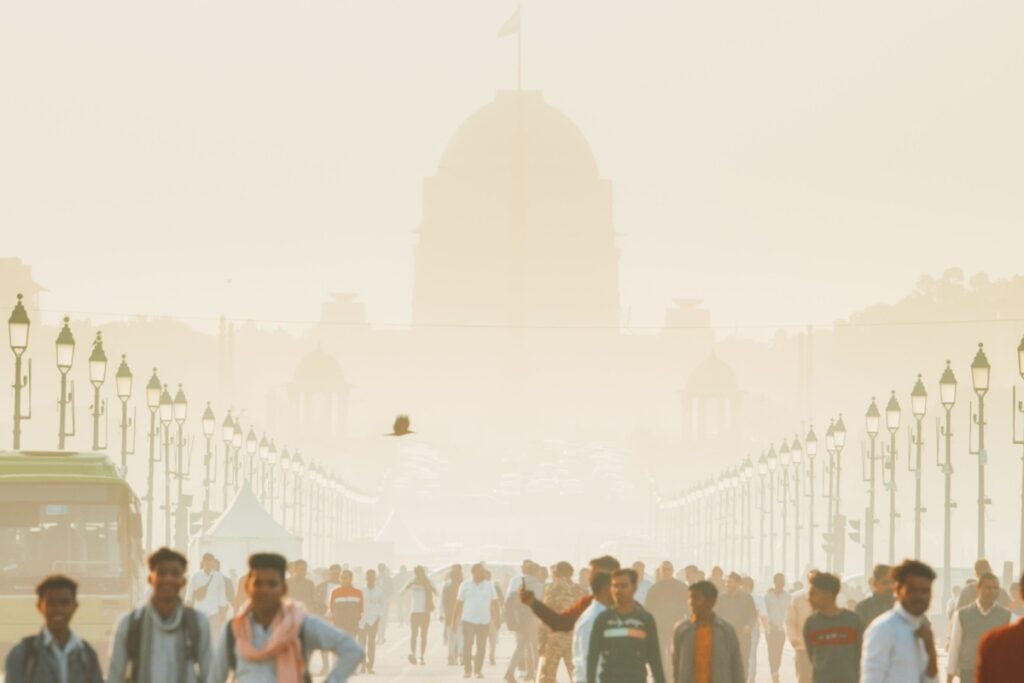
A dense blanket of toxic smog settled over New Delhi on Monday, Dec. 15, 2025, pushing pollution to its worst levels in weeks and prompting authorities to tighten emergency controls. Official readings showed the capital’s air remaining in the federal government’s “severe” category for a second consecutive day, a range officials warn can affect even healthy people and can seriously endanger those with heart or lung disease.
Monitoring data from India’s Central Pollution Control Board (CPCB) showed several stations above 450 on Sunday after readings rose from about 430 on Saturday. The index reported on Monday stood at 449, far above the level considered “good” (below 50). Government guidance during severe episodes advises residents to avoid outdoor exposure when possible and to wear N95 masks if they must go outside.
Officials warned that children, pregnant women, older adults, and people with pre-existing respiratory or cardiovascular conditions face higher risks during heavy smog. Residents were urged to reduce strenuous activity outdoors and to take extra precautions during commutes.
Flights Canceled, Trains Delayed, Patients Increase
The smog coincided with significant disruption to travel. Authorities said more than 40 flights were canceled and several dozen were delayed. Rail operations were also hit, with over 50 trains arriving and departing New Delhi delayed by several hours.
Hospitals reported an influx of patients with breathing difficulties and eye irritation, and health experts urged residents to avoid outdoor activities while conditions remain extreme. Naresh Dang, a physician at Max Healthcare, said air purifiers can help only to a limited extent and called for permanent solutions. Tourist Tiam Patel said the smoke was noticeable while breathing, underscoring how quickly the haze can affect visitors as well as residents.
Emergency Curbs Expand Under GRAP Framework
Authorities expanded restrictions aimed at cutting emissions and controlling dust. Measures cited in the report included a ban on construction activity, tighter limits on diesel generators, and restrictions on vehicle use. Municipal teams deployed water sprinklers to reduce dust and haze, while schools and offices allowed more students and workers to stay home.
These steps fit within the region’s Graded Response Action Plan (GRAP), overseen by the Commission for Air Quality Management (CAQM). GRAP is designed to scale controls based on air-quality categories, and the published schedule emphasizes escalation and frequent review when pollution enters “severe” and “severe+” ranges (Stage III and beyond).
Environmentalists quoted in the report said the crisis requires structural changes because the air can remain unhealthy outside the months when smog is most visible. Vimlendu Jha, a Delhi-based environmentalist, said the city’s air “doesn’t get cleaner,” and that pollution persists through much of the year.
Winter Conditions Fuel a Recurring Crisis
New Delhi and its surrounding region routinely ranks among the world’s most polluted urban areas. The report cited an IQAir assessment earlier in the year describing New Delhi as the most polluted national capital and noting that India has six of the world’s 10 most polluted cities.
Air quality typically worsens in winter as cooler temperatures and calmer winds trap pollutants near the ground. Smoke from crop-residue burning in nearby states can mix with emissions from vehicles, construction, and industry, producing thick haze that the report said can soar far above World Health Organization guideline levels.
The story referenced protests by residents earlier this month, and it quoted Shweta Narayan of the Global Climate and Health Alliance saying deaths linked to air pollution are difficult to count systematically without consistent mechanisms. Research published in The Lancet Planetary Health estimated that about 1.5 million deaths each year in India are associated with long-term exposure to PM2.5 above the World Health Organization guideline level.
Authorities have also tried high-profile interventions. The report said officials carried out a cloud-seeding experiment in October 2025 intended to induce rainfall and help clear the air, but the effort ended without rain.
