


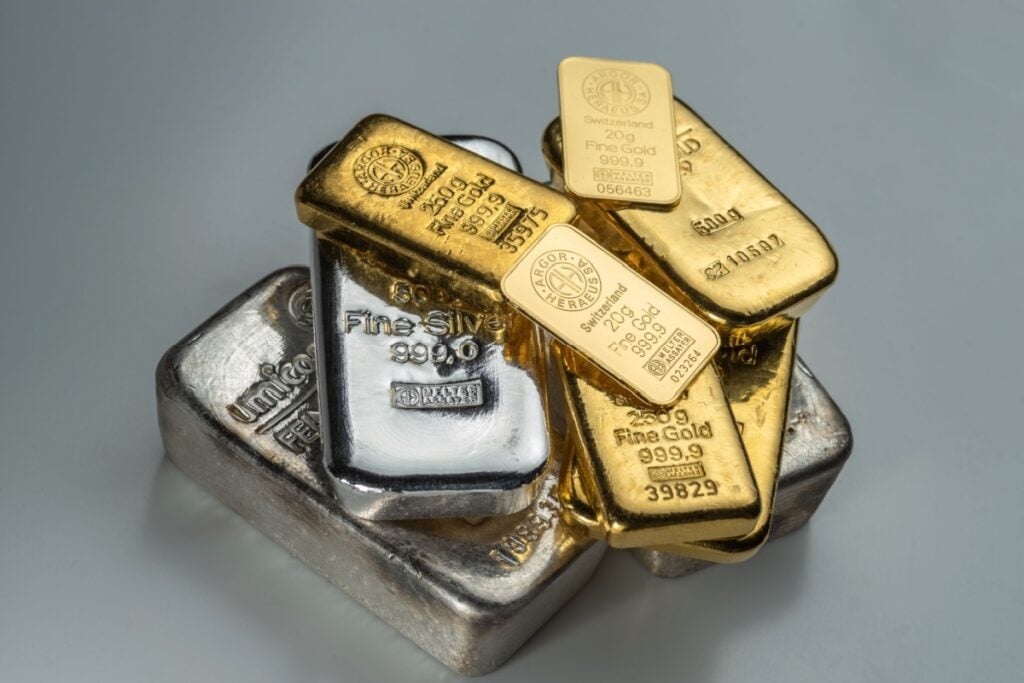
Silver and gold futures fell steeply on Monday after the Chicago Mercantile Exchange (CME) increased the amount of collateral traders must post to hold positions in several precious-metals contracts. In early trading, silver futures sank about 8%, while gold futures slid roughly 5%, reversing part of a powerful year-end rally that had pushed both metals to fresh highs.
The move came after the exchange published an advisory announcing higher “performance bond” requirements citing a routine review tied to elevated volatility. The updated requirements were set to take effect after the close of business on Monday, Dec. 29, 2025, following a notice dated Friday, Dec. 26, 2025.
Other market reporting on the session described the retreat as one of the sharpest one-day reversals in recent years, with year-end positioning and profit-taking adding to the selling pressure after a rapid run-up.
CME Margin Increase Adds Pressure To Leveraged Positions
The CME said it was raising requirements “as per the normal review of market volatility” to maintain adequate collateral coverage, language commonly used when sharp price swings raise the risk that a trader could default on obligations at settlement. When requirements rise, leveraged traders may need to add cash quickly or cut positions, which can accelerate a pullback.
In the advisory, the maintenance margin for COMEX 100 Gold Futures (GC) rose to $22,000 from $20,000. For COMEX 5,000 Silver Futures (SI), the maintenance requirement increased to $25,000 from $22,000. The notice also listed changes for other metals, reflecting a broad recalibration of collateral levels across the complex.
Margins in futures markets are not a down payment on the metal itself; they are a financial safeguard meant to reduce default risk. CME Group educational material notes that futures margins typically represent a small share of a contract’s notional value while brokers may collect more than the exchange minimum.
Precious Metals Surge In 2025 Before Pullback
Despite Monday’s decline, precious metals have posted exceptional gains in 2025. Gold futures were up about 65% for the year, while silver had more than doubled, according to figures cited in the AP report.
The rally has been fueled by a mix of investment demand and broader uncertainty. Gold often attracts buyers seeking a hedge against inflation, currency weakness, or geopolitical shocks, and some investors have also rotated toward hard assets after strong runs in parts of equity markets.
Silver’s run was even more dramatic. Silver futures started 2025 around $30 per ounce and briefly touched about $80 per ounce before the margin announcement, highlighting how quickly momentum can build in a market where positioning can shift rapidly.
Industrial Demand And Tight Supply Keep Silver Volatile
Silver often tracks gold because both are bought as stores of value, and it is frequently described by investors as the “poor man’s gold.” But silver’s price behavior can diverge sharply because a large share of demand is tied to industry, making it more sensitive to swings in manufacturing activity and technology investment.
The latest rally has coincided with tightening supplies and rising industrial consumption. The AP report cited dwindling supply and slower output at major mines, alongside increased use in solar panels and data centers applications where silver’s conductivity is difficult to substitute.
Industry groups have also highlighted structural imbalances. The Silver Institute has said the market is on track for a fifth successive “structural market deficit” and estimated total global silver demand in 2025 at roughly 1.12 billion ounces, pointing to pressure on inventories even as demand shifts between categories.
History offers a reminder of how quickly silver can swing when leverage and exchange rules collide. The metal’s spike in the early 1980s was followed by a sharp collapse after trading conditions tightened and investors struggled to meet margin calls, an episode linked to the failed effort by the Hunt brothers to corner the market.
