


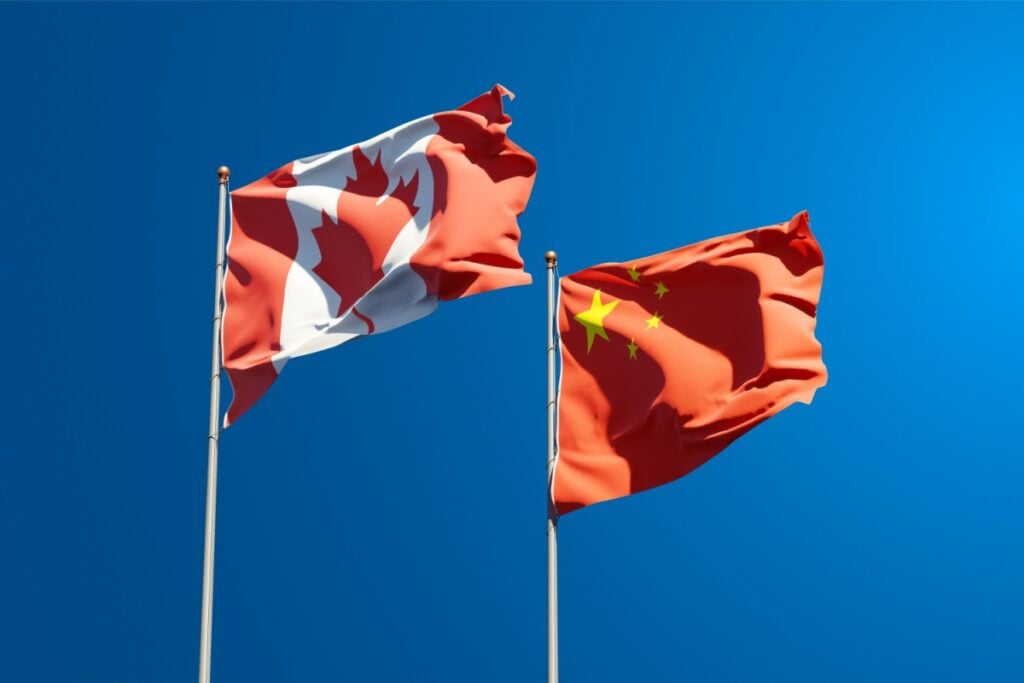
Canadian Prime Minister Mark Carney is traveling to China this week, a high-level visit aimed at stabilizing a relationship that has been strained for years and expanding Canada’s commercial options beyond the United States. It is being billed as the first trip by a Canadian leader to China in nearly a decade. Carney is expected to arrive on Wednesday, remain in China until Saturday, then visit Qatar before heading to the annual World Economic Forum meeting in Switzerland.
The Canadian government has announced that the visit will take place from January 13 to 17, 2026, and will be the first trip to China by a Canadian prime minister since 2017.
Ottawa says Carney will meet Chinese President Xi Jinping and Premier Li Qiang, as well as other officials and business leaders, with discussions expected to span trade and other policy areas.
In announcing the trip, Carney said Canada is working to build a “more competitive, sustainable, and independent economy,” and set a target to double Canada’s non-U.S. exports over the next decade as global trade becomes more volatile.
Tariff Pressure Shapes Ottawa’s Rethink
The visit comes as Canada’s ties with Washington have become more contentious under President Donald Trump. The AP reported that Trump’s tariffs have increased pressure on a deeply integrated cross-border economy, while his remarks that Canada could become “the 51st state” have sharpened political concerns about the durability of the partnership.
Carney has been in office for less than a year, having succeeded Justin Trudeau. In China, some analysts describe U.S. protectionism as creating an opportunity for China and Canada to explore cooperation, although they also stress that Canada remains a U.S. ally. Zhu Feng, dean of the School of International Studies at Nanjing University, cautioned against overstating the significance of the trip, citing the deep geographic and cultural ties that bind Canada and the United States.
The wider environment is also being shaped by the signals from the U.S.-China relationship. The AP noted that Trump has said he intends to visit China in April, even after a tit-for-tat tariff fight that pushed duties to more than 100% before he backed down.
Huawei Case And Tariffs Continue To Complicate Ties
Relations worsened sharply in late 2018, when Canada detained Meng Wenzhou, a Huawei Technologies Co. executive, at the request of the United States, which sought her extradition. China retaliated by arresting two Canadians, Michael Kovrig and Michael Spavor, on espionage charges. Meng was held under house arrest in Vancouver while Kovrig and Spavor were jailed in China; all three were freed in 2021 under an agreement.
Trade measures have since become another flashpoint. Canada aligned with the United States by imposing a 100% tariff on Chinese electric vehicles and a 25% tariff on Chinese steel and aluminum. China responded with tariffs on Canadian exports, including canola, seafood, and pork, and has indicated it could remove some measures if Canada drops the 100% EV tariff.
Chinese officials have portrayed Carney’s visit as an opportunity to sustain the recent improvement. Mao Ning, a Chinese Foreign Ministry spokesperson, said Beijing sees the trip as an opportunity to “consolidate the momentum” in bilateral relations. A state-run Global Times editorial likewise welcomed the visit while urging Canada to lift what it called “unreasonable” tariff restrictions.
Wider Reset Includes India And Other Western Moves
The AP noted that Canada’s outreach fits a broader pattern among Western governments. Australia’s Anthony Albanese has sought to reset ties with China since taking office in 2022, and Britain’s Keir Starmer has pursued repairs since winning power in 2024, even as London raises sensitive issues such as the case of Hong Kong media figure Jimmy Lai with Xi Jinping.
Carney is also attempting to stabilize Canada’s ties with India. The AP reported that relations deteriorated after the Trudeau government accused India of involvement in the 2023 killing of a Sikh activist in Canada, leading to diplomatic expulsions, disrupted visa services, reduced consular staffing, and a freeze in trade talks. A cautious thaw began last June; in November, Canadian Foreign Minister Anita Anand said the countries would move quickly to advance a trade deal, and Carney is expected to visit India later this year.
