


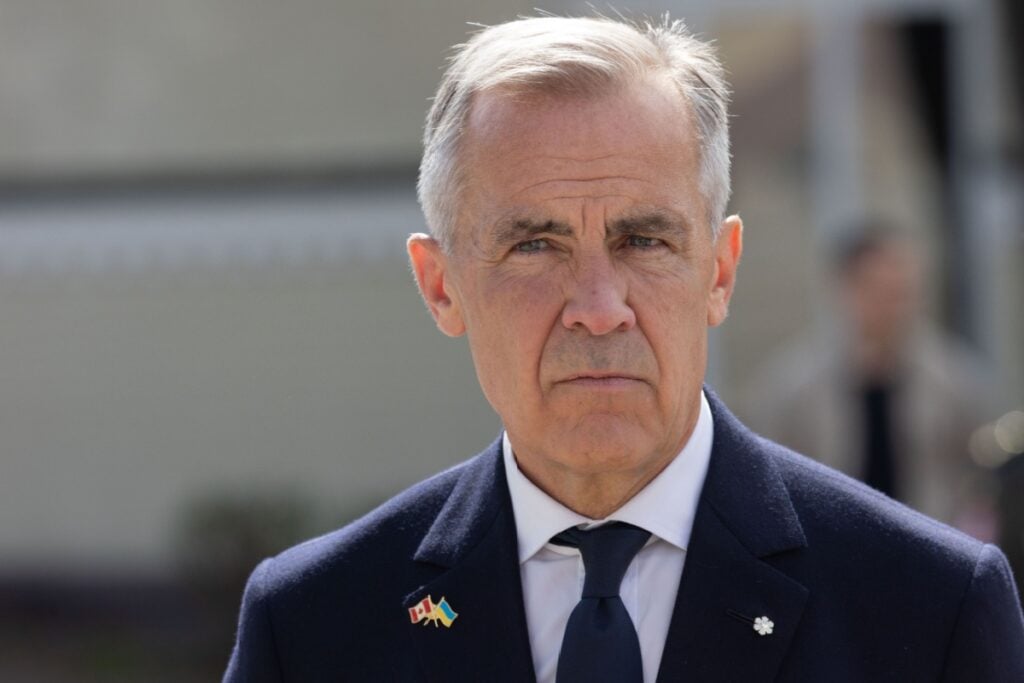
Canadian Prime Minister Mark Carney said Canada will reduce its 100% tariff on Chinese electric vehicles as part of an exchange for lower Chinese tariffs on key Canadian farm exports, announcing the arrangement after two days of meetings in Beijing.
Carney described the recent trajectory of ties as “more predictable,” arguing the latest steps show measurable outcomes after a period of strained diplomacy and trade friction. The announcement followed Carney’s meetings with senior Chinese officials, including a Friday session with Chinese President Xi Jinping at the Great Hall of the People.
Carney’s trip marked the first visit to China by a sitting Canadian prime minister in eight years, part of what he has framed as a push to rebuild channels of communication and expand trade options beyond North America.
Import Cap And China’s Canola Tariff Reduction
Under the terms Carney outlined, Chinese EV exports to Canada would be subject to an annual ceiling, starting at 49,000 vehicles and rising to about 70,000 over five years, according to the prime minister.
On the agricultural side, Carney said China would cut its overall tariff on canola seeds—a major Canadian export—from 84% to about 15%. He presented the shift as a meaningful reopening for a product that has faced steep duties and limited access in recent years.
Carney also cast the arrangement as a managed transition for Canada’s auto market, saying the initial cap would represent about 3% of the roughly 1.8 million vehicles sold in Canada each year. He added that Canada expects Chinese investment in the Canadian auto sector within three years, describing that expectation as part of the broader economic rationale for the deal.
Backdrop Of Retaliation And Domestic Pushback
Canada’s earlier stance had largely tracked U.S. policy. Under former Prime Minister Justin Trudeau, Canada imposed 100% tariffs on Chinese EVs and 25% tariffs on steel and aluminum, moves that were followed by retaliatory Chinese duties, the AP reported.
China’s response included tariffs of 100% on Canadian canola oil and meal and 25% on pork and seafood, plus an additional 75.8% tariff on canola seeds announced last August, measures that Canadian industry groups said effectively shut canola out of the Chinese market. The AP also cited Chinese trade data showing China’s imports from Canada fell 10.4% last year to $41.7 billion.
Reaction inside Canada was not uniformly supportive. Ontario Premier Doug Ford, whose province anchors much of Canada’s auto manufacturing base, criticized the move as giving China an opening that could come “at the expense of Canadian workers,” and warned it could complicate access to the U.S. market, Canada’s largest export destination.
Business interests with exposure to China offered a different assessment. Jacob Cooke, CEO of WPIC Marketing + Technologies, called the visit “game-changing,” arguing it restores dialogue and a workable framework after years in which “the parties were not talking.”
Wider Reset As U.S. Pressure Shapes Strategy
Carney’s announcement came as he faces unresolved trade friction with U.S. President Donald Trump, who has imposed tariffs affecting major Canadian sectors and has repeatedly raised the idea of Canada becoming the “51st state,” according to the AP.
In Beijing, Carney told Xi that improved ties could support a global governance system he said is under “great strain,” while later suggesting that the post–World War II trade order may increasingly be replaced by more regional or country-to-country arrangements. He linked those pressures to an “America-first” approach and broader disruptions affecting both the Canadian and Chinese economies.
Chinese officials, for their part, have signaled they see space to draw partners into policies less aligned with Washington. Carney responded by emphasizing that Canada’s U.S. relationship remains “deeper and broader,” while acknowledging Canada and China diverge on issues such as human rights, which he said limits how far cooperation can go even as both sides look for practical overlap.
Carney was scheduled to leave China on Saturday, travel to Qatar on Sunday, and then attend the World Economic Forum gathering in Switzerland the following week, with his office saying he would meet business leaders and investors to promote trade and investment.
