


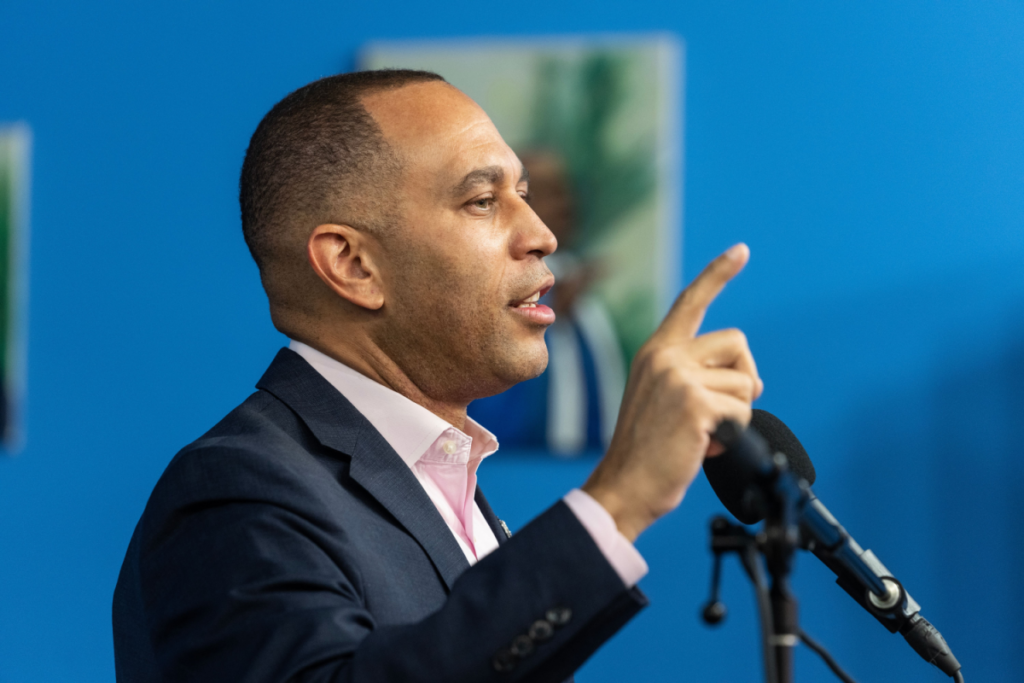
Party Leaders Draw a Clear Line
House Democratic leaders have privately signaled strong opposition to a bill funding the Department of Homeland Security, citing deep concerns over immigration enforcement and the role of Immigration and Customs Enforcement. In a closed-door meeting, the party’s top leaders told colleagues they intend to vote against the measure, reflecting widespread frustration within the caucus after a fatal shooting involving an ICE officer in Minneapolis that has intensified scrutiny of the agency’s actions.
Their stance indicates that most House Democrats are likely to oppose the legislation. The anger goes beyond a single incident and taps into long-running concerns about ICE accountability, enforcement practices, and the lack of structural reform. Many Democrats believe the funding package fails to meaningfully address these issues and instead maintains the status quo at a moment when public trust has been badly shaken.
At the same time, party leaders made clear they will not actively whip votes against the bill. This decision gives politically vulnerable moderates room to support the legislation if they believe it is necessary for their districts or to avoid broader consequences. As a result, Democratic opposition alone is unlikely to stop the bill from passing.
What the Funding Bill Includes
The DHS funding bill keeps ICE’s overall budget at roughly the same level as before, but includes several changes that Democrats negotiated during talks with Republicans. Among the most notable provisions is dedicated funding for body-worn cameras for ICE personnel. Supporters argue this investment could improve transparency and accountability during enforcement operations.
The legislation also reduces funding for ICE enforcement and removal operations and lowers the number of detention beds available nationwide. Democratic negotiators have pointed to these cuts as evidence that they were able to curb some of the agency’s most controversial activities, even if broader reforms were left out.
Beyond ICE, the bill contains funding for other DHS components that Democrats consider critical, including agencies responsible for disaster response, transportation security, and maritime safety. Backers of the compromise stress that these functions affect millions of Americans and should not be jeopardized because of unresolved disputes over immigration enforcement.
Still, many Democrats argue that incremental adjustments are not enough. They say the bill misses an opportunity to impose stronger oversight, clearer limits on enforcement practices, and meaningful consequences for misconduct. For them, supporting the legislation would amount to endorsing a system they believe is fundamentally flawed.
Tensions Within the Democratic Caucus
The debate has exposed divisions within the Democratic Party. Progressive members and civil rights advocates are pressing for a hard line against ICE funding without major reforms, arguing that anything less sends the wrong message after recent events. They contend that continued financial support enables practices that disproportionately harm immigrant communities and erode civil liberties.
More centrist Democrats, especially those from swing districts, face a different calculation. Some worry that voting against DHS funding could be portrayed as weakening border security or law enforcement, a line of attack Republicans frequently use in competitive races. Others are concerned about the practical fallout of a funding lapse, including disruptions to disaster relief, airport security, and other core services.
One influential Democrat involved in negotiating the bill urged colleagues to consider local impacts and the concessions already secured. He argued that while the package is imperfect, it represents the best achievable outcome in a divided Congress and includes tangible safeguards that did not exist before.
Party leaders appear to be trying to balance these competing pressures by taking a personal stand against the bill while avoiding a full-scale whip operation. This approach allows members to vote their conscience or political interests without fracturing the caucus publicly.
Shutdown Risks and Political Stakes
The funding fight comes as lawmakers face an approaching deadline to keep the government running. Failure to pass the broader spending package, which includes DHS funding, could trigger a partial shutdown. Democratic negotiators have emphasized that preventing such an outcome was a key factor in accepting a compromise that fell short of their ideal policy goals.
Even so, senior Democrats have openly acknowledged that the DHS bill does not deliver the reforms many in the party sought. Some have questioned whether incremental gains justify supporting a measure that leaves ICE’s core structure intact. Others argue that separating the DHS vote from the larger spending package gives members the chance to register protest without derailing essential government operations.
Republicans, meanwhile, are expected to provide enough votes to pass the bill, framing it as a necessary step to maintain national security and border enforcement. The outcome will likely underscore the limits of Democratic leverage in the House and highlight how immigration enforcement continues to divide Congress.
As the vote approaches, the episode illustrates a broader tension within American politics: how to reconcile demands for accountability and reform with the realities of divided government and must-pass legislation. For Democrats, the decision on DHS funding is not just a budgetary question, but a test of how far the party is willing to go in challenging an agency that has become a flashpoint in the national debate over immigration and law enforcement.
