


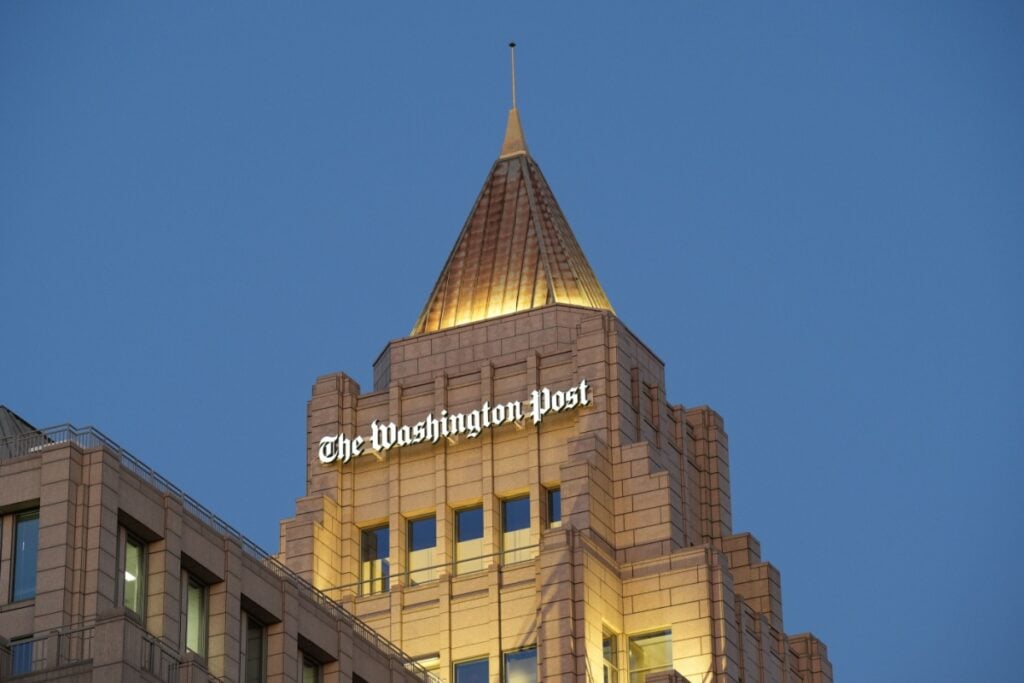
The Washington Post says it is laying off one-third of its staff across all departments, a move that reaches well beyond the business side and into core news operations. During an all-staff Zoom meeting, executive editor Matt Murray told employees the changes amount to a significant restructuring intended to streamline the organization.
Among the most prominent newsroom shifts, the Post is eliminating its sports department and reducing the number of journalists stationed abroad, signaling a pullback in both sports coverage and international reporting. The paper is also shutting down its books department, pausing the daily podcast Post Reports, and reorganizing coverage in the Washington region alongside editing operations.
The scale of the layoffs has amplified concerns about what day-to-day coverage will look like after the reductions. Reuters, citing a source, reported that sports and international coverage were hit especially hard, while leadership emphasized that politics and government reporting will remain a central priority.
Financial Pressure And Strategy Debates Inside The Paper
The layoffs arrive after months of visible tension inside the Post over cost controls and editorial direction. Employees have publicly appealed to owner Jeff Bezos, as the organization has grappled with subscriber and revenue challenges.
In recent weeks, an internal alarm also surfaced around decisions affecting major event coverage. The AP reported that sportswriters who expected to cover the 2026 Winter Olympics were initially told the trip to Italy would not proceed; after the decision became public, the newspaper reversed course and said it would still send reporters, though in a reduced capacity.
Management has framed the reductions as a necessary reset—an attempt to realign resources with the Post’s most important journalism and stabilize the business. Reuters described the changes as part of a broader effort to reshape the newsroom amid continuing financial strain, noting the cuts represent a departure from earlier messages that newsroom staff would be protected from major reductions. The Guardian similarly characterized the moment as a “strategic reset,” with the sports desk dismantled, local structures reshuffled, and international reporting scaled back.
Guild Pushback And Wider Industry Context
The Washington Post Guild sharply criticized the layoffs, warning that deep staffing cuts threaten the breadth and quality of the Post’s journalism. In a widely shared message echoed in reporting, the union argued that the institution’s identity is inseparable from its workforce and urged public support for employees.
The staff reductions are also being discussed through the lens of recent controversies that have affected reader trust and subscription momentum. Reuters reported that the Post’s decision to avoid endorsing a candidate in the 2024 U.S. presidential election contributed to more than 200,000 subscription cancellations. The AP noted staff concerns that ownership decisions, including pulling back from an endorsement during that election cycle and steering opinion coverage, have played a role in subscriber losses and internal dissent.
Beyond one newsroom, the Post’s moves reflect a broader recalibration across the media industry as publishers confront shifting reader habits and increased competition for digital attention. Reuters pointed to the wider financial squeeze on news organizations, where subscription growth is harder to sustain, and advertising remains volatile.
Rival Comparisons And What Changes Signal For Coverage
The AP contrasted the Post’s contraction with The New York Times’ expansion, citing the Times’ investments in digital products and reporting that it has doubled its staff over the past decade. That comparison has become a reference point in industry conversations about diversification, building revenue streams beyond traditional news subscriptions.
For the Post, the announced reductions suggest a newsroom increasingly concentrated on a narrower set of priorities, especially politics and government, while some long-running pillars of coverage and culture (sports, books, and a flagship daily podcast) are either being eliminated or paused. The Guardian reported that former executive editor Martin Baron described the period as one of the darkest days in the publication’s history, underscoring the emotional and institutional weight of the restructuring.
The immediate next phase will be operational: reassigned beats, redesigned editing workflows, and decisions about how much of the former output can be maintained with fewer people. As the paper executes the layoffs, the core question for readers—and competitors—will be how the Post balances cost-cutting with the ambition and scope that built its reputation.
