


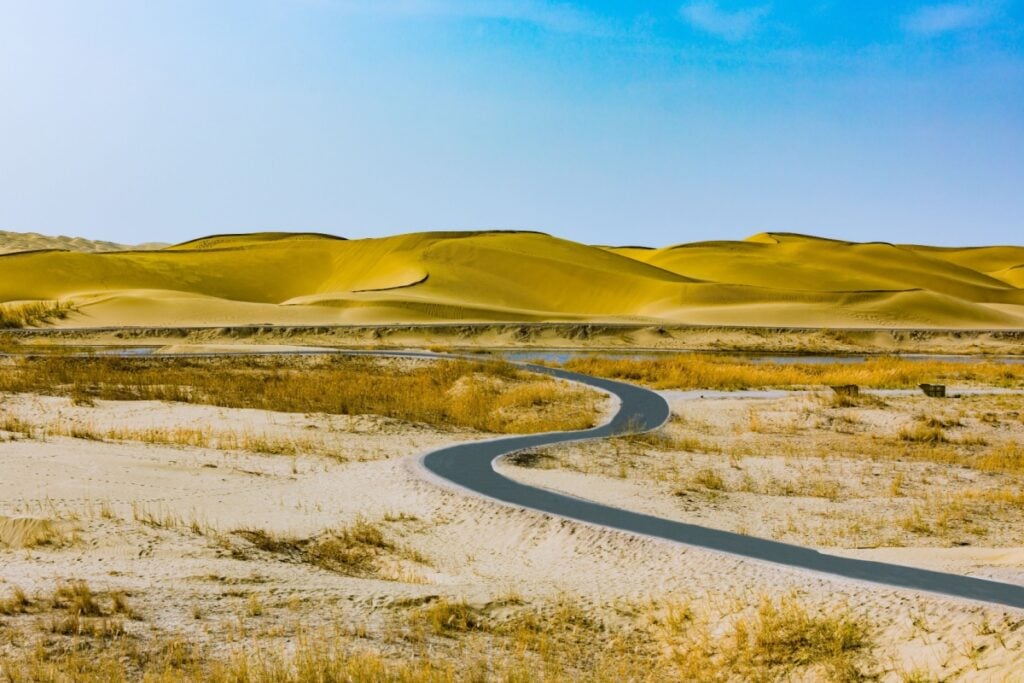
New research suggests China’s decades-long planting campaign around the Taklamakan Desert is doing more than slowing moving sand: it is now drawing down more carbon dioxide than the area releases, effectively functioning as a carbon sink. The Taklamakan is among the world’s largest and driest deserts, spanning roughly 130,000 square miles (337,000 square kilometers) and ringed by high mountains that limit moisture for much of the year.
Scientists say the shift is concentrated along the desert’s margins, where vegetation has been established through a vast afforestation effort. A study co-author, Yuk Yung of Caltech and a senior research scientist at NASA’s Jet Propulsion Laboratory, described the findings as evidence that “human-led intervention” can boost carbon uptake even in extreme arid settings.
Evidence From Satellites, Field Data, And Carbon Models
The research team examined multiple indicators over roughly 25 years: ground-based observations of vegetation types, satellite-based estimates of precipitation and plant growth, and estimates of photosynthesis and CO₂ fluxes. To support those observations, they also drew on NOAA’s Carbon Tracker, a modeling system used to map global carbon sources and sinks.
Their results, published in PNAS in January 2026, point to expanding vegetation and rising CO₂ uptake along the Taklamakan’s outer edge, which align in both time and location with planting linked to China’s long-running shelterbelt effort. Researchers also reported a distinct seasonal signal: during the wet season from July to September, rainfall was about 2.5 times higher than in the dry season, averaging roughly 0.6 inches (16 millimeters) per month. In the same period, the study found lower atmospheric CO₂ over the desert, dropping from about 416 parts per million in dry months to around 413 ppm in wet months, consistent with stronger plant growth and photosynthesis when water is more available.
From “Great Green Wall” To A Completed Desert Encirclement
The Taklamakan’s interior is dominated by mobile dunes; the study notes that over 95% of the desert is shifting sand, a factor behind its reputation as a “biological void.” Against that backdrop, China launched the Three-North Shelterbelt Program in 1978, part of a broader strategy to curb desertification in northern regions.
By late 2024, state media and officials reported that a sand-blocking green belt fully encircled the Taklamakan, stretching roughly 3,046 km around the desert’s perimeter in Xinjiang Uyghur Autonomous Region. In a separate report, Reuters cited state media describing the campaign as a 46-year push to plant trees and shrubs in China’s largest desert, with the final stretch completed after the last 100 meters were planted on the southern edge.
The same reporting also placed the Taklamakan work in the context of wider forest expansion: China’s national forest coverage rising above 25% versus about 10% in 1949, according to figures attributed to state sources.
What The Findings Do And Don’t Settle
Researchers emphasize that the carbon-sink signal appears strongest around the rim, where planted vegetation has taken hold, rather than across the entire desert interior. The study also situates its results alongside earlier work suggesting deserts can absorb CO₂ in other ways, such as uptake associated with sand. But prior research has raised questions about how stable that kind of storage may be under warming conditions that can increase gas release from soils and sediments.
Separately, a news release from the University of California, Riverside described the Taklamakan greening effort as creating a “visible and measurable” carbon sink and framed it as a real-world demonstration that shrubs and other plantings can curb emissions in extremely dry landscapes. At the same time, the broader effectiveness of large shelterbelt projects remains debated in some scientific circles, including the extent to which they consistently reduce dust and sandstorms across regions and years.
