


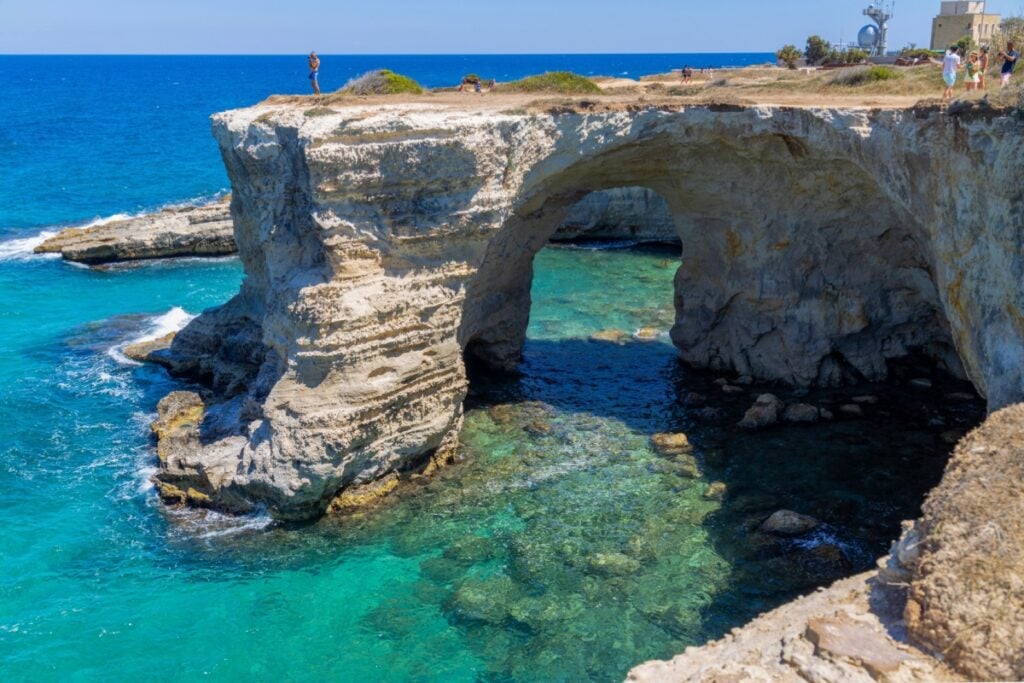
A well-known natural rock formation nicknamed “Lovers’ Arch” has collapsed along Italy’s southern Adriatic shoreline, after days of rough weather battered the coast. The arch was part of the Sant’Andrea sea stacks near Melendugno in the Puglia region, an area where limestone cliffs and sea stacks draw visitors for beach tourism and photography.
The collapse occurred around Valentine’s Day, following heavy rain, strong winds, and turbulent seas that weakened the already fragile structure. Some visitors and residents noticed the landmark was gone the next morning, with the former arch reduced to rubble at the waterline.
Local Leaders Describe a Blow to Tourism and Identity
Local officials framed the loss as both emotional and economic, noting the arch’s symbolic status for the surrounding Salento area. Maurizio Cisternino, the mayor of Melendugno, told a local outlet: “This is an unwanted Valentine’s Day gift,” calling the collapse “a very hard blow” for the area’s image and visitor economy.
In remarks reported separately, Cisternino described the damage as deeply personal as well as reputational, saying the event was “a devastating blow to the image of Salento and to tourism,” and adding: “It’s a blow to the heart.”
The arch had become a popular setting for proposals and couple photos, boosted in recent years by social media. Because the site is freely accessible, officials said there is no precise count of how many people visit annually, but its visibility made it a defining postcard image for the coastline.
Officials Warn of More Instability Along the Cliffs
Authorities cautioned that the collapse may not be an isolated incident. After the arch fell, officials pointed to visible cracks in nearby rocky sections and warned that additional parts of the coastline could also fail, highlighting long-running concerns about coastal erosion and instability.
Cisternino attributed the immediate trigger to the week’s severe conditions, heavy rain, strong winds, and rough seas, and he summarized the event with the line: “Nature has taken back what it created.”
Reporting on the same episode described the coastline’s vulnerability as the result of decades of wave action and weathering, with more recent bouts of extreme weather accelerating the damage. A separate account said the area had also been affected earlier in the year, citing prior storm impacts and local efforts to obtain funding for erosion-control and preservation work that did not succeed.
Wider Storm Impacts Across Southern Italy
The collapse comes amid a broader stretch of destructive weather in southern Italy, which has damaged coastal infrastructure and prompted emergency responses in multiple areas. Reuters reported that storms and heavy rain have also chewed away at sections of the Ionian coastline between Ugento and Gallipoli, damaging beach structures, causing small cliff falls, and affecting ports.
In addition to coastal damage, authorities have pointed to inland impacts from the same period of severe weather. Reuters said the estimated damage in southern Italy has climbed to well over €1 billion, and noted that a landslide forced more than 1,500 people to leave their homes in Niscemi, Sicily.
Another report tied the Lovers’ Arch collapse to a named weather system, Storm Oriana, and described the landmark’s cultural pull through a local legend that couples who kissed beneath it would find lasting love.
