


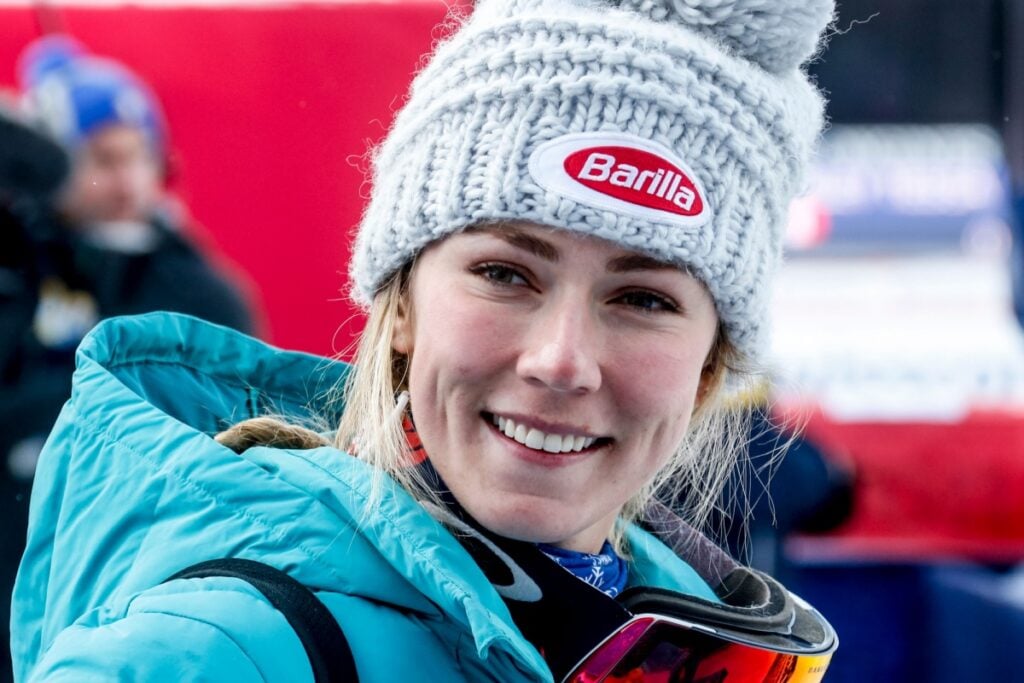
When Mikaela Shiffrin crossed the line in Cortina d’Ampezzo, Italy, the reaction that followed did not match the scale of the result. Her final run left her 1.5 seconds ahead of the rest of the field, a decisive margin in a discipline where medals often hinge on tiny fractions. Yet she did not leap, shout, or collapse. She stopped, stood still, and looked back up the slope, poles hanging at her sides as the crowd around her erupted.
Only after a beat that seemed to stretch did she drop into a crouch and stare at the snow. The scene carried its own symbolism because this was the performance many had expected for years on the Olympic stage, but that had not yet arrived. By combining two strong runs, Shiffrin captured her first Olympic gold in eight years and her first Olympic slalom gold in 12 years, delivering the kind of clear win that removes debate from the results sheet.
The podium placed Camille Rast in silver and Anna Swenn Larsson in bronze, with the gap behind the winner framed as unusually large. The day, in competitive terms, became a statement of control. In personal terms, it presented something different: a quiet stillness that preceded any outward release.
A Private Grief Behind A Public Career
In the moments after the race, Shiffrin’s thoughts were not anchored to rankings or missed chances. She focused on her father, Jeff Shiffrin, an anesthesiologist who also devoted himself to skiing and photography. He grew up skiing in the northeastern United States, traveling from New Jersey to Vermont when he could, and later earned a place on the Dartmouth ski team. Along with his wife, Eileen, he helped shape a family life centered on the mountains.
That foundation was shattered in February 2020, when Jeff Shiffrin fell from the roof of the family home in Denver and later died. Mikaela Shiffrin and her mother returned from competitions in Europe, and she has described being present in his final moments. In the years since, she has spoken about the disorienting aftermath and the way grief reshaped her relationship to sport and to everyday life.
At the base of the Olimpia delle Tofane, with her name sitting on top of the leaderboard, she said she did not feel a comforting presence as some people describe after a loss. Instead, she described a different sensation: peace. She framed it as acceptance not only of an Olympic result, but of a reality she has struggled to live inside, a life defined by moving forward without her father.
Records, Expectations, And The Weight Of Narrative
The victory also rewrote the public storyline that had tightened around Shiffrin across recent Olympic cycles. Her résumé now includes a cluster of historic markers: she is both the youngest at 18 and the oldest at 30 American woman to win Olympic alpine gold, and her return to the same event with a 12-year gap stands out in the Olympic context. She also became the first U.S. skier to win three Olympic gold medals, and her latest slalom win was reported as the largest margin in the event since 1998.
Yet the numbers that circulate most easily are not always the ones that reflect a career’s substance. In Beijing 2022, she left without a medal, with highly visible exits that hardened into a shorthand narrative. In these Games, early results added to the scrutiny, including a 15th place in the team combined and an 11th in the giant slalom. Even supporters spoke of pressure and bad luck, reducing one of the most decorated careers in alpine skiing to a question of whether she could simply finish.
Shiffrin herself offered a more complicated arc. She recalled being 18 in Sochi 2014, arriving with fearlessness and ambition, and later feeding expectations by talking openly about dominating multiple disciplines. Asked what she would tell her younger self now, she first joked, then explained she hesitated to dull that earlier confidence. Over time, she said, her relationship with expectation has kept evolving, and the world that once felt open narrowed into something heavier.
The Day Of The Race And The Mental Work Behind It
In the days before the slalom, Shiffrin described writing a note that became an Instagram post but began as something closer to a journal entry. She said that after a serious injury in 2024, she worked with a psychologist and learned to be more direct with herself, building a louder internal voice rather than relying on quiet restraint. In her post, she repeated the phrase “I won” four times, presenting it as an intention rather than a celebration.
On race day, she said she woke at 1:30 a.m., aware of the length of the day ahead. When she entered the start for the first run, she produced a time of 47.13, placing her 0.82 ahead of Lena Duerr in second, a gap described as enormous for slalom. Between runs, she tried to rest but instead cried while thinking about her father.
The format meant she would ski last in the second run, with the order inverted among the top 30 from run one. After Duerr failed to make it past the first gate, the scene sharpened, and Shiffrin entered the start with the weight of both opportunity and memory close by. She completed the run cleanly, then moved through the medal ceremony in a quiet rhythm: hugging her mother, returning to the podium area, and pausing with visible composure as her medal was placed around her neck.
