


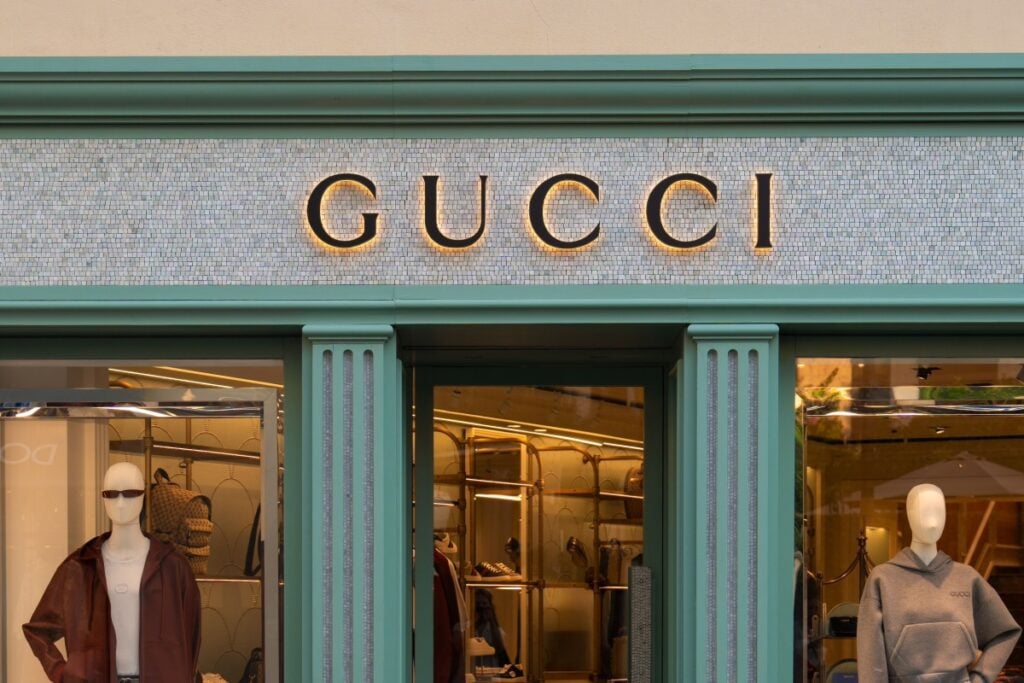
Gucci has drawn online criticism after publishing a set of promotional images labeled “Created with AI” to advertise its upcoming Primavera presentation during Milan Fashion Week. The posts circulated across the brand’s social platforms and were quickly reposted by users who argued the visuals looked inconsistent with a luxury house that markets itself around craftsmanship and creative production.
The campaign points to the show’s timing and format, listing “February 27” and “2 p.m. CET” in the promotional copy shared online. The show is expected to stream, adding to its visibility beyond the Milan runway calendar.
Much of the criticism focused less on whether AI can be used in fashion marketing and more on the perceived mismatch between the tool and the brand’s pricing and positioning. Commenters used the phrase “AI slop”, an internet term for low-quality or generic AI output, while others described the visuals as cheap or impersonal.
What The Images Showed And Why They Stood Out
Reports describing the posts said the AI-labeled images included scenes such as a woman in a fur coat in a restaurant, a close-up of legs stepping out of a car, and figures posed against a night sky. Another image showed a sports car in a stylized render that some users compared to the look of the Grand Theft Auto video game franchise.
While the AI disclaimer became the focal point, coverage also noted that the wider Primavera push mixed formats, including non-AI photography alongside the AI-tagged imagery. That blend complicated the message for some viewers, who questioned why a house known for traditional production values would use AI at all in a high-profile runway run-up.
Pricing was repeatedly invoked in the online response and in subsequent coverage. One report cited $850 as the price of Gucci’s least expensive handbag and $10,000 as the upper end for the most expensive, figures used by critics to argue that a brand charging premium prices should invest in human-led creative work rather than machine-generated visuals
Demna’s Debut Raises The Stakes For The Brand
The timing of the controversy is tied to a leadership change. Demna Gvasalia, widely known professionally as Demna, is preparing for his first major presentation connected to Gucci, following his long tenure at Balenciaga. The upcoming Primavera show is being framed as a public debut, with the brand under pressure to signal direction and momentum.
Business conditions add another layer. Gucci sits within Kering, and coverage of the AI backlash pointed to a difficult recent performance for the label, with Gucci reported to have posted a 22% revenue decline on a reported basis and 19% on a comparable basis in 2025. Against that backdrop, the brand’s marketing choices are being interpreted by observers through both a creative and commercial lens.
The company did not provide an immediate public explanation in the reviewed reporting, leaving outside analysts and consumers to speculate about its intent. Some branding and fashion specialists cited in coverage suggested the decision could be framed as an attempt to position Gucci at the intersection of fashion, art, and technology, rather than purely a cost-saving move.
Luxury Marketing And AI Remain A Live Debate
The dispute around Gucci’s AI-tagged posts follows other high-profile experiments by luxury brands. Gucci recently worked with Snapchat on an AI lens that let users adopt stylized looks linked to a “La Famiglia” concept, a sign of the industry’s interest in interactive, platform-native formats.
The reaction also fits a broader pattern in which audiences respond sharply when AI appears to replace, rather than support, traditional creative labor. Coverage cited concerns that luxury depends on narratives of human craft, heritage, and scarcity, and that AI-driven visuals can be read as undermining those signals if they appear mass-produced.
Other fashion houses have faced similar scrutiny. One report pointed to Valentino drawing criticism after an AI-generated campaign for a handbag in December, used as an example of how quickly public sentiment can shift when consumers feel authenticity is compromised.
For Gucci, the immediate practical issue is that attention around the AI images has partially competed with messaging about the runway itself. With February 27 approaching, the brand’s next communications and the reception of Demna’s first presentation are likely to be closely watched across both fashion media and social platforms, where commentary on luxury branding often travels faster than official campaign narratives.
