


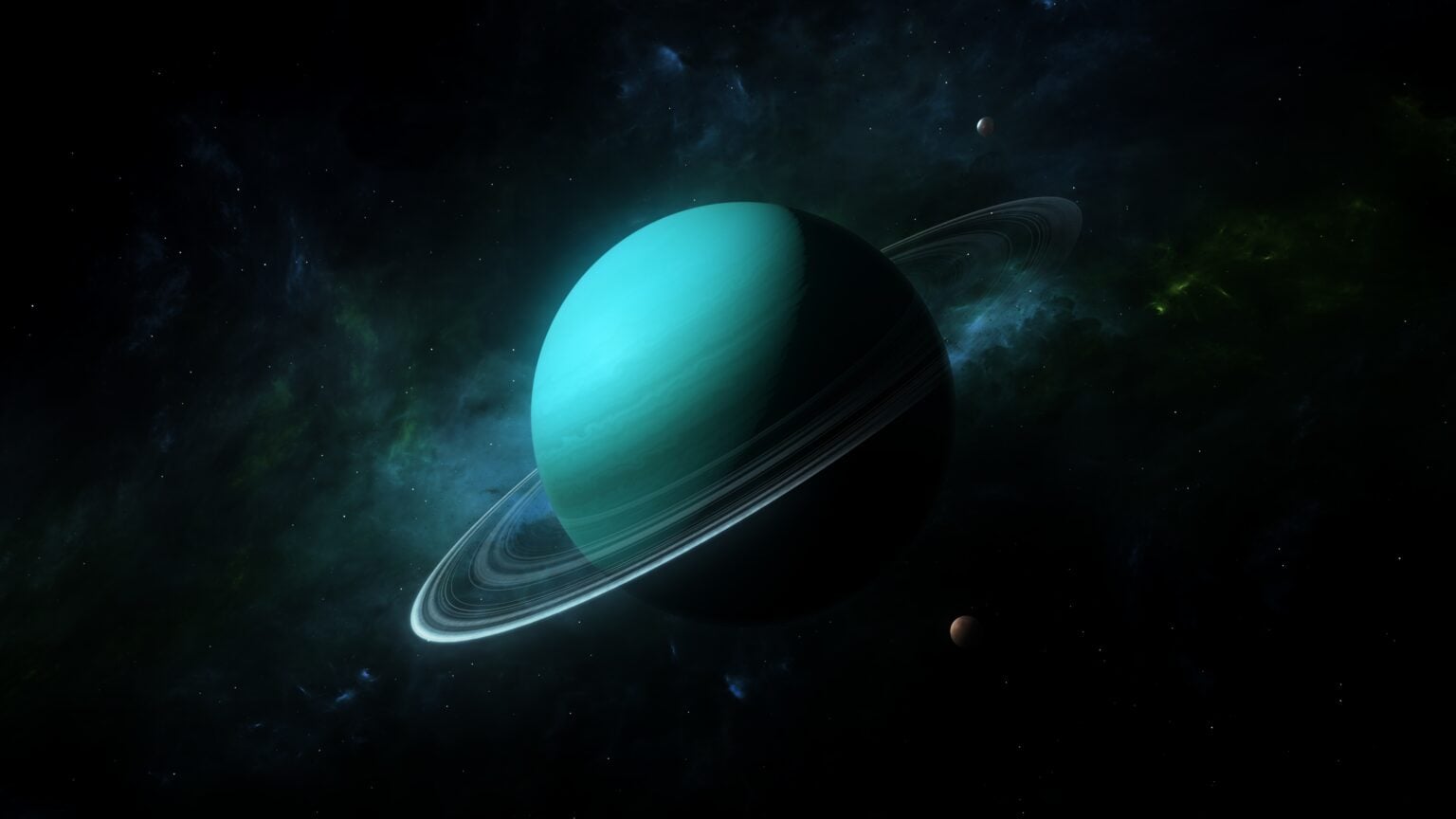
Astronomers using the James Webb Space Telescope (JWST) have produced the clearest look yet at how Uranus’ upper atmosphere behaves, after tracking the planet for about 15 hours, nearly a full Uranian rotation, to capture how its auroras and charged particles change with time and altitude.
The observations focused on Uranus’ ionosphere, the high-altitude region where solar-driven particles interact with the planet’s magnetic environment. Using JWST’s Near-Infrared Spectrograph (NIRSpec), the team mapped the temperature and density of ions through the upper atmosphere, creating what researchers described as the first three-dimensional view of key parts of the system.
Uranus has long been difficult to study up close. The only spacecraft to pass near the planet was NASA’s Voyager 2 in 1986, leaving decades of unanswered questions about how this ice giant’s atmosphere and magnetosphere operate compared with those of Jupiter, Saturn, and Earth.
A Tilted Magnetic Field Drives Unusual Auroral Geometry
Scientists have known that Uranus’ magnetic setup is extreme: its magnetic pole is tilted by roughly 60 degrees relative to the planet’s geographic pole, and the field is also offset from the rotation axis. That geometry is expected to make auroras behave differently than on Earth, where most activity clusters near the poles.
Webb’s data align with that expectation. The observations revealed broad auroral structures and helped trace how the magnetosphere’s shape influences where energetic particles deposit energy into the atmosphere. In NASA’s description of the results, the new view shows auroras “shaped” by the tilted field and provides a detailed portrait of where the emissions form.
The study was published on February 19, 2026, in Geophysical Research Letters and was led by Paola Tiranti of Northumbria University. In statements released alongside the findings, Tiranti highlighted Uranus’ magnetosphere as among the strangest in the solar system and said Webb is revealing how deeply those effects extend into the atmosphere.
Temperature And Density Peak At Different Heights
One of the most detailed JWST results is that the ionosphere’s temperature and density do not reach their maximum values at the same altitude. Instead, the warmest ion temperatures were observed roughly 4,000 to 5,000 kilometers above Uranus’ cloud tops, while the densest ion concentrations were found closer to about 1,000 kilometers above the clouds.
Researchers linked this mismatch to the “complex geometry” of Uranus’ magnetic field, which influences how particles move and where energy is deposited. By following the vertical structure, the observations help constrain how energy flows upward through the atmosphere, an important step for understanding the overall energy balance of ice giant planets.
Webb’s sensitivity also allowed the team to identify notable structure within the auroral region itself. Two bright auroral bands appeared near the magnetic poles, but between those belts, the instruments detected a relative “depletion” in ion density and auroral emissions. Scientists suggested that this gap may be tied to transitions between magnetic field lines—an effect with analogs in observations of Jupiter’s upper atmosphere.
Evidence Uranus’ Upper Atmosphere Keeps Cooling
Alongside the auroral mapping, Webb’s measurements support earlier findings that Uranus’ upper atmosphere has been cooling since the 1990s. NASA said the new dataset provides further information on that long-term trend, while media reports summarizing the work cite an average upper-atmosphere temperature near 153°C (about 307°F) based on the Webb analysis.
Researchers emphasize that the Uranus results extend beyond one planet. Ice giants are common among known exoplanets, and understanding how a tilted, offset magnetic field can reshape auroras and affect upper-atmospheric heating on Uranus may help scientists interpret distant worlds whose atmospheres can be studied only indirectly.
