


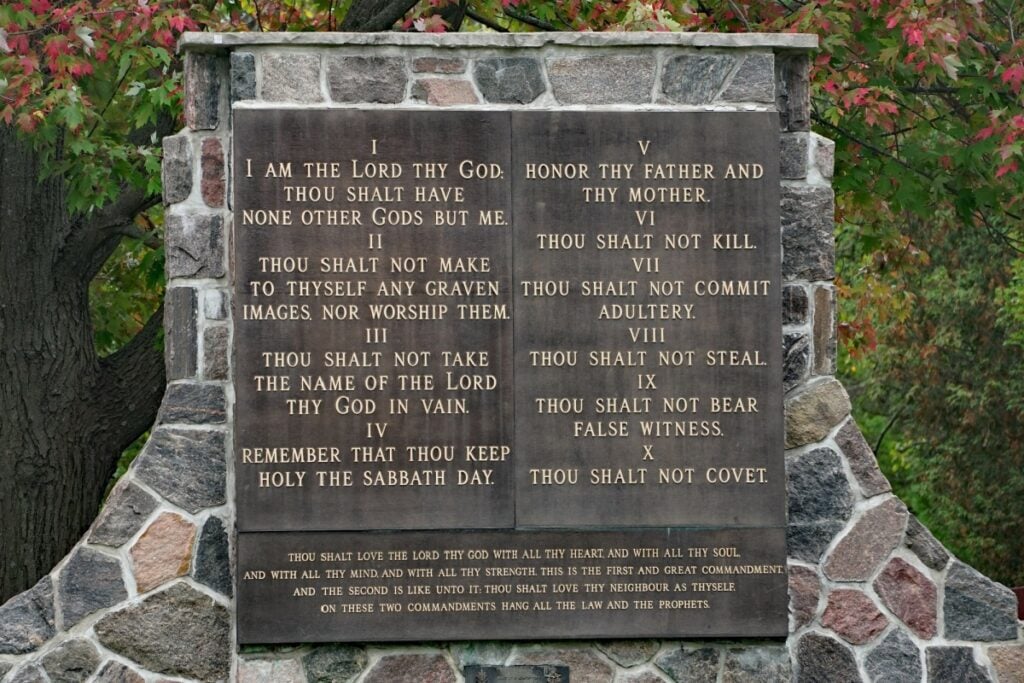
A federal judge has invalidated an Arkansas law that required public schools to display the Ten Commandments in classrooms, marking a significant development in an ongoing national legal dispute over religion in education. The ruling found that the mandate violated constitutional protections separating government and religious activity.
The case stemmed from a lawsuit filed by several families representing both religious and nonreligious backgrounds. They argued that the requirement compelled students to engage with a specific religious text in a public, taxpayer-funded setting. The law, enacted in 2025, applied broadly to elementary and secondary schools, requiring displays in classrooms and libraries.
In his decision, the judge emphasized that placing religious doctrine in academic environments lacked a valid constitutional basis. The ruling specifically blocked enforcement in several school districts, though legal analysts suggest the reasoning could extend statewide.
State officials have signaled plans to challenge the decision. Arkansas Governor Sarah Huckabee Sanders criticized the ruling and indicated that an appeal would be pursued, framing the law as part of broader efforts to reinforce moral instruction in schools.
Broader Push Across Republican-Led States
The Arkansas measure is part of a wider legislative trend in several Republican-led states aiming to integrate religious references into public education. Similar laws have been introduced or enacted in Louisiana and Texas, reflecting a coordinated policy direction.
In Texas, state law requires that each classroom display a poster of the Ten Commandments, sparking debates among educators, parents, and students about the role of religion in public institutions.
Louisiana has taken comparable steps. A state law mandates the display of the Ten Commandments in public school classrooms, with supporters arguing the text represents a historical foundation of American law rather than solely a religious doctrine.
Proponents across these states maintain that such displays provide cultural and historical context. Critics, however, contend that these measures effectively endorse a specific religious viewpoint, raising concerns under the First Amendment’s Establishment Clause.
Diverging Court Decisions Fuel Legal Uncertainty
Court rulings on these laws have varied, contributing to a complex and evolving legal landscape. While the Arkansas decision halted enforcement, a federal appeals court recently allowed Louisiana’s law to proceed, at least temporarily, while litigation continues.
This divergence has intensified expectations that the issue may ultimately be resolved by the U.S. Supreme Court. Legal experts note that lower courts have reached different conclusions about whether such displays constitute unconstitutional religious endorsement or permissible historical expression.
Civil liberties organizations, including the American Civil Liberties Union, have played a central role in challenging the laws. These groups argue that mandatory classroom displays place undue pressure on students and blur the line between church and state.
Supporters of the measures counter that the Ten Commandments have long been referenced in legal and cultural traditions, and that their inclusion in schools can be framed in a secular, educational context.
Ongoing Debate Over Religion in Public Education
The legal battles surrounding these laws reflect a broader national debate over the place of religion in public institutions. The issue has surfaced repeatedly in U.S. history, with courts often weighing the balance between religious freedom and government neutrality.
In Arkansas, the recent ruling underscores the judiciary’s continued scrutiny of policies perceived as advancing religious doctrine in public settings. At the same time, ongoing cases in Louisiana and Texas suggest that the matter remains unsettled, with additional rulings likely in the months ahead.
As litigation progresses, school districts across affected states face uncertainty over how to comply with shifting legal interpretations. Some have delayed implementing the displays pending clearer guidance, while others have moved forward under state directives.
The outcome of these disputes could have far-reaching implications for education policy nationwide, particularly if the Supreme Court agrees to review one or more of the cases.
