


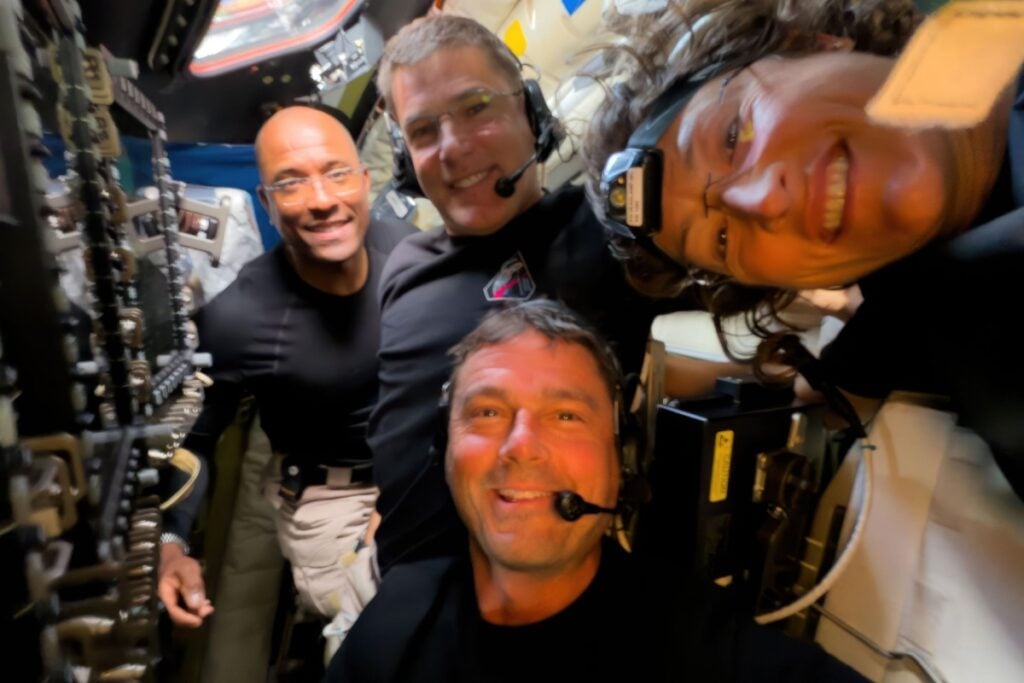
NASA’s Artemis II mission concluded with a safe splashdown in the Pacific Ocean, bringing four astronauts back to Earth after a landmark voyage around the Moon. The mission marked the first time humans traveled to the Moon in more than half a century, signaling a major milestone in the revival of lunar exploration.
The Orion spacecraft carrying NASA astronauts Reid Wiseman, Victor Glover, and Christina Koch, along with Canadian astronaut Jeremy Hansen, touched down off the coast of California after a journey lasting nearly ten days. At its farthest point, the crew traveled approximately 252,756 miles from Earth, surpassing previous distance records set during the Apollo era.
Following splashdown, recovery teams retrieved the spacecraft and transported the astronauts for routine medical checks before returning them to NASA facilities. The safe landing demonstrated the reliability of Orion’s heat shield and recovery systems, both considered essential for upcoming missions intended to carry astronauts deeper into space.
Mission Tested Systems for Future Lunar Landings
Although Artemis II did not attempt a lunar landing, its primary objective was to test systems required for future missions. The flight followed a “free-return” trajectory, looping around the Moon and using its gravitational pull to guide the spacecraft back to Earth without the need for major engine burns.
During the mission, astronauts evaluated life-support equipment, navigation systems, and communication technologies while orbiting beyond the far side of the Moon. Engineers closely monitored spacecraft performance under extreme conditions, including high-speed atmospheric reentry, where Orion endured intense heat as it descended toward the ocean.
Crew members described the journey as both technically demanding and visually extraordinary. From their vantage point, they observed the Moon’s far side and captured images of Earth appearing as a distant sphere. These observations provided scientific data while also demonstrating the spacecraft’s ability to operate safely at distances not experienced by human crews since the early 1970s.
The mission also represented a notable moment in the history of human spaceflight. Koch became the first woman to travel to the vicinity of the Moon, while Glover became the first Black astronaut assigned to a lunar mission. Hansen’s participation marked the first time a Canadian astronaut journeyed beyond Earth orbit toward the Moon.
Global Attention and Renewed Interest in Lunar Exploration
The Artemis II flight drew widespread international attention, with millions following the spacecraft’s journey and eventual return. Public enthusiasm reflected renewed global interest in lunar exploration after decades focused primarily on low-Earth orbit missions.
During the flight, the crew completed several observational tasks and documented lunar features while testing onboard equipment. Engineers noted minor technical challenges during the mission, including equipment malfunctions that were resolved without compromising safety. These events provided valuable insights for refining hardware ahead of future launches.
Scientists and mission planners view Artemis II as a transitional step between early testing flights and full-scale lunar operations. By validating systems in real-world conditions, the mission reduced uncertainties associated with sending astronauts back to the lunar surface.
The program also includes international partnerships and commercial collaboration, underscoring a broader shift toward cooperative space exploration. Such partnerships are expected to play a critical role in developing technologies needed for sustained human activity beyond Earth orbit.
Next Steps Focus on Returning Humans to the Moon
With Artemis II completed, attention is now turning to the next phases of NASA’s lunar program. Future missions are planned to test docking procedures with lunar landers and prepare astronauts for landing operations near the Moon’s south pole, a region believed to contain water ice and other valuable resources.
The Artemis program is designed as a long-term effort to establish a sustainable human presence on the Moon. Engineers aim to refine spacecraft systems, develop surface habitats, and expand mission capabilities in preparation for deeper space exploration, including potential missions to Mars.
Data gathered during Artemis II will guide decisions about spacecraft design, astronaut training, and mission planning. Lessons learned from the mission are expected to influence hardware upgrades and operational strategies for the upcoming Artemis III and Artemis IV flights, both considered essential steps toward achieving long-term lunar exploration goals.
