


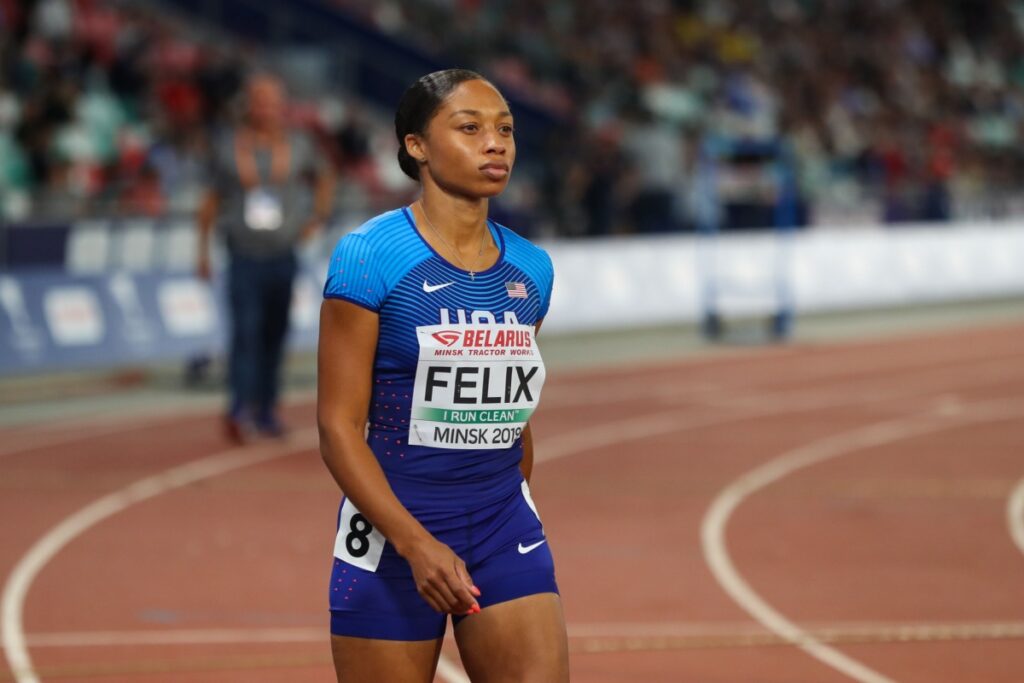
American track star Allyson Felix, the most decorated woman in Olympic track and field history, has announced plans to return to competitive athletics with the aim of qualifying for the 2028 Summer Olympics in Los Angeles. The decision marks a surprising shift for the former sprinter, who retired from professional competition in 2022 after a career that spanned nearly two decades.
Felix, now 40, intends to pursue what would be her sixth Olympic appearance, a milestone rarely achieved in sprinting. If successful, she would compete at age 42 in her hometown Games, a goal she has described as both personal and symbolic. The Los Angeles Olympics represent the first time in her career that the Games will be held in the city where she grew up.
The athlete revealed that the opportunity to compete in front of a home crowd played a major role in her decision to return. Having participated in five Olympic Games from 2004 through Tokyo 2020, Felix accumulated 11 Olympic medals, including seven gold, cementing her status as one of the most successful track athletes in history.
Her comeback effort will require qualifying through the highly competitive U.S. trials system, widely considered one of the toughest pathways to Olympic participation.
Training Plans Set for Gradual Return
Felix has outlined a timeline that begins with a structured training program scheduled to resume later this year. Reports indicate she plans to return to full training under longtime coach Bobby Kersee, who guided her through much of her career, including her final competitive season before retirement.
The plan includes a gradual reintroduction to elite-level conditioning, with competition expected to follow in subsequent seasons. Officials familiar with her preparation indicated that the athlete aims to return to racing in 2027 as she works toward the Olympic qualification cycle.
Felix has acknowledged the physical challenges associated with returning to high-performance sprinting in her 40s. Sprinting events demand explosive power, speed endurance, and recovery capacity—attributes that typically decline with age. Despite these realities, she has framed the effort as an exploration of athletic longevity rather than a return to her previous peak form.
Her approach reflects broader trends in elite sport, where athletes in multiple disciplines have extended their careers into later stages of life. Felix has cited inspiration from prominent athletes who continued competing successfully into their 40s, reinforcing her belief that age-related barriers in sport are evolving.
The long preparation window before 2028 allows time for both physical adaptation and evaluation of competitive readiness.
Legacy and Motivation Behind the Comeback
Felix’s decision carries significance beyond athletic performance. Over the course of her career, she became a prominent advocate for women athletes, particularly regarding maternity rights and contract protections. Her advocacy work helped drive changes across the sports industry, including expanded maternity policies among major athletic sponsors.
In interviews, Felix has emphasized that her return is motivated by a desire to challenge perceptions about motherhood and aging in professional sport. As a mother of two, she has described the comeback as an opportunity to demonstrate that elite competition remains possible beyond traditional timelines.
The 2028 Olympics also hold symbolic meaning for athletes connected to Los Angeles. Felix has long expressed regret that her earlier Olympic appearances were held outside the United States. Competing in a home-city Games, she noted, represents a rare opportunity that many athletes never experience.
Her participation in the LA28 Organizing Committee Athletes’ Commission further deepens her involvement in preparations for the Games. This role places her among athletes contributing to planning and athlete-focused decision-making ahead of the event.
Observers note that her legacy as both an athlete and advocate makes the comeback particularly notable within the track and field community.
Qualification Path Remains Highly Competitive
Despite widespread attention surrounding her announcement, Felix’s path to Los Angeles remains uncertain. Qualifying for the Olympic team requires meeting strict performance standards and finishing among the top competitors at national trials, where younger athletes often dominate sprint events.
Officials within the sport emphasize that returning athletes face unique obstacles, including injury risk and recovery limitations associated with age. Felix has openly acknowledged these factors, describing the attempt as an ambitious challenge rather than a guaranteed outcome.
Still, her competitive history demonstrates resilience under demanding conditions. During her career, Felix successfully transitioned from the 200-meter sprint, where she earned multiple world titles, to the 400-meter event, later capturing additional global championships and Olympic medals.
The timeline toward the 2028 Games allows for multiple seasons of competition to gauge performance levels. Analysts expect early races following her return to provide insight into whether she can maintain the speed and endurance required at the elite level.
Regardless of the eventual outcome, the announcement has generated renewed attention for the upcoming Los Angeles Olympics, highlighting the growing anticipation for one of the most high-profile athletic events of the decade.
