


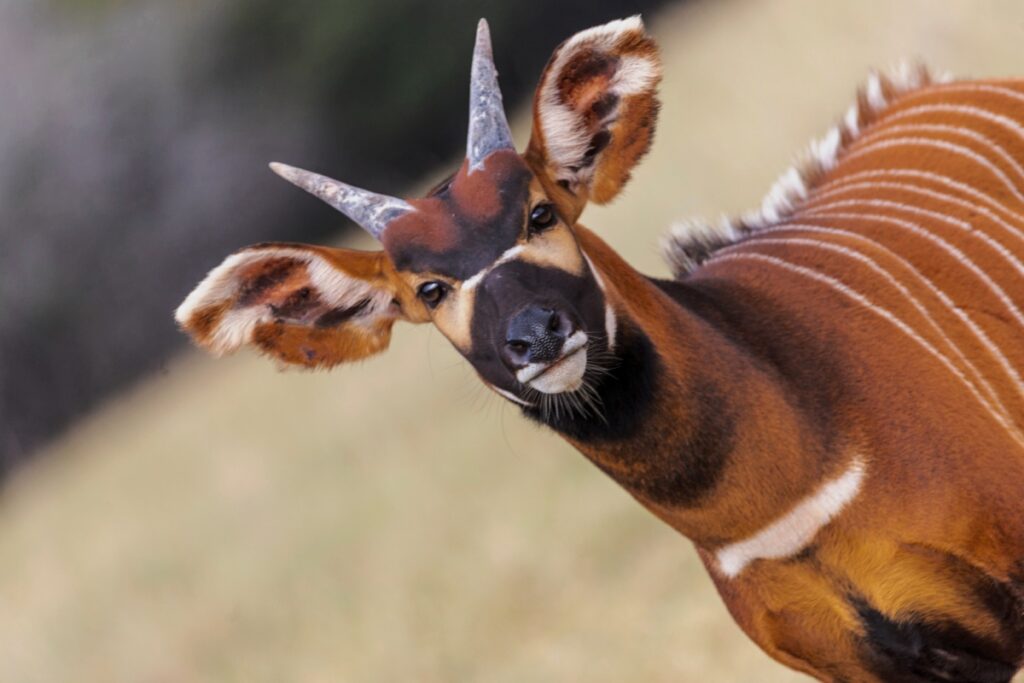
Four critically endangered mountain bongos have been transported from a zoo in the Czech Republic back to Kenya, marking another step in an international effort to rebuild wild populations of the rare forest antelope. Officials described the relocation as a symbolic return of a species native to Kenya’s highland forests.
The animals arrived in Nairobi in specially designed crates and were welcomed by senior government officials, including Kenya’s Cabinet Secretary and tourism officials. The relocation is part of a long-running partnership between Kenyan conservation authorities and European zoological institutions.
Mountain bongos, known for their chestnut coats marked with narrow white stripes, are considered among Africa’s rarest large mammals. Their numbers have declined sharply over the decades because of habitat loss, poaching, and disease outbreaks. Fewer than 100 individuals are believed to remain in the wild, according to Kenyan authorities.
The four animals will remain under veterinary supervision throughout quarantine and gradual acclimatization. After this phase, they are scheduled to move to a protected breeding center on the slopes of Mount Kenya.
Long-Term Recovery Plan Focuses on Genetic Strength
The relocated bongos are expected to play a critical role in strengthening the genetic health of Kenya’s remaining population. Conservation specialists plan to integrate the animals into an existing managed group, enabling controlled breeding to increase genetic diversity.
The Mount Kenya Wildlife Conservancy, where the animals will eventually reside, currently cares for more than 100 bongos. This managed population forms part of a national recovery strategy designed to produce future generations suitable for release into forest habitats.
Conservationists emphasize that genetic variation is essential for the species’ survival. When populations become too small, inbreeding can weaken immunity and reduce fertility, making recovery more difficult. By introducing animals raised in carefully monitored breeding programs, scientists aim to counteract those risks.
European zoos have maintained mountain bongo breeding programs for decades, documenting genetic lineages across generations. These records allow specialists to select animals most suitable for strengthening Kenya’s population without increasing the likelihood of inherited health problems.
Species Decline Linked to Disease and Habitat Loss
Mountain bongos once inhabited large stretches of Kenya’s montane forests, where dense vegetation provided both food and protection from predators. However, several factors have contributed to their dramatic decline.
One of the most damaging events occurred during the 1980s, when a rinderpest outbreak swept through wildlife populations across East Africa. The disease killed large numbers of grazing animals, including bongos, significantly reducing their numbers. Habitat fragmentation and illegal hunting further intensified the losses over subsequent decades.
As forests were cleared for agriculture and settlement, suitable habitat shrank, isolating small groups of animals. These fragmented populations struggled to reproduce effectively and maintain stable numbers.
Conservationists also note that mountain bongos play an important ecological role. By feeding on leaves and shrubs, they help shape forest vegetation patterns. Their presence supports healthy forest ecosystems that are closely tied to water resources relied upon by communities downstream.
International Cooperation Drives Conservation Efforts
The transfer of bongos from Europe to Kenya reflects growing international collaboration in wildlife conservation. Officials from both Kenya and the Czech Republic described the relocation as part of a shared commitment to protecting biodiversity and preventing extinction.
This recent arrival marks the third return of mountain bongos from European breeding facilities in recent years. Each transfer builds on earlier phases of the recovery program, gradually expanding Kenya’s managed population and strengthening the foundation for future reintroductions into protected forests.
Conservation groups and researchers involved in the project view the program as a model for safeguarding species facing similar threats. By combining captive breeding, scientific planning, and habitat protection, they aim to create conditions that allow endangered species to recover over time.
Filmmakers and conservation advocates monitoring the project have highlighted the broader environmental benefits of restoring bongo populations. Healthy forests supported by species like the mountain bongo help regulate water cycles and sustain biodiversity across entire ecosystems.
Authorities in Kenya continue to monitor the newly arrived animals closely as they adapt to their surroundings. Their successful integration into the breeding program is expected to shape the next stage of conservation work aimed at restoring viable populations of mountain bongos across their native range.
