


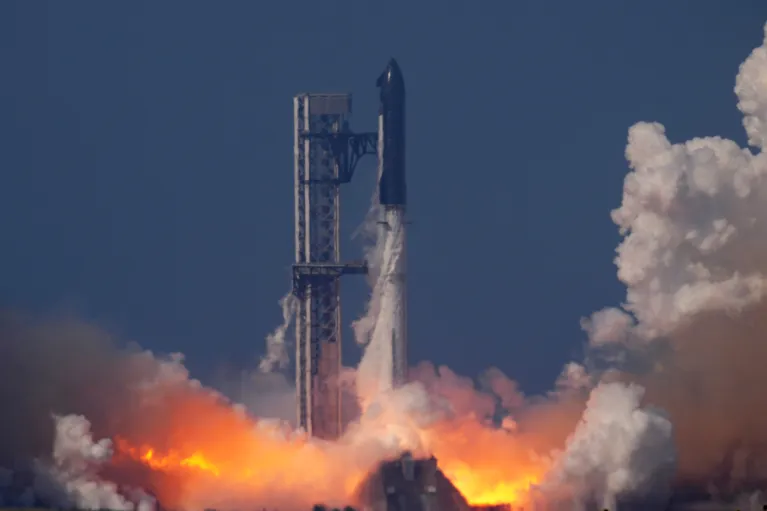
SpaceX launched its largest and most powerful Starship yet on Friday, sending a redesigned mega rocket on a high-stakes test flight that NASA is watching closely as it prepares for future Artemis moon missions. The upgraded vehicle, built with more thrust, stronger systems and new mission-ready features, completed an hourlong journey halfway around the world before ending in a fiery ocean impact that SpaceX said was expected.
A Bigger Starship Takes Flight From Texas
The new Starship lifted off from SpaceX’s Starbase facility near the southern tip of Texas, close to the Mexican border. The launch came two days after SpaceX CEO Elon Musk announced he was taking the company public, adding even more attention to the already closely watched test.
This was the 12th test flight for Starship, the rocket system Musk hopes will one day carry humans to Mars. For now, its more immediate mission is tied to NASA’s Artemis program, which aims to return astronauts to the moon for the first time since Apollo 17 in 1972.
The third-generation Starship, known as V3, launched from a new pad after last-minute issues delayed the first attempt. The rocket carried 20 mock Starlink satellites, which were released midway through the flight.
A Test Flight With Trouble, But No Midair Fireball
SpaceX was hoping to avoid the dramatic failures seen during previous test flights, including midair explosions that scattered debris over the Atlantic. This time, the liftoff was smooth, and the spacecraft continued eastward at an altitude of about 120 miles, or 194 kilometers.
There were still technical problems. Not all booster engines fired during the controlled return attempt, and the spacecraft also had to continue with fewer engines than planned. Even so, Starship reached its target zone in the Indian Ocean.
The vehicle descended upright under what appeared to be full control, then toppled over and ignited on impact. According to SpaceX, that fiery ending was not unexpected.
Musk celebrated the milestone, calling it “an epic” launch and landing. In a message to his team on X, he said, “You scored a goal for humanity.”
New Cameras Deliver a First Look From Starship
One of the most notable moments came from two modified, camera-equipped Starlink satellites released from the spacecraft. They provided brief views of Starship in flight, offering a remarkable first look at the vehicle from deployed satellite hardware.
The test also demonstrated SpaceX’s growing focus on using Starship not only as a deep-space vehicle, but also as a platform for launching Starlink satellites and supporting future orbital operations.
Built Taller, Stronger and More Mission-Ready
At 407 feet, or 124 meters tall, the latest Starship is several feet taller than earlier versions and delivers more engine thrust.
The upgraded booster includes fewer but larger grid fins, designed to help steer the rocket back to Earth after liftoff. It also features a larger and stronger fuel transfer line feeding the 33 main engines. That line alone is described as being the size of SpaceX’s Falcon 9 first-stage booster.
The stainless steel spacecraft has also received major upgrades, including more cameras, stronger navigation systems, more computing power and docking cones that could be used for future rendezvous missions, including moon operations.
NASA Watches Closely as Artemis Plans Advance
NASA Administrator Jared Isaacman attended the launch and said Starship is now one step closer to the moon.
NASA is paying SpaceX billions of dollars to develop a lunar lander for the Artemis program. The agency is also funding Jeff Bezos’ Blue Origin, whose Blue Moon lander is competing to be ready for crewed lunar missions.
The two companies are racing to prove their systems can safely support NASA’s return to the lunar surface. Starship has already reached the edge of space several times, while Blue Moon has not yet launched, though a prototype is being prepared for a moonshot later this year.
The Moon Race Is Heating Up
NASA recently completed a successful lunar flyaround with four astronauts in April. The next major step is a docking trial in Earth orbit planned for next year.
For Artemis III, astronauts are expected to practice docking their Orion capsule with Starship, Blue Moon or possibly both. A crewed moon landing under Artemis IV could follow as soon as 2028, depending on which lander is safest and ready first.
That mission would mark NASA’s first crewed lunar landing since Apollo 17. The long-term goal is to build a base near the moon’s south pole, where astronauts and robots could work together.
Private Moon and Mars Flights Enter the Picture
Beyond NASA, SpaceX is already taking reservations for private Starship flights to the moon and Mars.
California businessman Dennis Tito, known as the world’s first space tourist, signed up with his wife 3 1/2 years ago for a private flight around the moon, though the timing remains uncertain.
Another wealthy space tourist, Chinese-born bitcoin investor Chun Wang, announced this week that he plans to fly on Starship’s first interplanetary Mars mission. Wang previously chartered a SpaceX polar flight in a Dragon capsule and became part of the first crew to orbit above both the north and south poles.
No price or launch date has been announced for Wang’s planned Mars trip.
A Fiery Ending, But a Forward Step
The latest Starship test did not end with recovery, and neither the booster nor the spacecraft was meant to be saved. The Gulf of Mexico served as the final stop for the booster, while the Indian Ocean marked the end for the spacecraft and satellite demos.
Still, the flight showed meaningful progress for SpaceX’s most ambitious rocket. With NASA depending on Starship for future moon landings and Musk still focused on Mars, each test brings the company closer to proving whether the giant stainless steel vehicle can become the reusable deep-space system it was designed to be.
