


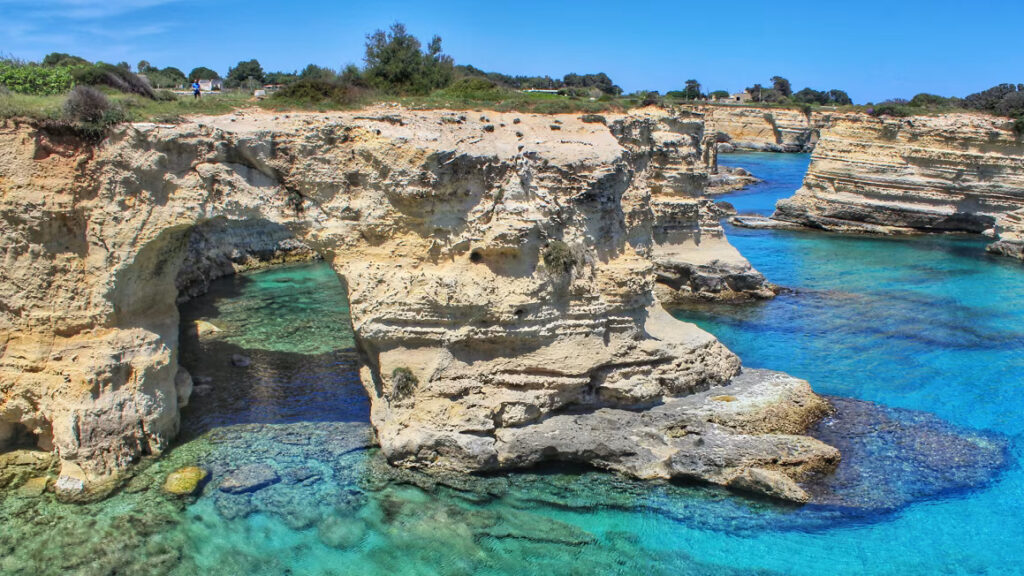
Italy’s beloved “Lovers’ Arch,” a natural coastal landmark in Salento, has collapsed after powerful storms battered the region. Known for its romantic legend, dramatic cliffs, and turquoise Adriatic waters, the arch had long attracted couples, tourists, and locals who saw it as one of Puglia’s most meaningful symbols of love and beauty.
A Romantic Landmark Lost to the Sea
The Faraglioni di Sant’Andrea, home to the famous stone arch, stood along the coast of Salento in Italy’s Puglia region. For generations, visitors came to the site to propose marriage, share first kisses, celebrate anniversaries, and take photos beneath the natural formation.
Local legend said that couples who kissed under the arch were destined for eternal love. Over time, that story helped turn the site into one of the area’s most recognizable romantic destinations.
A Blow to Salento’s Image and Tourism
The collapse has been deeply felt by local leaders, residents, and tourism officials. The landmark was not only a natural wonder, but also a major attraction for visitors to the Adriatic coast.
Maurizio Cisternino, mayor of Melendugno, near the fallen arch, told CNN that the collapse was a “devastating blow to the image of Salento and to tourism.” He added, “It’s a blow to the heart.”
Hotels, resorts, and local businesses had grown around the popularity of the arch, with many using its name and image to attract travelers looking for romance, scenery, and coastal beauty.
Centuries of Nature Shaped the Arch
The arch was formed over centuries as harsh winds and powerful seas carved into the Calcarenite stone cliffs of Puglia. Long before it became a romantic destination, the site also served as a strategic lookout point used to warn of pirates approaching the coast.
In recent years, social media brought even more attention to the landmark. Cisternino said Instagram photos helped draw thousands of couples to the area, though because the site was free and open to the public, exact visitor numbers were difficult to track.
Memories Remain for Local Couples
For many residents, the collapse feels personal. Lorenzo Barlato, a local resident, proposed to his wife on the clifftop overlooking the arch more than 40 years ago. The couple often returned to the site for anniversaries.
After the collapse, Barlato wrote on Facebook, “I couldn’t wait to return.” He added, “Now, unfortunately, all I have left are the many beautiful photos I took of that piece of paradise.”
An Inevitable Loss, Officials Say
Concerns about the arch’s fragile structure had existed for years. Local authorities had applied for a $4.5 million grant to fund a preservation project aimed at fighting coastal erosion, but the funding was not secured, according to Cisternino.
“It’s a tragedy we knew was inevitable, we just didn’t expect it to happen so soon,” Cisternino told local media.
He also told CNN that “nature has reclaimed the arch, just as it created it,” while stressing that more resources are needed to address the changing coastline. “Nature has been transformed: what was there 30 years ago is no longer there.”
Climate, Storms, and Coastal Erosion
Warmer sea temperatures linked to climate change are seen as one factor behind the extreme weather affecting parts of southern Italy. The arch had already suffered damage from earlier severe weather, and repeated storms continued to weaken the coastline.
The collapse comes amid broader weather-related damage across southern Italy, including landslides, flooding, and destruction in other communities.
A Funeral for One of Italy’s Happiest Places
The municipality has said the remaining rubble will be left to wash out to sea. For many, that decision marks the end of a beloved landmark that once symbolized love, beauty, and memory.
Puglia tourism councillor Francesco Stella described the loss by saying, “It’s like a funeral.”
The collapse of Lovers’ Arch is more than the fall of a rock formation. It is the disappearance of a place where nature, romance, history, and local identity came together for generations. Though the arch is gone, its legend will remain part of Salento’s story.
