


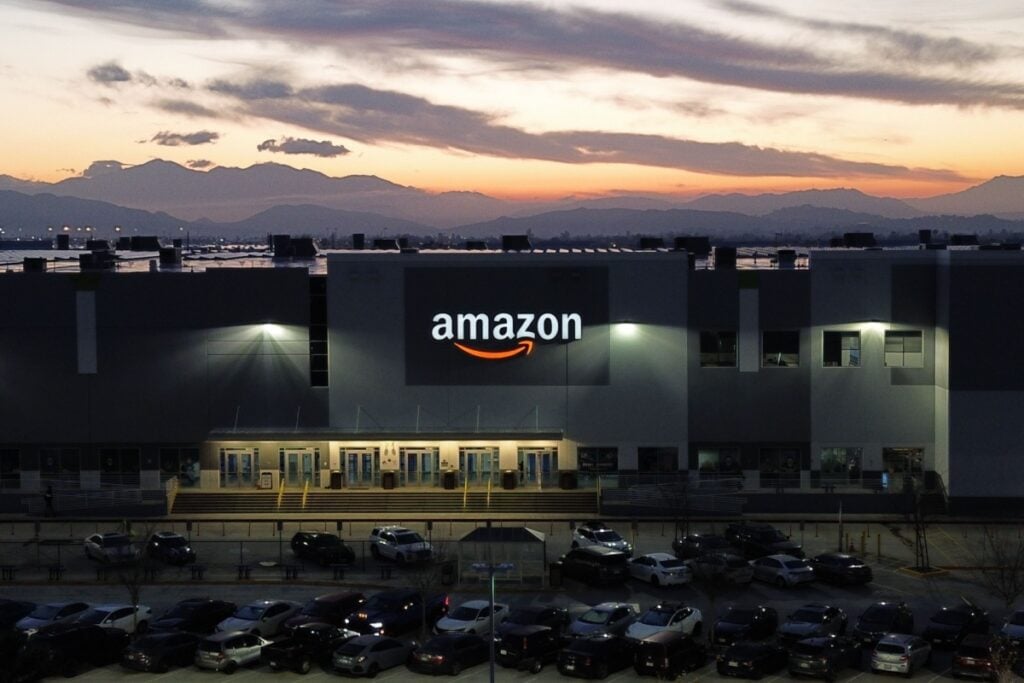
Amazon shares fell about 11% in after-hours trading after the company outlined a sharp increase in investment spending, even as it reported strong fourth-quarter results. The Seattle-based company said it plans to increase capital spending by nearly 60% to about $200 billion in 2026, up from $128 billion a year earlier, as it targets growth opportunities in artificial intelligence, robotics, semiconductors, and satellites.
Market expectations had been lower. Analysts tracked by FactSet had been looking for capital spending closer to $147 billion, the report said, adding to investor concern that near-term costs could rise faster than profits.
On an earnings call following the release, Andy Jassy told investors the company expects “strong long-term return on the invested capital,” pointing to what he described as unusually fast demand for AI-related capacity. He said Amazon has been monetizing new AI capacity as it comes online and argued that many existing customer experiences will be “reinvented” over time.
Fourth-Quarter Revenue Rises 14% as AWS Accelerates
Amazon said revenue climbed to $213.4 billion in the quarter ended Dec. 31, up from $187.8 billion a year earlier, reflecting a 14% increase and stronger-than-expected holiday demand. Net income rose to $21.2 billion, or $1.95 per share, compared with $20.0 billion, or $1.86 per share, a year earlier.
The company’s profit, however, came in slightly below Wall Street estimates cited in the report. Analysts polled by FactSet had been expecting $1.97 per share on $211.4 billion in sales.
A key focus for investors was the pace of growth at Amazon Web Services. Amazon reported 24% growth for AWS in the fourth quarter, and said AWS revenue reached $35.6 billion, above the $34.9 billion expectation cited in the report.
The stronger cloud performance comes as Amazon faces pressure to reassure customers that AWS can keep pace with rivals from Microsoft and Alphabet. The AP report noted Alphabet said its cloud unit posted a 48% increase and nearly $18 billion in revenue.
Layoffs, Retail Retrenchment, and Faster Delivery Push
Alongside its investment push, Amazon has continued restructuring parts of its workforce and retail footprint. The report said the company is cutting about 16,000 corporate jobs in what it described as a second round of major layoffs in three months. Amazon said in an emailed statement that AI was “not the reason behind the vast majority” of the reductions, attributing the move instead to eliminating layers to increase speed.
Separately, the report cited notices to state workforce agencies indicating Amazon planned to cut about 5,000 retail workers tied to a decision to close nearly all Amazon Go and Amazon Fresh stores. Those cuts would add to earlier reductions, including 14,000 job cuts in October, taking the total to well above 30,000 since Jassy highlighted a shift toward AI-driven organizational changes.
Even as it narrows parts of its physical retail strategy, Amazon is continuing to invest in fulfillment speed. The company highlighted ongoing work on robotics and AI-supported logistics. It also pointed to “Amazon Now,” an ultra-fast delivery service promising delivery on thousands of items in 30 minutes or less, available in parts of India, Mexico, and the United Arab Emirates, with tests underway in the United States and the United Kingdom. The company also said it is expanding same-day grocery delivery to more than 2,300 U.S. cities and towns.
Big Tech AI Spending Rises as Amazon Guides Q1 Sales Range
Amazon’s projected spending increase lands amid a broader AI investment wave across major technology companies. The AP report said several large firms are expected to lift AI-related spending in 2026, citing Alphabet’s forecast for $175 billion to $185 billion in capital expenditures after investing $91 billion previously.
For the current quarter, Amazon said it expects sales of $173.5 billion to $178.5 billion, compared with an analyst projection of $175.6 billion cited in the report.
