


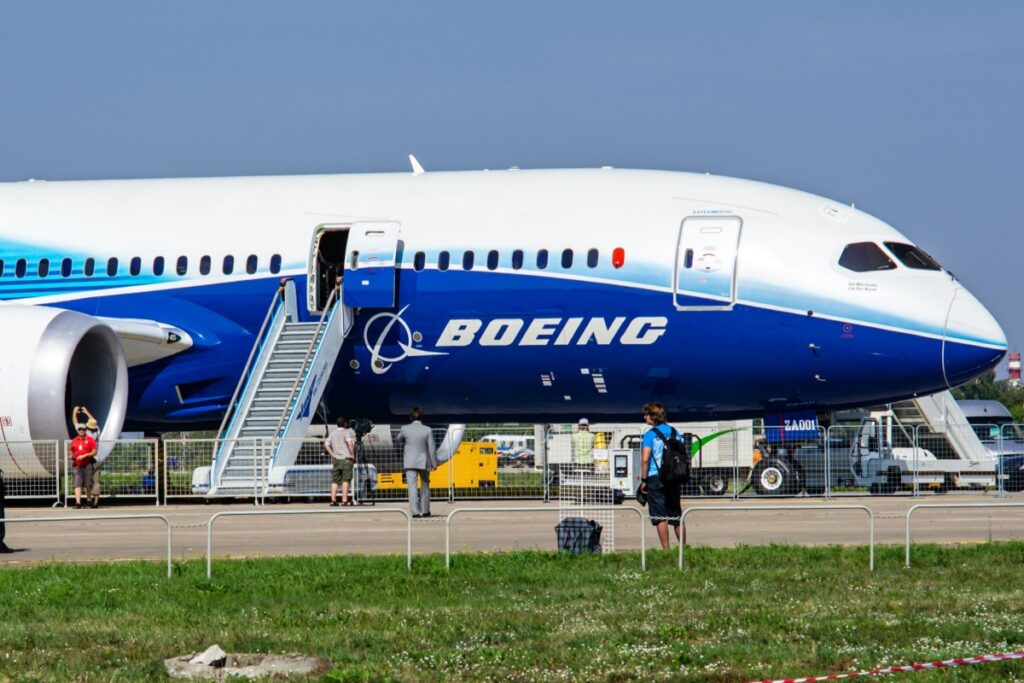
Boeing reported a sharp fourth-quarter rebound as commercial airplane deliveries accelerated, helping lift revenue and earnings after several years of disruptions. Revenue for the three months ended Dec. 31, 2025, rose to $23.95 billion, up from $15.24 billion a year earlier and ahead of the $22.6 billion expected by analysts surveyed by FactSet.
The company said it delivered 160 commercial aircraft during the quarter, more than doubling the 57 deliveries recorded in the same period the prior year. The delivery pace marked its strongest quarter for commercial handovers since 2018, an important milestone for a manufacturer that depends on completed deliveries for cash receipts tied to aircraft purchase contracts.
In a statement accompanying the results, CEO Kelly Ortberg said: “We made significant progress on our recovery in 2025 and have set the foundation to keep our momentum going in the year ahead.” The update lands amid continued scrutiny of production quality and safety oversight, particularly around the 737 Max program, which has remained central to Boeing’s turnaround efforts.
Profit Rebound Boosted by Major One-Time Gain
Boeing reported quarterly net income of $8.13 billion, or $10.23 per share, compared with a loss of $3.92 billion, or $5.46 per share, in the year-earlier quarter. On an adjusted basis that excludes certain items, the company said earnings were $9.92 per share, far above Wall Street expectations for a $0.44 per-share loss.
A key driver of the headline profit was a sizable accounting gain tied to a divestiture. Boeing recorded a $9.67 billion gain related to closing the sale of portions of its Digital Aviation Solutions business. The assets sold included aviation software and data products such as Jeppesen, ForeFlight, AerData, and OzRunways, in a transaction valued at about $10.55 billion with private-equity firm Thoma Bravo, according to Boeing’s prior disclosures.
The quarter’s performance also reflected the impact of Boeing’s broader effort to stabilize its manufacturing system—work that investors and regulators have watched closely as the company seeks to restore consistency across its commercial production lines and deliver aircraft from a large backlog.
Legal Case and FAA Oversight Remain Central to Recovery
Boeing’s turnaround continues to unfold against the backdrop of the 737 Max crisis, which intensified after two fatal crashes in 2018 and 2019 that killed 346 people. In November 2025, a federal judge in Texas approved the U.S. government’s request to dismiss a criminal conspiracy charge tied to those crashes, removing a major legal overhang.
Under the associated agreement cited in public summaries, Boeing committed roughly $1.1 billion (reported elsewhere as $1.14 billion) toward penalties, compensation connected to victims’ families, and internal safety and quality measures. The arrangement also allowed Boeing to use a compliance consultant rather than being overseen by an independent monitor.
Separately, Boeing has faced intensified regulatory oversight after a January 2024 incident in which a door plug failed on an Alaska Airlines 737 Max 9, prompting renewed concerns about manufacturing controls. The Federal Aviation Administration (FAA) later increased Boeing’s monthly 737 Max production limit to 42 aircraft from 38, following additional reviews.
Orders, Production Cadence, and Competitive Pressure
The delivery rebound comes as Boeing works to rebuild output while competing with Airbus in an industry constrained by supply-chain bottlenecks and certification timelines. Recent reporting on Boeing’s results also pointed to strengthening demand signals, including a large volume of gross orders during 2025, alongside a focus on improving free cash flow consistency.
For Boeing, the near-term challenge is sustaining delivery momentum within FAA oversight while reducing rework and disruptions that can delay handovers. The company’s results underscore how sensitive its financial performance remains to production stability: when deliveries rise, revenue and cash generation typically improve, while disruptions can quickly compress margins and push results off course.
Boeing’s executives have framed the latest quarter as evidence of operational traction, but the company still must maintain quality performance and regulatory confidence as it attempts to increase output and meet airline demand, especially for the 737 Max, which remains the backbone of its commercial portfolio.
