


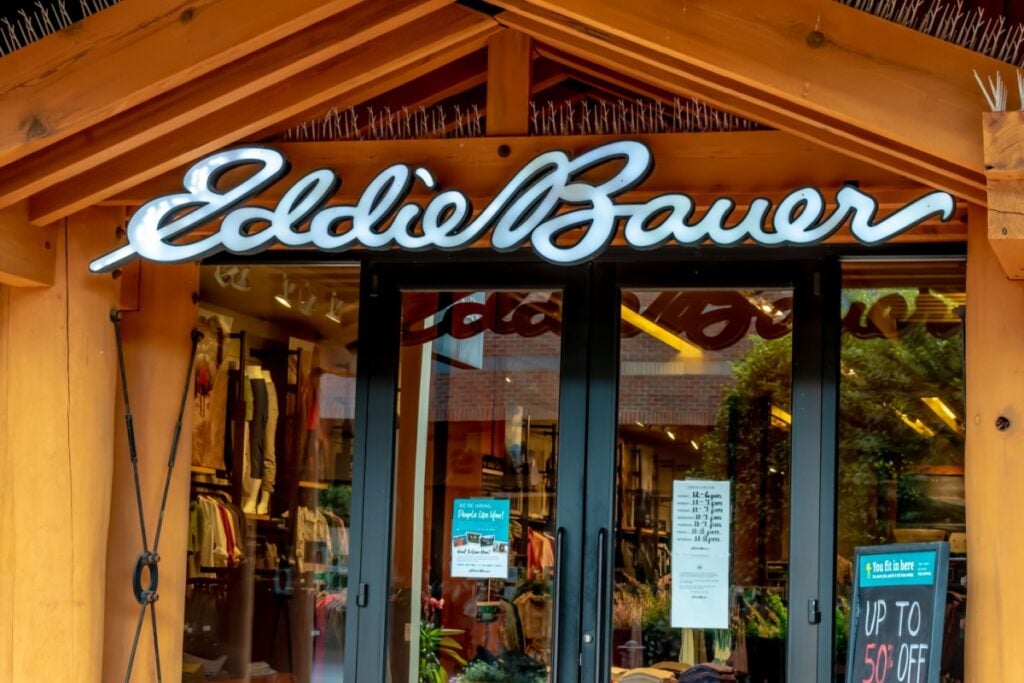
The company that runs Eddie Bauer’s North American stores has filed for Chapter 11 bankruptcy protection, setting up a court-supervised process that could lead to a sale of the business or, failing that, a broader shutdown of its U.S. and Canadian retail operations. The filing was made in federal bankruptcy court in New Jersey, and the operator said it has reached a restructuring agreement with secured lenders as it begins the proceedings.
Under the retailer’s plan, most Eddie Bauer retail and outlet locations in the U.S. and Canada are expected to remain open in the near term, even as some stores begin winding down. The company said it will pursue a sale of all or part of its North American store-operations business while conducting liquidation activities at stores during the process. If a buyer does not emerge, the operator said it may proceed with a full wind-down of its U.S. and Canadian retail footprint.
In a statement, Marc Rosen, chief executive of Catalyst Brands, said the decision followed a prolonged decline in sales and other operational strains, and that the restructuring path was intended to maximize value for stakeholders while preserving liquidity at the parent company.
What Stays Open And What Does Not
The bankruptcy filing applies to the entity operating roughly 180 Eddie Bauer stores across the U.S. and Canada, with reports indicating nearly 200 North American locations may be affected bythe court process.
Notably, the operator said several parts of the broader Eddie Bauer business are outside the Chapter 11 case. Stores located outside the U.S. and Canada are run by other licensees and are not included in the filing. In addition, the brand’s e-commerce and wholesale activities are not part of the wind-down plan because those operations are handled by Outdoor 5, LLC, following a licensing transition described as effective in early February.
The financial snapshot disclosed in the court documents indicates a large and complex creditor base. The operator reported more than 100,000 creditors, with estimated assets in the range of $100 to $500 million and estimated liabilities between $1 billion and $10 billion.
Ownership, Licensing, And Brand History
While the North American store operator is in Chapter 11, the Eddie Bauer name itself sits within a licensing model. Authentic Brands Group owns the brand’s intellectual property and indicated it may license the label to other operators in the future, depending on how the restructuring and any sale process unfold.
The filing also extends a long arc of financial distress for a label that dates back more than a century. Eddie Bauer began in Seattle in 1920 and became known for technical outerwear and outdoor gear, including early innovations in down apparel. The current filing marks the brand’s third bankruptcy-related proceeding in just over two decades, following restructurings tied to earlier corporate owners and a separate Chapter 11 process in 2009.
The retail operator is tied to Catalyst Brands, a company created in January 2025 when JCPenney and SPARC Group combined operations under a single organization.
Retail Pressures And The Bankruptcy Landscape
The operator attributed its deteriorating position to a mix of company-specific weaknesses and broader pressures affecting the apparel and mall-based retail sectors. Rosen pointed to higher operating costs driven by inflation, ongoing supply chain challenges, and uncertainty tied to tariffs as factors that intensified challenges over the past year.
The bankruptcy comes amid continued reshaping of U.S. retail, as chains close underperforming locations and, in some cases, reorganize under court protection. Business Insider has tracked hundreds of planned store closures across 2026 among retailers and restaurant operators, reflecting a sustained shift toward leaner footprints and greater emphasis on digital sales.
For Eddie Bauer shoppers and landlords, the immediate implications hinge on the court-supervised sale effort. A successful buyer could keep at least part of the store network operating, while an unsuccessful process would likely accelerate closures across the chain’s U.S. and Canadian locations, even as international stores and separate online/wholesale channels continue under different operators.
