


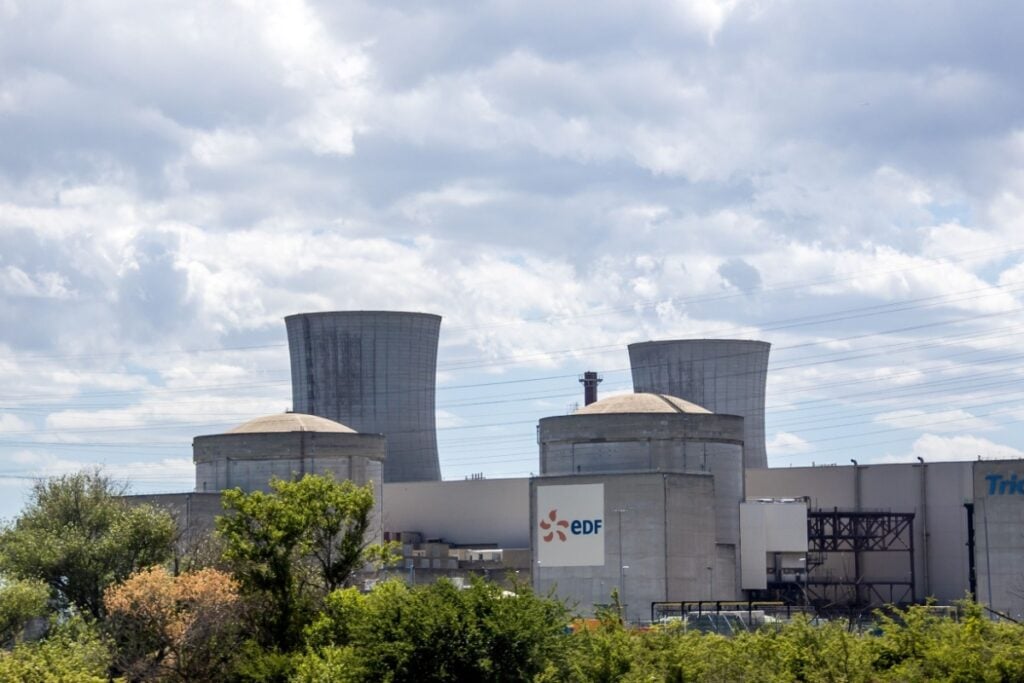
France’s state-owned utility EDF said it will cap the cost of building six new nuclear reactors at 72.8 billion euros, a sharp rise from the 51.7 billion euros referenced when the plan was announced in 2022. The ceiling is stated in 2020 values, and EDF said it intends to improve both cost discipline and construction speed as the project moves toward an investment decision.
The proposed reactors are expected to deliver around 10 gigawatts of capacity in total, helping to replace older facilities while underpinning future supplies. France generates about 70% of its electricity from nuclear power, and EDF has argued that additional output will be needed as electrification expands.
EDF said a final investment decision is planned by the end of 2026, with the first new reactor targeted to be commissioned in 2038.
Funding Structure And Government Support
The revised figure arrives as EDF balances large investment needs with financial constraints. Reuters said the utility has accumulated heavy debt since the programme was announced, and that weak power consumption has weighed on wholesale prices and the company’s profit.
On the public side, France is also trying to rein in its finances. Reuters noted that the cost revision comes as the country struggles to reduce a large public sector budget deficit, adding sensitivity to how new nuclear construction is funded.
EDF outlined a financing approach that relies heavily on the state. The utility said it expects a subsidised loan to cover about 60% of construction costs, and that contracts for difference on the electricity produced would be used to reimburse the loan over time.
Cutting Costs With Replication And Faster Build Times
EDF framed the programme as an attempt to standardise delivery after years of setbacks in Western Europe. Reuters reported that EDF’s most recently completed reactor project at Flamanville cost 23.7 billion euros and suffered long delays, making it a frequent reference point in debates over execution risk.
Even at the higher headline number, EDF argued that the implied unit cost is lower than the burden created by one-off builds. Reuters reported that the revised programme budget would still put the cost per reactor far below Flamanville, which became the symbol of escalating costs in French nuclear construction.
For the six-reactor programme, EDF executives said the company intends to benefit from “replication” by constructing reactors in a series rather than as stand-alone projects. Xavier Gruz, executive director in charge of new nuclear projects, said EDF expects the serial approach to reduce costs by around 30% by the time the sixth reactor is completed.
EDF also set a target construction duration of 70 months as the programme matures. Reuters reported that EDF is looking to results in China, which it described as a reference for reactor production, and is aiming for faster timelines as teams repeat the same design across sites.
Gruz said EDF is aiming to shorten the timeline by almost three years between the first unit planned at Penly and the sixth unit planned at Bugey, reflecting expectations of smoother execution once designs, suppliers, and on-site methods are repeated.
Demand Outlook And A Tested National Strategy
EDF linked its long-term demand assumptions to structural changes in power use. Gruz said the company expects electricity consumption to “strongly increase” by the time the reactors are completed, pointing to demand growth from data centres among other drivers.
The higher cap also intersects with prior warnings about readiness. In January, Reuters reported that France’s Court of Auditors said the country was “far from ready” to deliver the six-reactor programme, highlighting uncertainties around financing, industrial preparation, and execution risk; that report referenced an updated estimate of 67.4 billion euros (in 2020 euros) for the first six units.
EDF’s new ceiling sets a clearer benchmark ahead of the end-2026 investment decision. The next phase will involve finalising site and design work, securing financing terms consistent with European rules, and translating a replication strategy into contracts, workforce planning, and a supply chain capable of delivering multiple large projects on a predictable cadence.
