


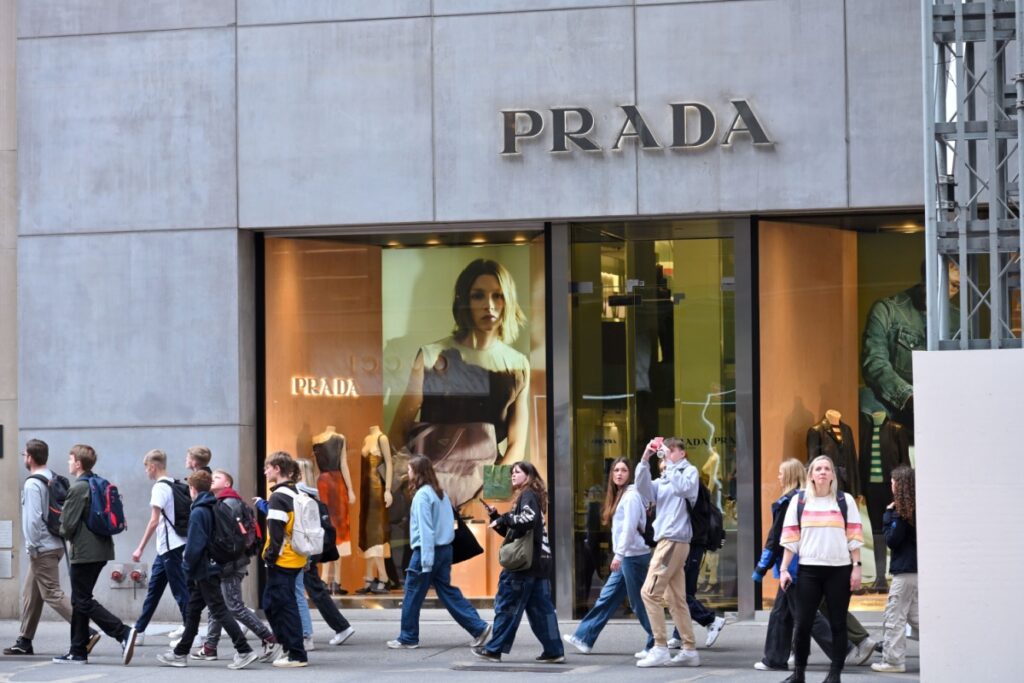
The Prada Group has completed its acquisition of Versace in a cash deal worth about $1.375 billion, bringing one of Italy’s most flamboyant fashion houses under the same umbrella as Prada’s more restrained aesthetic and its younger label Miu Miu. The transaction, finalized after regulatory clearances in major markets, ends Versace’s six-year spell under Capri Holdings and ranks among the most closely watched shake-ups in European luxury fashion in 2025.
In a brief statement, Prada confirmed that the purchase had closed, while Capri Holdings, which also owns Michael Kors and Jimmy Choo, said it will use the proceeds primarily to pay down debt. The aim on Prada’s side is to revive Versace, whose post-pandemic performance has been solid but less dynamic than some rivals despite its powerful global name recognition. On Instagram, Donatella Versace marked both the deal and the birthday of her late brother and founder Gianni Versace, telling followers that he would have smiled to see the house join the Prada family, underscoring the emotional weight of the change in ownership.
Versace Leadership And Brand Revival Plans
Versace’s next chapter will be guided by Lorenzo Bertelli, heir to the Prada empire, who takes on the role of executive chairman while retaining his positions as group marketing director and sustainability chief at Prada. Bertelli has indicated that he does not plan an immediate shake-up of Versace’s internal leadership, but he has also acknowledged that the brand, despite being among the world’s most recognizable labels, has not fully converted its visibility into sustained market outperformance.
Analysts say the combination of Prada’s minimalist style with Versace’s maximalist, logo-driven identity could be mutually beneficial, allowing each label to address different segments of the luxury market without directly competing. Research firm Bernstein has pointed to “significant” untapped growth potential at Versace if the house can be repositioned in a way that feels relevant again to younger, internationally mobile shoppers who in recent years have gravitated toward quieter branding and subtler logos.
The creative relaunch is already underway. Versace’s new designer Dario Vitale, formerly head of design at Miu Miu, presented his first collection for the brand during Milan Fashion Week in September. The show, built around strong color and 1980s-inspired silhouettes, drew mixed critical reviews but stronger interest from buyers, who saw commercial promise in the pieces. Executives have stressed that Vitale’s appointment predated the takeover and was part of a broader effort to refresh the house’s image while preserving its bold visual language.
Financial Stakes For Prada And Capri
For Capri Holdings, the sale represents an exit from an asset it bought for roughly $2 billion in 2018, when the group was betting heavily on high-visibility logos and aggressive global expansion. In recent seasons, that approach has been challenged by the rise of so-called “quiet luxury,” as wealthier consumers shift toward more discreet branding and craftsmanship after a period of steep price increases across the sector.
Capri has said Versace accounted for about 20% of its 2024 revenue of 5.2 billion euros. On Prada’s projections, Versace is expected to contribute around 13% of the Prada Group’s pro-forma revenues, compared with roughly 64% from the core Prada label and 22% from Miu Miu. Overall, the group reported a 17% rise in annual revenue to about 5.4 billion euros, giving it the financial capacity to invest in Versace’s turnaround while continuing to support its other brands and store network.
The acquisition comes as global demand for high-end goods has become more uneven. Studies cited by industry observers show some upper-income shoppers pulling back after repeated price hikes, forcing brands to focus more on iconic products, selective store openings and stronger digital engagement rather than pure volume growth. In that environment, Prada is effectively waging that Versace’s powerful name recognition can be translated into durable growth if the brand is repositioned carefully within a larger luxury portfolio.
Manufacturing Network And Jobs In Italy
A central element of Prada’s strategy is to integrate Versace into its predominantly Italian production network, which the group promotes as a guarantee of quality and traceability. At its leather-goods factory in Scandicci, near Florence, workers currently produce bags for Prada and Miu Miu; production lines there are being prepared to add Versace accessories as well. Managers argue that the same technical know-how and artisan skills can serve multiple labels even when their aesthetics differ sharply.
Prada’s in-house academy, operating for about 25 years, trains artisans in regions including Tuscany, Marche, Veneto and Umbria. The company says the school has prepared roughly 570 leather-goods specialists, hiring about 70% of the 120 trainees who completed the program last year. In 2025, the number of trainees rose by around 28% to 152, reflecting plans to expand capacity as Versace is integrated. To support that growth, the Prada Group has invested about 60 million euros in its supply chain this year alone, including a new leather-goods facility near Siena, a knitwear plant close to Perugia, increased production at its Church’s footwear operations in the United Kingdom, and expansion of another factory in Tuscany, on top of roughly 200 million euros in supply-chain investments between 2019 and 2024.
