


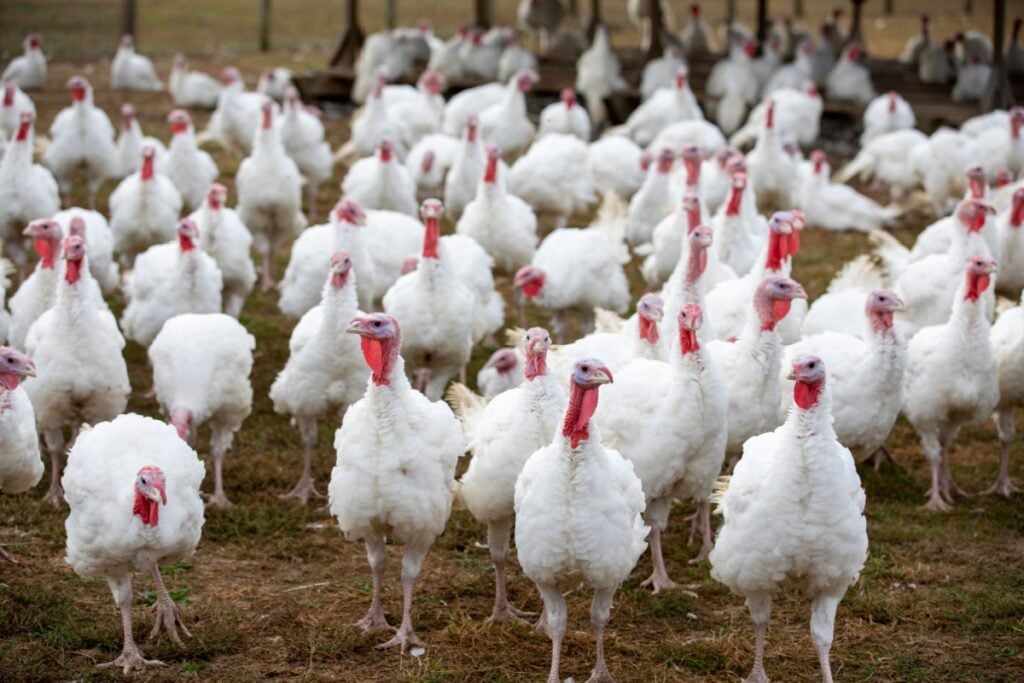
At Old Brick Farm in Chelsea, Michigan, farmer Larry Doll has watched a national disease crisis unfold while his own barns stayed healthy. His family’s operation, founded in 1864, escaped recent waves of highly pathogenic bird flu and avian metapneumovirus that have swept through U.S. flocks, killing more than 2 million turkeys in the past three months and pushing the national turkey population to a 40-year low.
The impact still reached him indirectly. The hatchery that supplies his chicks had fewer birds available, forcing Doll to plan further ahead and place orders early. He expects to bring in another 100 hatchlings that will not arrive until July, a reminder that rebuilding production after disease outbreaks takes time.
Food economists say that squeeze on farms is reflected in wholesale markets. Michigan State University expert David Ortega estimates that wholesale turkey prices are roughly 40% higher than a year ago, even as retailers try to shield shoppers from the full impact.
Discounted Birds, Costly Side Dishes
Government figures suggest wholesale prices for turkeys will climb about 44% this year, according to the U.S. Department of Agriculture. Yet many major chains are offering discounted turkeys as loss leaders to attract customers and ease pressure on Thanksgiving budgets.
The relief on the main course is not always matched elsewhere in the cart. Market-research firm Datasembly priced a basket of 11 Thanksgiving staples – including a 10-pound frozen turkey, 10 Russet potatoes, stuffing mix and canned corn, green beans and cranberry sauce – at $58.81 as of November 17, up 4.1% from last year. Its data show the retail price of a 10-pound turkey down about 2%, highlighting how supermarkets are cutting margins on the bird while side dishes carry more of the inflation burden.
Other surveys reach slightly different totals but tell a similar story. The American Farm Bureau Federation estimates that a classic Thanksgiving meal for 10 people averages a little over $55 this year, about 5% cheaper than in 2024.
Supermarket Promotions And Wholesale Pressures
To keep price-sensitive shoppers from trading down or skipping holiday extras, retailers are leaning on bundled offers. Discount grocer Aldi is promoting a $40 Thanksgiving package designed to feed 10 people with 21 items, and Kroger says its store-brand spread can serve a similar-sized group for under $50.
A separate Walmart bundle, advertised at about $4 per person and praised by former President Donald Trump as 25% cheaper than a year ago, illustrates how chains use selective pricing to stand out. Analysts note that Walmart cut the number of products and changed the basket’s contents, so the savings largely reflect a different mix rather than broad declines in food costs.
Behind the promotions, wholesale prices have jumped sharply. Market analyst Mark Jordan of Leap Market Analytics estimates that in the second week of November, frozen hens weighing 8 to 16 pounds averaged about $1.77 per pound, an 81% increase from the same period in 2024. Disease losses are a major factor, but demand has also shifted as shoppers move away from more expensive beef, which was roughly 14% pricier in September than a year earlier.
Tariffs, Weather And Small-Farm Economics
Beyond the barnyard, tariffs and weather are shaping what ends up on Thanksgiving tables. Economists say U.S. tariffs on imported steel and aluminum have lifted the cost of metal cans, contributing to higher prices for canned goods. In Datasembly’s basket, jellied cranberry sauce is almost 38% more expensive than a year ago. At the same time, U.S. cranberry production is expected to be down about 9% in 2025, after drought in Massachusetts damaged some crops.
Pumpkins tell a different story. In Illinois, where much of the nation’s canning pumpkins are grown, relatively dry weather limited moisture-related diseases. A 30-ounce can of pumpkin pie mix now averages about 5% less than last year, offering a rare price break for bakers.
For Doll, the economics look different from those in the supermarket aisles. This year he raised 92 turkeys and says every bird has already been sold at about $6.50 per pound. Regular customers tell him they are willing to pay a premium for birds raised on pasture and processed by a local butcher, seeing them as the central feature of a once-a-year celebration. The sales bring Doll a modest profit and the assurance that, even in a difficult year for poultry producers, his flock will anchor dozens of Thanksgiving tables.
