


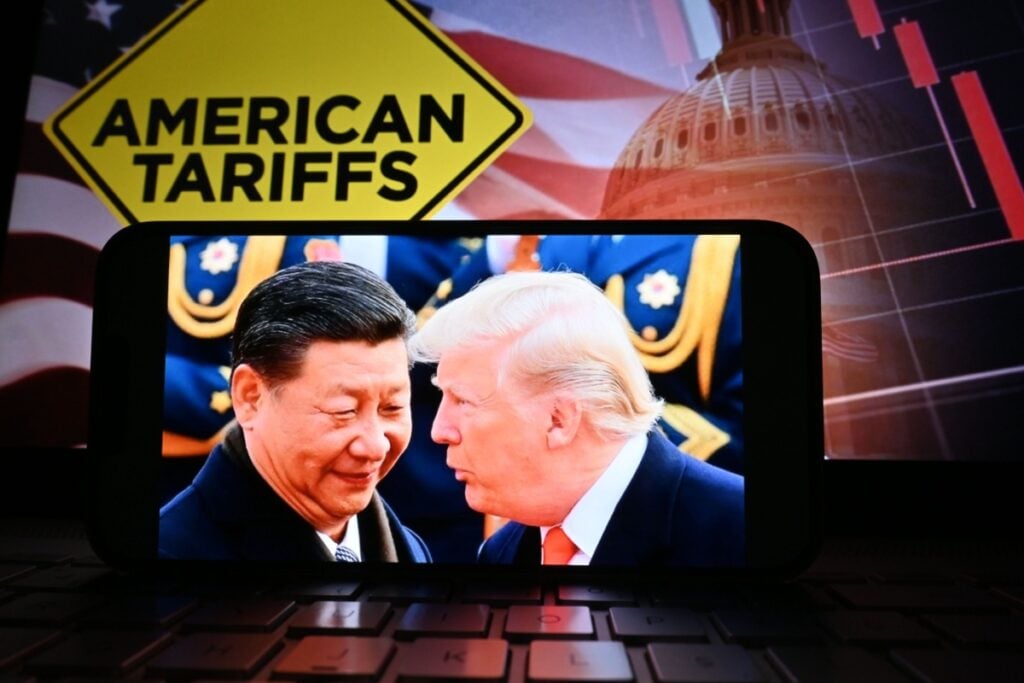
Senior U.S. and Chinese officials ended high-level trade talks in Paris with a public display of caution rather than a breakthrough. China’s lead trade representative, Li Chenggang, said Beijing had raised serious concerns about new U.S. tariff moves and related trade investigations, warning that further action could undermine the more stable commercial relationship the two sides have recently tried to restore.
The meeting came as both governments worked to manage tensions that had earlier pushed tariffs to triple-digit levels before they agreed to a one-year truce.
The discussions were also designed to prepare for a possible visit by President Donald Trump to China in roughly two weeks. That trip, if it goes ahead, would mark the first visit to China by a sitting U.S. president since Trump traveled there during his first term in 2017. While Chinese officials did not address the status of the visit directly, the timing gave the Paris talks added weight for businesses watching the future of bilateral trade.
China Pushes Back on New U.S. Measures
Beijing’s message after the talks focused on uncertainty created by Washington’s shifting tariff tools. Li said China was worried that U.S. investigations into manufacturing in other countries could lead to measures that interfere with what he described as hard-won economic stability between the world’s two largest economies. He added that both tariff and non-tariff barriers were discussed, and said the two sides agreed to try to keep those measures stable.
The U.S. side has been adjusting its trade approach after the U.S. Supreme Court struck down earlier tariffs, prompting the Trump administration to explore new mechanisms. That legal and policy shift has become a central concern for China, which is trying to gauge how far the White House may go in reshaping import restrictions. For companies with supply chains tied to both markets, the immediate issue is not only whether tariffs rise again, but whether policy changes become harder to predict.
Washington Signals Work Plan, Not Breakthrough
Treasury Secretary Scott Bessent, who led the American delegation, described the Paris exchanges as constructive and said they reflected a degree of stability in the relationship. He said the purpose of the meetings was to avoid retaliation, suggesting that both governments are trying to contain escalation even as underlying disputes remain unresolved.
U.S. Trade Representative Jamieson Greer said the sides outlined the broad terms of a work plan for a future Trump-Xi Jinping meeting, with the goal of producing potential deliverables. He also said U.S. officials briefed their Chinese counterparts on how Washington is adapting trade policy after the Supreme Court ruling. Greer emphasized that the administration’s trade objectives have not changed, even if the legal tools used to pursue them may now look different.
That combination of continuity and adjustment is likely to matter in boardrooms as much as in diplomatic circles. A stable negotiating channel may reduce the risk of sudden retaliation, but the absence of a concrete deal leaves exporters, manufacturers, and investors facing continued uncertainty over future costs, market access, and compliance requirements. This is especially significant in sectors already exposed to policy-sensitive sourcing decisions and politically driven trade reviews.
Iran Conflict Adds Pressure to Economic Agenda
The wider geopolitical backdrop has complicated the trade track. AP reported that the Iran war has emerged as a possible obstacle just as Washington and Beijing were trying to repair ties after their tariff battle. Trump has suggested that a trip to China could be delayed while he seeks Beijing’s help in reopening the Strait of Hormuz and easing pressure on oil prices, which have risen during the conflict.
Bessent, however, said that any postponement would not be tied to pressure on China over Hormuz. He told reporters that a delay, if it happens, would instead reflect the judgment that the U.S. president should remain at home while the war continues. Even so, the overlap between trade diplomacy and energy-security concerns has deepened the business stakes of the relationship.
For global markets, the Paris talks underscored a familiar pattern: commercial negotiations between the United States and China are no longer shaped solely by tariffs, but increasingly by legal rulings, strategic rivalry, and external shocks that can quickly alter the agenda.
