


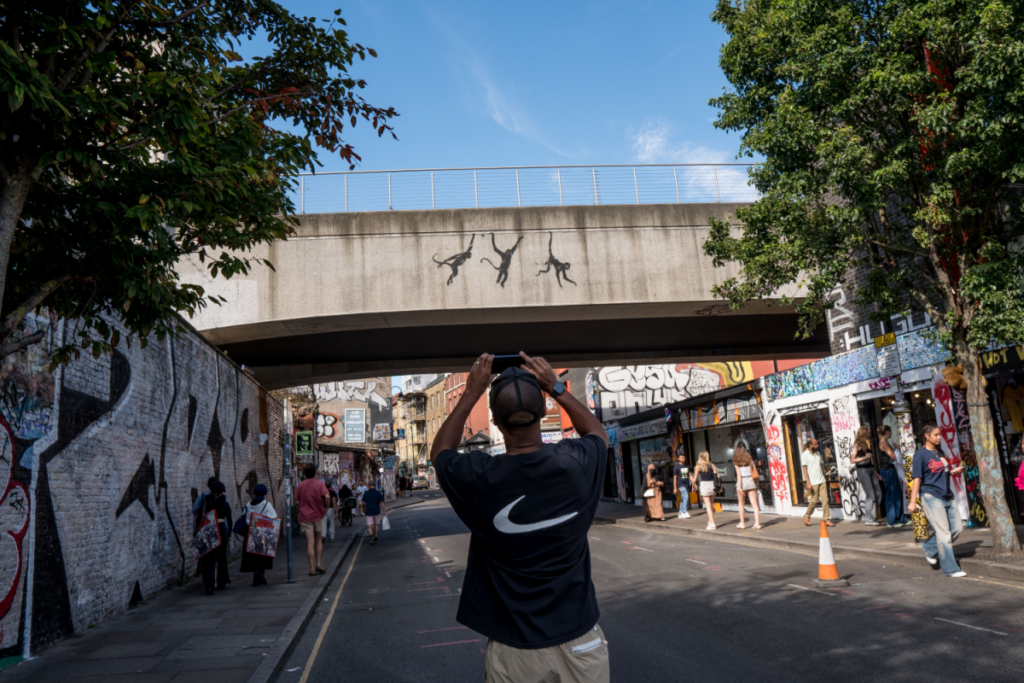
Murals Appear in West and Central London
Elusive street artist Banksy has confirmed responsibility for a new mural that appeared in Bayswater, west London, depicting two children lying on the ground and pointing toward the sky. The black and white artwork is painted above a row of garages on Queen’s Mews and shows the children dressed for winter in coats, wellington boots and knitted hats. One child gestures upward while the other looks on, creating a quiet, contemplative scene.
The artist confirmed the work by posting an image of the mural on his Instagram account, his usual method of authenticating new pieces. While Banksy’s representatives have officially confirmed only the Bayswater mural, an identical image appeared shortly beforehand near the Centre Point building in central London. Although unconfirmed by the artist himself, multiple observers and art specialists believe both works are by the same hand and were created as part of a coordinated statement.
The appearance of two nearly identical murals is notable, as Banksy rarely repeats imagery in different locations. The choice of understated black and white tones and the absence of any text place emphasis on the figures themselves rather than on overt political messaging.
Interpreting the Imagery and Locations
Artists and commentators have suggested the murals are intended as a reflection on child homelessness and social invisibility. The Centre Point location in particular carries historical significance. Once left vacant for years after its construction, the tower became a symbol of housing inequality and later inspired the name of the homelessness charity Centrepoint. Today, the building has been converted into luxury apartments, adding further layers of contrast to the mural’s message.
Artist Daniel Lloyd Morgan said the imagery of children gazing upward evokes themes of hope and neglect at the same time. According to him, passersby often walk past both the artwork and people sleeping rough without stopping, mirroring the way social problems can be overlooked in busy urban environments. The children’s upward gaze has also been likened to stargazing, with some viewers interpreting it as a reference to guidance or longing during the winter season.
Banksy has not publicly commented on the intended meaning of the murals or the choice of locations. As with much of his work, the ambiguity appears deliberate, inviting interpretation rather than providing clear answers.
Public Reaction and Artistic Continuity
Local residents in Bayswater quickly gathered to view the mural after word spread that Banksy was responsible. Some described a sense of excitement at discovering internationally known street art in a quiet residential area, while others focused on the emotional tone of the image. The calm posture of the children contrasts with the often confrontational style seen in some of the artist’s past political works.
Banksy enthusiast Jason Tomkins noted that one of the children closely resembles a figure from the artist’s earlier mural Season’s Greetings, which appeared in Port Talbot several years ago. The reuse of a similar character is unusual and has led to speculation that the artist is intentionally creating a loose visual thread connecting different works addressing social hardship.
The central London mural near Centre Point drew less immediate attention from pedestrians, a detail some observers found telling. According to witnesses, many people passed by without stopping, reinforcing interpretations that the piece comments on how society overlooks vulnerable groups, especially in crowded city spaces.
Context Within Banksy’s Recent Work
The new murals follow a series of recent London works that have focused on protest, justice and marginalised voices. One earlier piece depicted a protester lying on the ground beneath a looming judge, an image that was later removed. More recently, Banksy created a trail of animal themed artworks across the capital, drawing large crowds and widespread media attention.
Compared with those highly visible interventions, the Bayswater and Centre Point murals are quieter and more introspective. They rely less on shock and more on atmosphere, suggesting a shift toward subtler storytelling. The decision to place the children at ground level, lying flat and looking upward, reinforces a sense of vulnerability while also implying the possibility of hope beyond their immediate surroundings.
As with many Banksy works, questions remain about how long the murals will survive before being removed, defaced or protected. For now, they stand as another example of how street art continues to provoke reflection on social issues within everyday urban life.
