


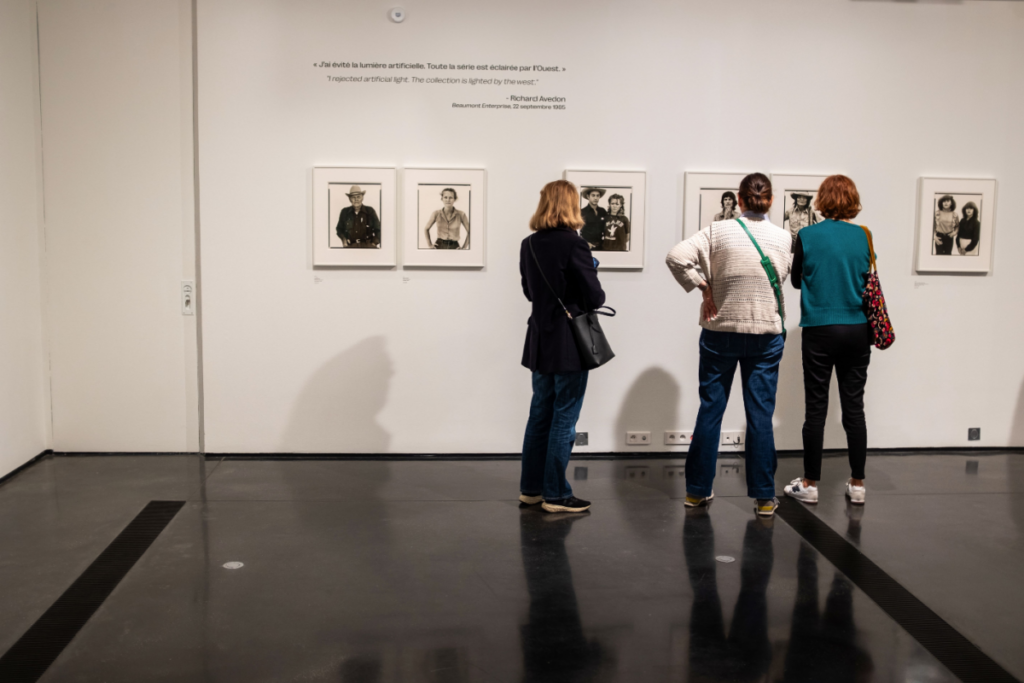
A Landmark Series Revisited Four Decades Later
In 1979, Richard Avedon left behind the world of fashion and celebrity portraiture and set out on a five year journey across the United States. Armed with a large format Deardorff camera and driving thousands of miles through Texas, Montana, New Mexico, North Dakota, Colorado, California and many other states, Avedon sought to document the people of regions he had never previously visited.
Rather than photographing movie stars like Marilyn Monroe or Audrey Hepburn, Avedon stopped at rodeos, county fairs, prisons and slaughterhouses, photographing miners, migrant workers, farmers, truck drivers and factory laborers. The result was In the American West, a body of work completed after more than one thousand sittings and first exhibited in 1985 at the Amon Carter Museum of American Art.
A New Generation’s Perspective
Four decades on, a selection of the original photographs has gone on display again, this time at Gagosian in London. The exhibition is curated by Avedon’s granddaughter, Caroline Avedon, marking her first solo curatorial project.
At 26, Caroline Avedon has deliberately shaped the show to resonate with younger audiences. Instead of focusing only on the most famous images from the series, she highlights portraits of children, teenagers and young adults, hoping viewers her own age can connect more directly with the subjects. She has described the project as an attempt to emphasize shared humanity across time, geography and class.
Debate and Lasting Relevance
When In the American West was first unveiled, it provoked controversy. Critics argued that Avedon’s stark white backgrounds stripped subjects of context and risked turning working class Americans into objects for elite consumption. Supporters countered that the simplicity of the setting forced viewers to confront individuals who were rarely represented in museums or galleries.
Today, many see the images as newly relevant. The portraits were created during a period of political upheaval that spanned the Carter and Reagan presidencies, yet they reflect economic precarity that continues to shape life in much of the American West. Caroline Avedon has said the exhibition underlines how little progress has been made in acknowledging the people whose labor sustains the country.
Personal Connections and Legacy
The curator has also spoken of her personal efforts to trace the lives of her grandfather’s subjects, discovering that many worked in dangerous conditions and have since died. Others, she has learned, are still alive, allowing her to connect the frozen moments in the photographs with real lives that extended far beyond the frame.
By revisiting In the American West in London, the exhibition reframes Avedon’s work not as a historical artifact, but as a living document. It invites a new generation to look closely at faces from America’s margins and to reflect on how their stories continue to echo in the present.
