


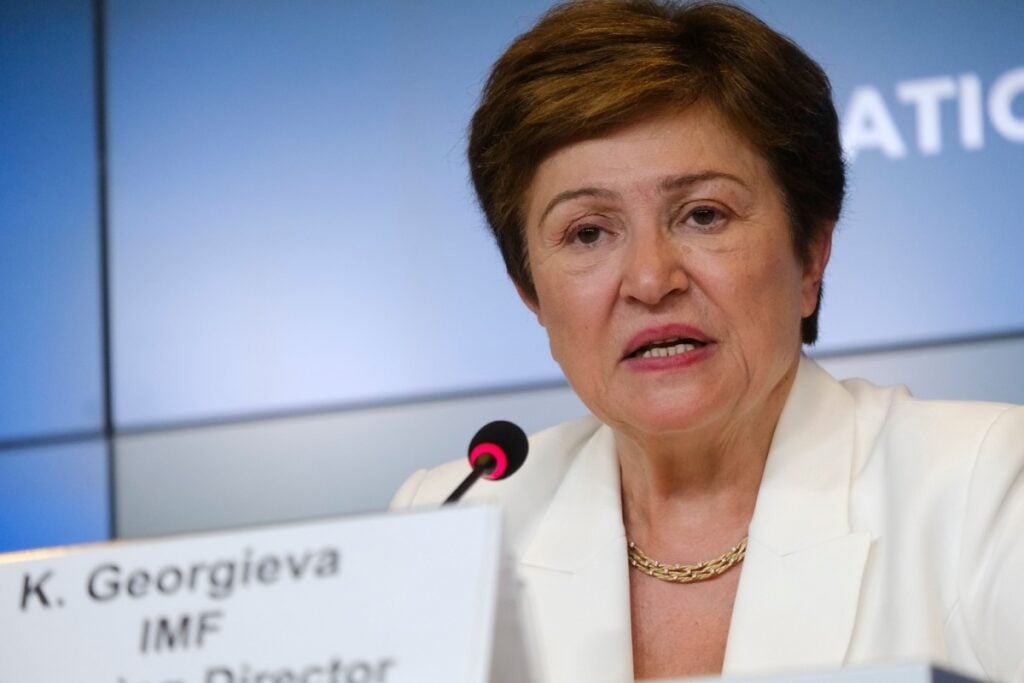
The International Monetary Fund (IMF) is urging China to tackle what it calls deepening economic “imbalances,” warning that a country of 1.4 billion people is now too large to lean on exports as its main engine of growth. After the Fund’s annual review of the Chinese economy, IMF Managing Director Kristalina Georgieva said Beijing’s record trade surplus and subdued domestic spending are feeding global tensions over trade and industrial policy.
China’s overall exports have continued to rise even as shipments to the United States have fallen in the wake of President Donald Trump’s sweeping tariff hikes on Chinese and other imports. Earlier this week, official data from Beijing showed that China’s trade surplus for 2025 had already surpassed $1 trillion, the first time it has crossed that threshold. Georgieva cautioned that such reliance on foreign demand is increasingly unsustainable and may attract tougher responses from trading partners, including fresh tariffs and other barriers.
The IMF argues that China’s “large domestic market” should instead be harnessed to drive growth, reducing the risk that clashes over trade and industrial subsidies spill over into broader economic or political conflict.
Domestic Weakness Behind Record Surplus
The IMF review links China’s swelling surplus not only to strong external demand, but also to weak domestic consumption and investment. Years of pandemic-related disruption and a prolonged slump in the property sector have eroded household confidence and cut into incomes, weighing on imports and pushing more of China’s output toward foreign markets.
At the same time, Beijing has encouraged rapid expansion in high-tech manufacturing, including electric vehicles, batteries and robotics, even as policymakers struggle to curb excess capacity in sectors such as automaking. Investment in these export-oriented industries, combined with subdued demand at home, has made it harder for China to absorb its own production. Morgan Stanley has estimated that China’s share of global exports could rise to 16.5% by 2030, up from about 15% today.
Soft domestic demand has also contributed to a weaker yuan, which has declined against the US dollar and other major currencies. A cheaper currency makes Chinese goods more competitive abroad, further reinforcing the trade surplus and widening the gap between what China produces and what it consumes.
Call For Structural Reforms And Stronger Safety Net
Georgieva said that comprehensive policy measures are needed to support Chinese households and encourage them to spend more. The IMF has long argued that strengthening the social safety net would reduce the need for precautionary savings and help rebalance the economy toward consumption.
The Fund’s latest assessment notes that China is still expanding at close to 5% a year, but stresses that the composition of growth matters as much as the headline rate. Shifting away from heavy investment in infrastructure and export-oriented manufacturing toward services and household spending, it says, would make growth more sustainable and less vulnerable to external shocks.
Chinese leaders have repeatedly signaled their intention to boost domestic demand. At a high-level meeting in October, the Communist Party highlighted the need to expand consumption and reduce the economy’s dependence on exports and large-scale construction, though the property downturn and uncertainty among consumers and private firms have slowed progress.
Global Reactions And Rising Trade Frictions
China’s growing surplus has drawn increasing criticism from its trading partners. As exports to the United States have declined, Chinese companies have stepped up sales to Africa, Latin America, Southeast Asia and Europe, prompting complaints from competitors that they are being undercut by subsidized production and an undervalued currency. The European Union Chamber of Commerce in China has warned that Beijing’s large surplus and limited import growth are fueling concern among European businesses and policymakers.
The IMF’s warning comes just after Premier Li Qiang told an international gathering of financial experts in Beijing that higher tariffs have already “dealt a severe blow” to the world economy. While the Fund acknowledges that tariff wars are weighing on global growth, it also stresses that China’s own policy choices will be crucial in determining whether trade tensions ease or intensify.
