


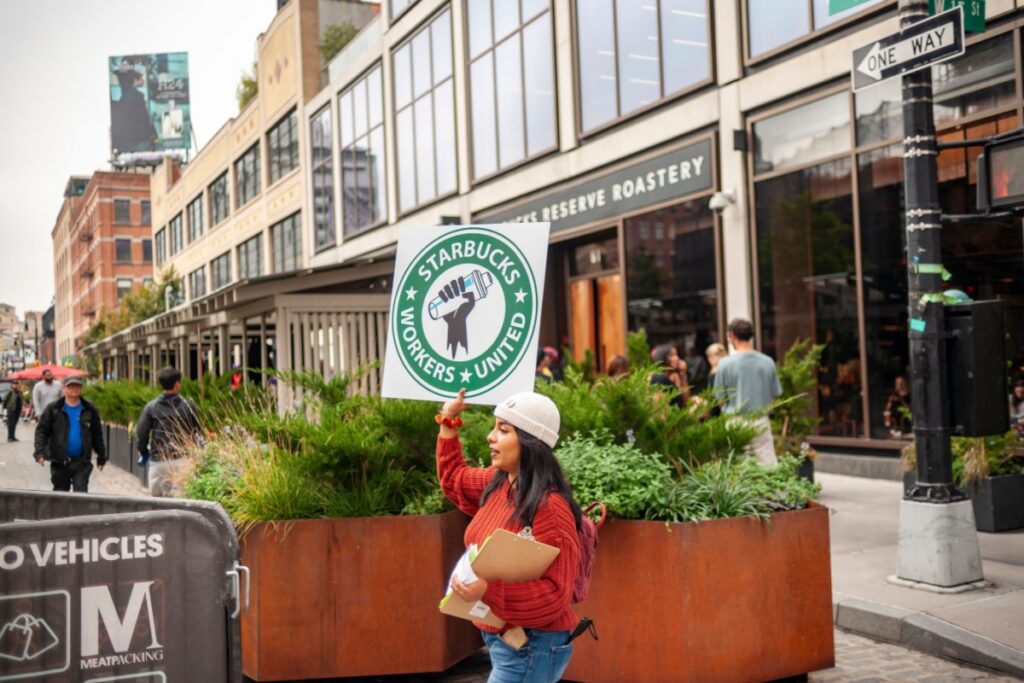
Starbucks has agreed to pay about $35 million to more than 15,000 current and former workers in New York City, resolving a multi-year investigation into claims that the company violated the city’s Fair Workweek scheduling rules. City officials said the deal is one of the largest worker-protection settlements in the city’s history and follows allegations that baristas were routinely denied predictable hours and had their shifts cut without notice.
Under the agreement with the city’s Department of Consumer and Worker Protection (DCWP), most hourly employees will receive $50 for every week they worked at a Starbucks store in New York between July 2021 and July 2024, provided they meet eligibility criteria. The settlement also sets aside $3.4 million in civil penalties and administrative costs, bringing the total financial package to roughly $38.9 million.
City investigators concluded that the company violated the law more than 500,000 times over a three-year period, according to the settlement documents. Officials framed the case as a warning to other large employers that failing to provide stable schedules can carry significant legal and financial consequences in New York.
Findings From The Fair Workweek Investigation
New York City’s Fair Workweek law, which took effect in 2017, requires fast-food employers to give workers predictable schedules, limit last-minute changes, and offer additional hours to existing staff before hiring new employees. The city’s probe into Starbucks began in 2022 after dozens of workers filed complaints, and it was eventually expanded to cover hundreds of locations across the five boroughs.
According to the city, investigators found that many baristas never received consistent schedules from week to week, making it difficult to arrange child care, attend school, or take a second job. The company was also accused of cutting scheduled hours without written consent and assigning shifts to new hires instead of offering them first to existing staff seeking more work. Some workers said they remained stuck in part-time roles despite wanting full-time hours.
As part of the settlement, Starbucks has agreed to comply with the Fair Workweek requirements going forward, including providing advance notice of schedules and paying premiums when changes occur outside the allowed time frames. The agreement also guarantees that employees who were laid off during certain recent store closures in New York will be given an opportunity to be reinstated at other company locations in the city.
Starbucks’ Response And Compliance Challenges
In statements responding to the deal, Starbucks said it supports the goals of the Fair Workweek law and is committed to following all applicable labor rules in cities where it operates. At the same time, the company argued that the New York statute is unusually complex and that even relatively small scheduling adjustments can trigger potential violations, such as when a worker calls out and another employee is asked to cover on short notice. Executives described this framework as “challenging to manage” in a busy, customer-facing business.
The company also highlighted its broader employment pitch, noting that more than 1 million people apply for jobs at Starbucks in a typical year and reiterating its claim that it offers some of the strongest benefits in retail, including tuition programs and health coverage for many part-time workers. The settlement, the company suggested, reflects an effort to resolve disagreements over how the law should be interpreted rather than an admission that it sought to undermine workers’ rights.
The payout comes as Starbucks continues to work through a period of uneven sales, restructuring costs and store redesigns. The company recently reported its first increase in U.S. same-store sales in nearly two years, but profits have been squeezed by higher operating expenses and strategic changes to its store base.
Linked To A Wider Labor Fight Over Scheduling And Unions
The announcement in New York coincided with an ongoing national strike by Starbucks Workers United, the union organizing baristas at the chain. The latest work stoppage, which started in November 2025, has involved more than 1,000 workers across dozens of U.S. cities and is part of a “No Contract, No Coffee” campaign pressing for a first national labor agreement.
Hours after the settlement was revealed, New York City mayor-elect Zohran Mamdani and U.S. Senator Bernie Sanders joined baristas and supporters on a picket line outside a Brooklyn store, underscoring how the dispute over scheduling and staffing has become a focal point for national labor advocates. Workers say they want more reliable hours, stronger staffing levels during rush periods and progress toward a contract nearly four years after the first successful union vote at a Buffalo, New York location in 2021. About 550 of Starbucks’ roughly 10,000 company-owned U.S. stores are now unionized.
New York’s Fair Workweek law was among the first in the United States to restrict “on-call” scheduling practices, and similar regulations have since been adopted in Oregon, San Francisco, Los Angeles, Chicago and other jurisdictions. Supporters argue that predictable timetables are essential for low-wage workers to maintain stable lives, while many business groups contend the rules are too rigid and could lead companies to reduce hiring. The scale of the Starbucks settlement is likely to intensify that debate as other cities consider tightening their own scheduling standards.
