


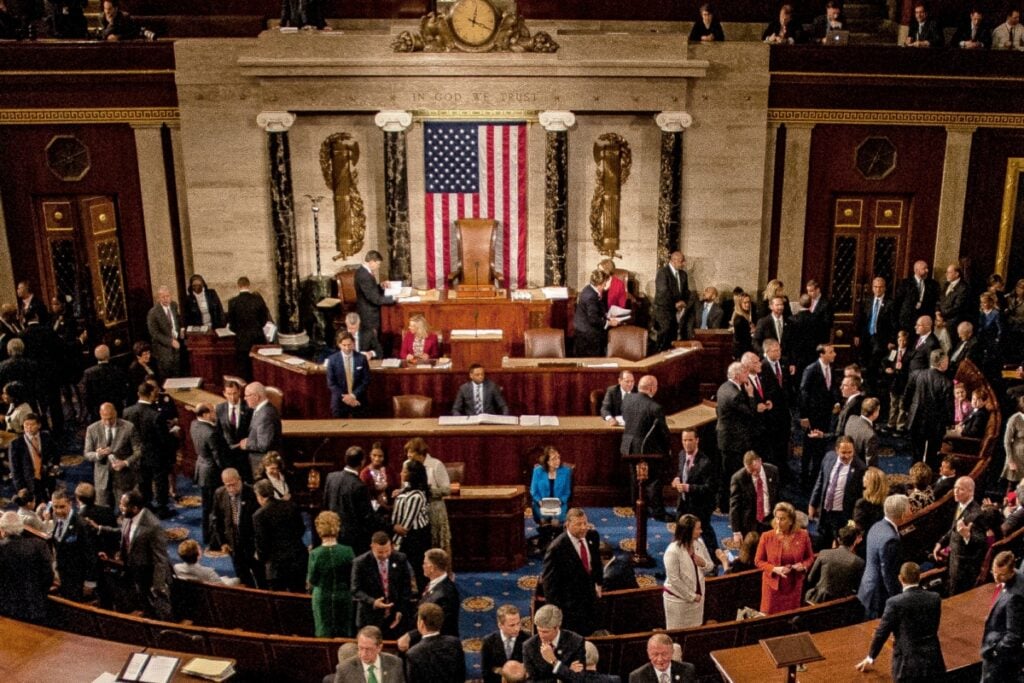
U.S. lawmakers are moving toward a rare war-powers confrontation with President Donald Trump after he authorized U.S. military action against Iran without a vote in Congress, setting up floor debates even as hostilities intensify. In one of the starkest tests of constitutional authority in years, members in both chambers are pressing for votes that would require congressional approval before the administration can continue or expand the campaign.
The fight is unfolding under unusual conditions: the military operation is already underway, and casualties have already been reported. The joint U.S.-Israel assault, also known as “Operation Epic Fury”, has involved sustained strikes and escalating threats, with at least four U.S. military personnel killed so far. Trump has warned publicly that “there will likely be more,” a message that has sharpened the stakes for lawmakers weighing whether to reassert Congress’s authority over war.
In the Senate, Sen. Tim Kaine of Virginia is among the leading voices demanding a swift vote, arguing the strikes risk pulling the U.S. into a deeper Middle East conflict. In the House, Rep. Ro Khanna of California and Rep. Thomas Massie of Kentucky, an unusual bipartisan pairing, have called for an immediate, public roll call on their own measure, framing the debate as a fundamental check on unilateral military action.
War Powers Tools Collide With Modern Military Reality
The U.S. Constitution assigns Congress the power to declare war, but modern conflicts have frequently expanded presidential latitude through limited strikes, long-running authorizations, or political reluctance to force a showdown. Congress has declared war five times, most recently in 1941. It has also passed authorizations for the use of military force (AUMFs), including in 1991 for the Gulf War and in 2001 and 2002 after the Sept. 11 attacks, yet those votes have been far rarer than the number of overseas operations undertaken in recent decades.
As a backstop, Congress created the War Powers Resolution in 1973, intended to prevent presidents from sustaining hostilities without lawmakers’ consent. The measures now headed for debate draw on that framework, with supporters describing them as an attempt to compel the administration to justify the Iran campaign, define objectives, and win explicit approval before committing the country to prolonged fighting.
Outside experts frame the moment as a governance test as much as a foreign-policy dispute. David Janovsky, acting director of The Constitution Project at the Project on Government Oversight, said the constitutional structure is designed to stop power from concentrating in one branch and stressed that elected representatives must weigh in on whether the country is going to war.
Republican Leaders Back Trump, While Dissent Spreads
Despite the push for a vote, the legislative path to restraining Trump remains narrow. Republicans control both chambers by slim margins, and many GOP leaders have praised the strikes, citing Iran’s nuclear ambitions and missile capabilities. Supportive comments from Sen. Lindsey Graham of South Carolina, who described the operation in laudatory terms, while other Republicans have argued military pressure is necessary to confront a longstanding adversary.
At the same time, the episode has exposed tensions inside the Republican coalition and among voters who expected a more restrained approach abroad. Massie criticized the campaign as inconsistent with Trump’s “America First” message, while Democrats have argued the administration has not adequately explained the legal basis, end state, or strategy for what comes next.
Even if a war-powers measure passes, its practical impact may be limited. A likely presidential veto would require a two-thirds vote in each chamber to override, an outcome unlikely in a closely divided Congress. In that sense, the debate may function less as an immediate brake on the operation and more as a public record of where lawmakers stand as the campaign continues.
Funding Leverage and Questions About the Campaign’s End State
Supporters of congressional restraint argue lawmakers still hold a potent lever: federal funding. John Yoo, a law professor at the University of California, Berkeley, told AP that Congress can stop a military campaign if it is willing to use the power of the purse, noting historical precedent for wars ending when lawmakers cut off funds.
But the political reality cuts the other way. Congress recently approved major Pentagon funding, about $175 billion, as part of a broader tax-cut package Trump signed, underscoring the degree to which the GOP majority is aligned with a more forceful approach toward Iran.
As debates begin, operational details and timelines remain contested. Sen. Tom Cotton, the Republican chair of the Senate Intelligence Committee, said Americans should expect an “extended air and naval campaign” rather than U.S. ground forces inside Iran, while acknowledging the risks of pilots being shot down and the uncertainty of what follows. “There’s no simple answer for what’s going to come next,” Cotton said.
Barriers to public scrutiny remain, too. White House briefings for congressional leaders are expected to be held behind closed doors, leaving lawmakers to argue over war powers and strategy while many operational details remain classified and the battlefield situation continues to evolve.
