


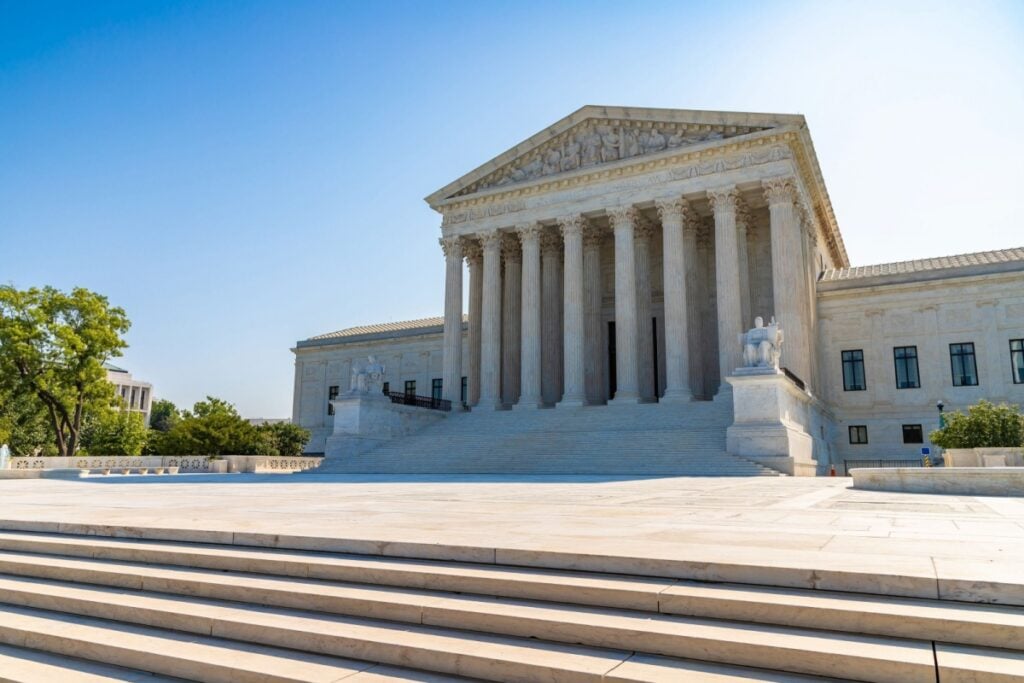
The United States Supreme Court is preparing to hear a landmark case that could redefine the scope of constitutional citizenship rights. At the center of the dispute is an executive order signed by President Donald Trump on January 20, 2025, seeking to restrict automatic citizenship for children born on U.S. soil to parents without permanent legal status.
The policy represents a significant departure from long-standing interpretations of the 14th Amendment, which has traditionally guaranteed citizenship to nearly all individuals born in the country. Legal challenges were swiftly filed after the order’s announcement, and lower federal courts have consistently blocked its implementation, finding it likely unconstitutional.
The Supreme Court agreed to review the issue as part of a consolidated case arising from multiple lawsuits, including a class action originating in New Hampshire. Oral arguments are scheduled as part of the court’s current term, with a decision expected later in 2026.
Constitutional Debate Over Citizenship Clause
At the core of the case lies the interpretation of the Citizenship Clause in the 14th Amendment, which states that all persons born in the United States and “subject to the jurisdiction thereof” are citizens.
The Trump administration argues that children born to undocumented migrants or temporary visa holders do not meet this jurisdiction requirement. Officials contend that the amendment was originally intended to address the status of formerly enslaved people, rather than to extend citizenship universally to all births within U.S. territory.
Opponents, including civil rights organizations and several states, maintain that this interpretation contradicts more than a century of legal precedent. They point in particular to the 1898 Supreme Court ruling in United States v. Wong Kim Ark, which affirmed that children born in the U.S. to noncitizen parents are entitled to citizenship, with limited exceptions such as children of foreign diplomats.
Legal scholars note that the case could hinge on whether the Court adheres to this established precedent or adopts a narrower reading of constitutional language.
Human Impact and Scope of the Case
The potential consequences of the ruling extend far beyond legal theory. Analysts estimate that more than 250,000 children born in the United States each year could be affected if the policy were upheld.
Families currently living in the country under temporary or undocumented status face particular uncertainty. Some parents have expressed concern that their children’s citizenship status could be altered retroactively or challenged in future administrative actions.
Advocacy groups warn that restricting birthright citizenship could lead to cases of statelessness, complicating access to basic rights such as education, healthcare, and legal identity. Federal judges in earlier rulings emphasized these risks, describing the policy as inconsistent with both constitutional principles and longstanding national practice.
The case has also drawn attention to broader immigration policies pursued since 2025, including reduced refugee admissions and tighter asylum procedures, which together form part of a wider effort to reshape the U.S. immigration system.
Political Context and Broader Implications
The legal dispute unfolds against a backdrop of intensified political debate over immigration and national identity. President Trump has repeatedly criticized birthright citizenship, describing it as an outdated policy and arguing that the United States is unusual in granting automatic citizenship at birth.
His administration’s legal arguments have drawn scrutiny from historians and constitutional experts, particularly for citing interpretations associated with 19th-century figures whose views on citizenship were widely rejected in subsequent jurisprudence.
The Supreme Court’s decision is expected to have far-reaching implications, not only for immigration policy but also for the limits of executive authority. The case raises the question of whether a president can effectively reinterpret a constitutional guarantee through executive action, or whether such changes require legislative or constitutional amendment.
As the Court prepares to hear arguments, the outcome remains uncertain, with legal experts divided over how the justices will balance historical precedent, constitutional interpretation, and contemporary policy considerations.
