


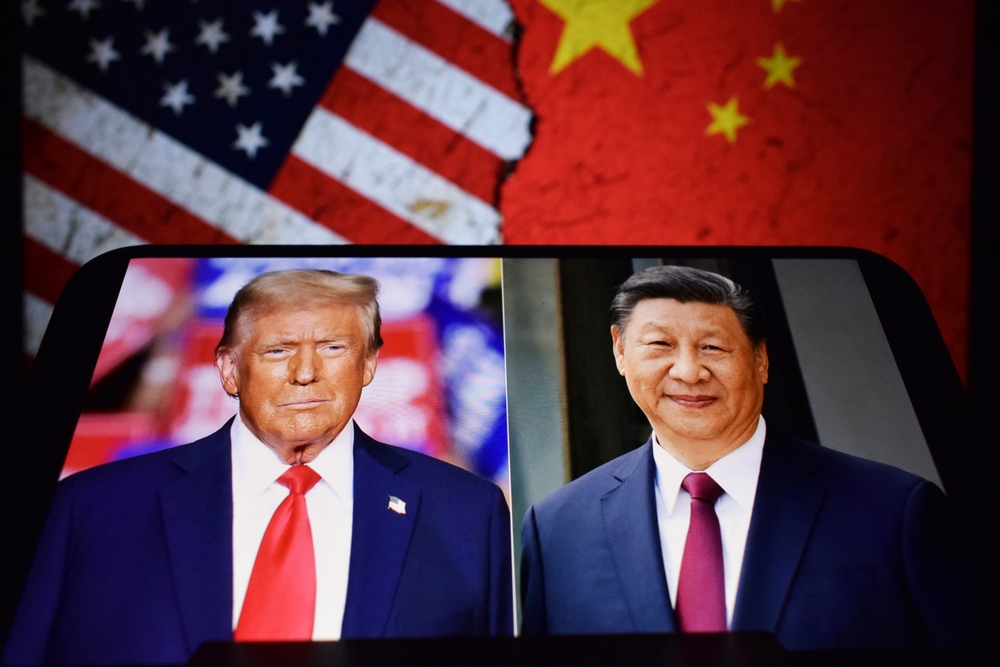
U.S. President Donald Trump arrived in Beijing on Wednesday for a high-stakes summit with Chinese President Xi Jinping centered on the Iran war, trade tensions, Taiwan, and global security. The meeting comes at a critical moment for both countries as rising energy prices, geopolitical instability, and growing competition over technology reshape the global economy.
China Rolls Out a Grand Welcome for Trump
China welcomed Trump with a carefully choreographed ceremony after Air Force One landed in Beijing. The reception featured a military honor guard, a military band, and roughly 300 Chinese youths waving American and Chinese flags while chanting, “Welcome, welcome! Warm welcome!”
Trump was greeted by Chinese Vice President Han Zheng, China’s ambassador to Washington Xie Feng, Executive Vice Foreign Minister Ma Zhaoxu, and U.S. Ambassador to China David Perdue.
Formal summit events begin Thursday and include bilateral talks, a visit to the Temple of Heaven, and a state banquet.
Trade Deals Take Center Stage
Before leaving Washington, Trump emphasized that trade discussions would dominate the summit agenda.
“We’re the two superpowers,” Trump told reporters as he departed the White House on Tuesday for the long flight to Beijing. “We’re the strongest nation on Earth in terms of military. China’s considered second.”
Trump is seeking agreements for China to increase purchases of American soybeans, beef, and aircraft while also proposing a new “Board of Trade” designed to manage disputes between the two nations.
The administration hopes the initiative can prevent another escalation in the trade war that erupted after Trump’s tariff hikes last year, which China answered with restrictions involving rare earth minerals.
Iran Conflict Overshadows the Summit
Although Trump attempted to downplay the issue before arriving in China, the war involving Iran remains a major backdrop to the meeting.
The effective closure of the Strait of Hormuz has disrupted oil and natural gas shipments, sending global energy prices sharply higher and increasing fears of an economic slowdown.
“We have a lot of things to discuss. I wouldn’t say Iran is one of them, to be honest with you, because we have Iran very much under control,” Trump told reporters Tuesday.
The remarks came shortly after Iranian Foreign Minister Abbas Araghchi visited Beijing last week, highlighting China’s growing diplomatic role in the crisis.
Taiwan Emerges as a Major Flashpoint
Taiwan is expected to be one of the most sensitive issues discussed during the summit. China strongly opposes the $11 billion U.S. weapons package approved for the self-governing island.
Trump confirmed earlier this week that he plans to discuss the arms package directly with Xi. The deal is the largest military package ever approved for Taiwan.
At the same time, Trump’s recent comments have fueled speculation about whether the United States could soften its long-term support for Taiwan.
China’s state-backed newspaper People’s Daily issued a sharp warning ahead of Trump’s arrival.
Taiwan is “the first red line that cannot be crossed in China-U.S. relations” and is “the biggest point of risk” between the two nations.
Taiwan’s strategic importance has also expanded because of its dominance in semiconductor manufacturing, which remains essential for artificial intelligence development worldwide.
Tech Leaders Join Trump’s Delegation
Trump traveled to Beijing alongside several high-profile business and technology executives, including Elon Musk and Jensen Huang.
While flying to China, Trump posted on social media that his “first request” to Xi would involve expanding opportunities for American companies inside China.
“I will be asking President Xi, a Leader of extraordinary distinction, to ‘open up’ China so that these brilliant people can work their magic, and help bring the People’s Republic to an even higher level!” Trump wrote.
China, meanwhile, hopes to ease U.S. restrictions on advanced computer chips and reduce tariffs affecting Chinese exports.
Analysts Say China Holds the Advantage
Some analysts believe Beijing is entering the summit from a stronger negotiating position than Washington.
Trump faces political pressure at home due to rising inflation and economic concerns tied to the Iran conflict, while China appears focused on maintaining stability and avoiding further escalation.
Scott Kennedy, a senior adviser at the Center for Strategic and International Studies, said China could benefit from the summit even without major concessions.
“But even if they don’t get much on any of those things, as long as there’s not a blow-up in the meeting and President Trump doesn’t go away and look to re-escalate, China basically comes out stronger,” Kennedy said.
Trump Pushes for a Three-Way Nuclear Pact
Trump also plans to raise the possibility of a nuclear arms agreement involving the United States, China, and Russia.
The proposal follows the expiration of the New START treaty between Washington and Moscow, which previously limited the size of both nations’ nuclear arsenals.
China has historically shown little interest in joining such a deal, largely because its nuclear stockpile remains significantly smaller than those of the United States and Russia.
However, Pentagon estimates suggest China’s operational nuclear arsenal could exceed 1,000 warheads by 2030.
A Defining Moment for U.S.-China Relations
The Beijing summit could shape the future of U.S.-China relations for years to come. Trade, artificial intelligence, Taiwan, nuclear security, and Middle East tensions are all converging at a time when both countries are trying to project strength without triggering further global instability.
Despite the tensions, Trump remained optimistic about the future relationship between the two powers.
“We’re going to have a great relationship for many, many decades to come,” Trump said of the U.S. and China.
