


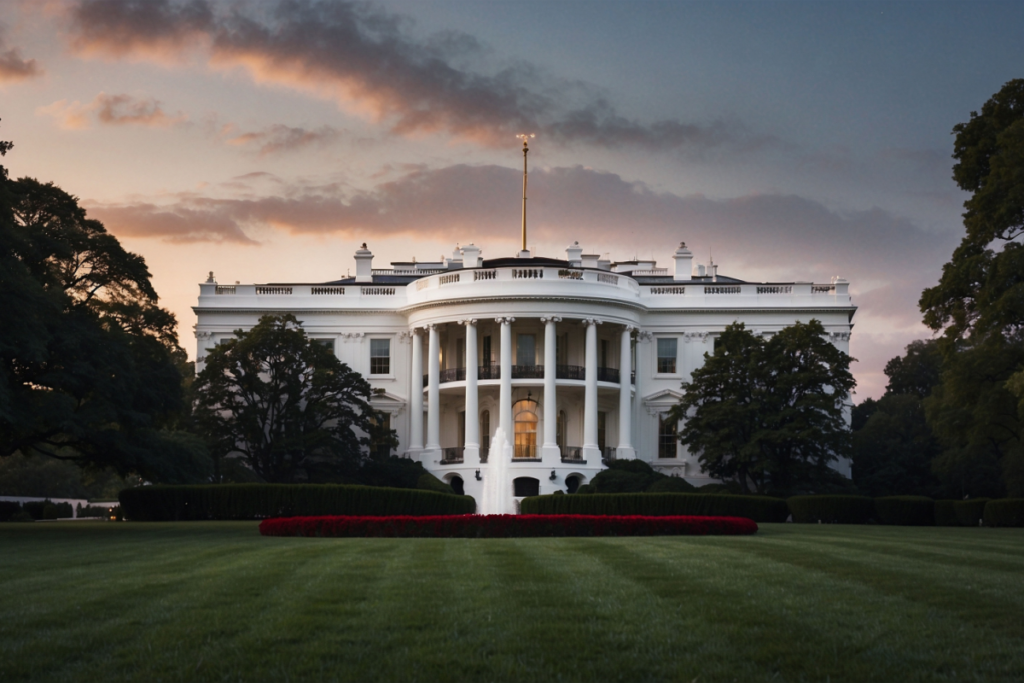
The White House has installed a series of new plaques in its colonnade that sharply criticize several former presidents, including Joe Biden and Barack Obama, while offering glowing assessments of President Donald Trump. The plaques are displayed beneath portraits as part of what the administration calls a newly added Presidential Walk of Fame. Their language and tone have sparked immediate debate in Washington about the appropriateness of using official space to promote partisan narratives.
According to the White House, the plaques were recently mounted beneath portraits already on display. One plaque placed under a stand in for former President Joe Biden refers to him using derogatory language and repeats claims about the 2020 election that have been widely disputed. Another plaque targeting Barack Obama highlights policy decisions from his presidency and repeats allegations previously raised by Trump, including claims related to surveillance during the 2016 campaign. White House officials confirmed that President Trump personally authored much of the text.
The installation has drawn attention not only because of its confrontational tone but also because it represents a departure from the traditionally restrained presentation of presidential history within the executive mansion. Former presidents customarily receive neutral descriptions emphasizing historical milestones rather than political judgments.
White House Response and Rationale
White House press secretary Karoline Leavitt defended the plaques, describing them as accurate reflections of each president’s legacy. She said that Trump views the displays as part of his interest in history and believes they offer clarity about the consequences of past administrations. The administration has not disclosed how the plaques were funded or whether government staff were involved in their installation.
The Biden and Obama offices declined or did not immediately respond to requests for comment. The plaques themselves include pointed language accusing Biden of economic mismanagement, foreign policy failures, and improper conduct while in office. Obama’s plaque criticizes the Affordable Care Act, the Iran nuclear agreement, and climate policies, while also referencing claims that intelligence agencies spied on Trump’s campaign.
By contrast, the plaques describing Trump’s first and second terms present an overwhelmingly positive account. They highlight tax cuts, economic growth, foreign policy initiatives, immigration enforcement, and social policies. The tone emphasizes achievements and frames Trump’s presidency as historically successful, ending with language suggesting further accomplishments ahead.
Political Reaction and Public Debate
Reaction on Capitol Hill has been mixed. Some Republicans expressed discomfort with the approach, arguing that former presidents deserve respect regardless of political differences. Senator Lisa Murkowski said she found the displays disturbing and inappropriate, noting that all presidents were elected by the American people and should be treated accordingly.
Other Republicans were less concerned. Senator Lindsey Graham characterized the plaques as more of a curiosity than a serious political issue and suggested that attention should remain focused on legislative priorities and upcoming elections. Democrats, meanwhile, have criticized the plaques as an abuse of official space and a deliberate attempt to promote misinformation.
Historians and former White House staff members have also weighed in, noting that while presidents often shape narratives about their own legacies, overt attacks on predecessors within the White House itself are highly unusual. The colonnade, typically associated with ceremonial events and public tours, has rarely been used for explicitly partisan messaging.
Broader Implications for Presidential Legacy
The controversy raises broader questions about how presidential history is presented and who controls that narrative. While museums and libraries often reflect curatorial perspectives, the White House has traditionally maintained a nonpartisan approach to historical displays. Critics argue that the new plaques blur the line between historical interpretation and political advocacy.
Supporters counter that every administration has the right to present its understanding of history and that Trump’s approach reflects the views of many voters who returned him to office. Still, the lack of transparency around funding and approval processes has added to scrutiny.
As the debate continues, it remains unclear whether the plaques will remain in place long term or face legal or procedural challenges. For now, they stand as a visible symbol of the sharp divisions that continue to shape American politics, even within the walls of the White House itself.
