


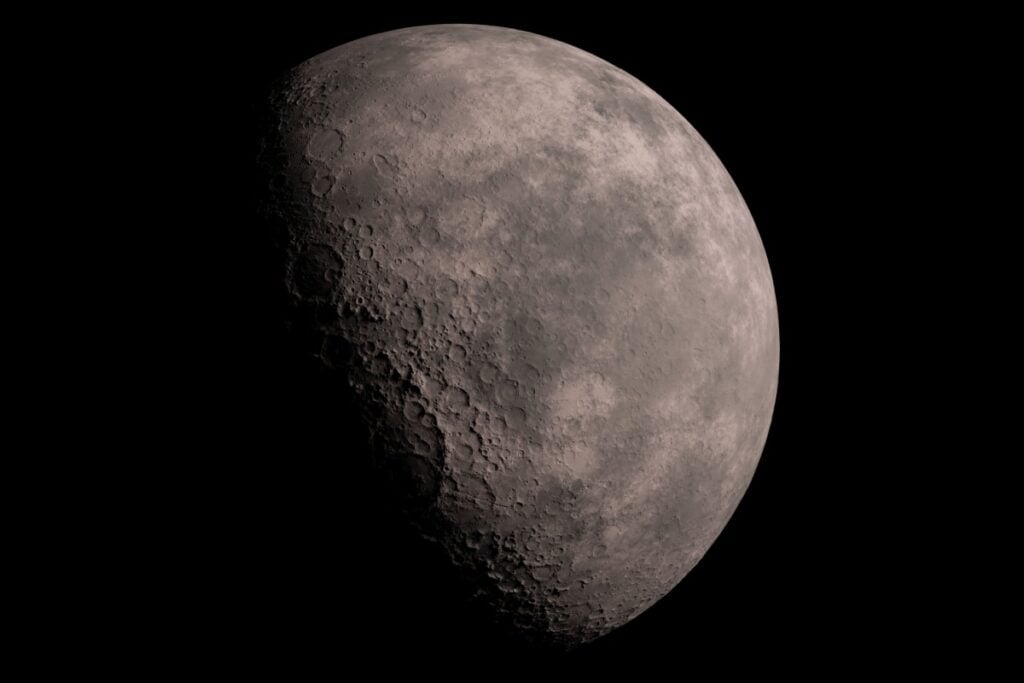
NASA’s Artemis II mission has achieved a major milestone in human space exploration, completing a historic flyby of the Moon and traveling farther from Earth than any previous crewed mission. The achievement marks the first time astronauts have ventured into deep space beyond the Moon’s vicinity since the Apollo era more than five decades ago.
During the flight, astronauts aboard the Orion spacecraft surpassed the distance record set in 1970 by the Apollo 13 crew. That earlier mission reached approximately 248,655 miles from Earth, a record that stood for over half a century. Artemis II exceeded that mark, establishing a new benchmark for human space travel.
The lunar flyby itself lasted several hours and brought the spacecraft within roughly 4,000 miles of the Moon’s surface. At its closest approach, the spacecraft passed behind the Moon, temporarily losing communication with Earth due to the natural blockage of radio signals. This brief blackout mirrored communication interruptions experienced during earlier Apollo missions.
The mission represents humanity’s first crewed return to deep space since 1972 and demonstrates the readiness of spacecraft systems designed for long-duration exploration. It also serves as a technical rehearsal for future missions intended to land astronauts on the lunar surface later in the decade.
Observations of the Moon’s Far Side
One of the most scientifically significant aspects of the mission was the direct observation of the Moon’s far side. While spacecraft have photographed this region before, the Artemis II crew provided firsthand visual observations, offering new perspectives of terrain that remains invisible from Earth.
Astronauts documented rugged landscapes filled with craters and geological formations, capturing high-resolution imagery and video. These observations are expected to support future mission planning, particularly for landing operations near the Moon’s south pole, a region believed to contain water ice deposits.
In addition to lunar imaging, the crew observed a solar eclipse from their vantage point in space, created when the Moon briefly blocked sunlight from their perspective. Such events provide opportunities to study solar behavior and light interactions in ways not possible from Earth’s surface.
The mission also produced notable visual records, including photographs showing Earth appearing to descend behind the lunar horizon. These images echo historic photographs taken during earlier Apollo missions and contribute to both scientific and cultural documentation of space exploration.
Testing Systems for Future Lunar Landings
Artemis II was designed primarily as a systems test rather than a landing mission. Engineers and mission planners focused on evaluating the Orion spacecraft’s performance in deep space, including its life-support equipment, navigation controls, and crew operations under extended conditions.
The crew consisted of four astronauts representing international collaboration, including members from the United States and Canada. Their mission marks the first time a woman and a non-American astronaut have traveled into deep space beyond low Earth orbit in the Artemis program.
These technical demonstrations are essential to validating the spacecraft’s ability to support human life during longer missions. Systems tested during Artemis II include environmental controls, manual piloting capabilities, and communications technology required for operations beyond Earth’s orbit.
NASA engineers will analyze the large volume of data returned from the mission to refine mission planning and address any performance challenges. This process is expected to influence the design and operational procedures of upcoming missions in the Artemis sequence.
Artemis Program and Long-Term Exploration Goals
The Artemis II mission forms part of a broader exploration initiative aimed at establishing a sustainable human presence on the Moon. The Artemis program, launched in 2017, seeks to return astronauts to the lunar surface and develop technologies necessary for deeper space exploration, including future missions to Mars.
Future Artemis missions are expected to build on the success of this flyby. Plans include landing astronauts near the Moon’s south pole, where permanently shadowed craters may hold frozen water that could support long-term habitation.
The mission also reflects renewed international interest in lunar exploration. Multiple space agencies and commercial partners are collaborating on technologies such as lunar landers and orbital stations designed to support extended operations beyond Earth.
As the Orion spacecraft returns toward Earth, scientists and engineers continue to evaluate the mission’s outcomes. The knowledge gained from this flight is expected to influence the next phase of human space exploration, shaping future missions intended to expand human presence beyond Earth’s orbit.
