


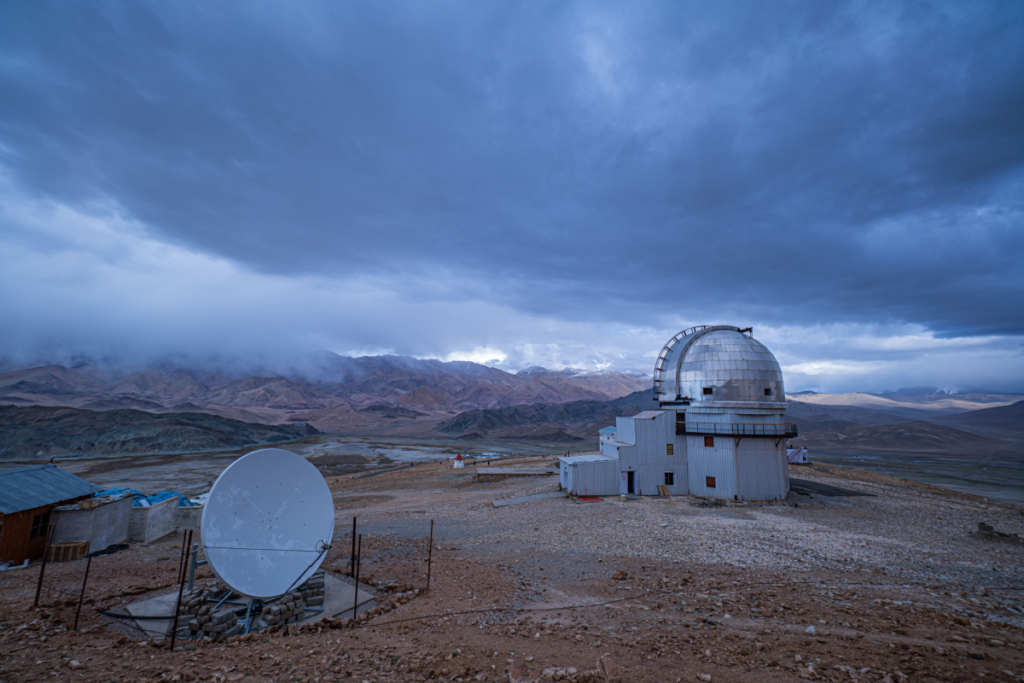
A New Philanthropic Push in Space Science
A billionaire funded philanthropic organization is setting out to reshape how major space observatories are built, funded, and deployed. Schmidt Sciences has announced the creation of the Eric and Wendy Schmidt Observatory System, an ambitious initiative that will bring together four complementary observatories designed to deliver world class science faster and at a fraction of the traditional cost.
Founded by Eric Schmidt and Wendy Schmidt, the organization says the new system reflects a deliberate shift away from decade long development timelines and multi billion dollar budgets. Instead, the goal is to prove that cutting edge astrophysics can be achieved through focused mission design, proven technology, and disciplined risk management.
At the heart of the initiative is a space based telescope that its developers say rivals the capabilities of much larger government missions. Alongside it, three ground based observatory networks are intended to work in concert, creating a flexible and responsive scientific ecosystem that supports a wide range of astronomical research.
Lazuli and the Case for Faster, Cheaper Space Telescopes
The centerpiece of the system is Lazuli, a space telescope with a primary mirror measuring three meters in diameter. This makes it larger than both the Hubble Space Telescope and the Nancy Grace Roman Space Telescope, which each feature 2.4 meter mirrors. Lazuli is designed to operate in a highly elliptical orbit around Earth and will carry three main instruments: a camera, a spectrograph, and a coronagraph.
Project leaders say Lazuli will deliver capabilities approaching those of flagship missions, but at a dramatically reduced cost. While no precise budget has been disclosed, the telescope is expected to cost only a small fraction of traditional flagship programs, placing it in the hundreds of millions rather than the billions.
To achieve this, the project relies heavily on existing technology. Roughly four fifths of the spacecraft is planned to use components with prior spaceflight heritage, reducing development risk and complexity. New technology is concentrated primarily in the scientific instruments, allowing the spacecraft platform itself to remain relatively conservative.
The development strategy also departs from standard practice. Assembly is planned close to the launch site to streamline logistics, and some system level tests may be skipped to accelerate the schedule. The goal is to demonstrate a new paradigm for space science, one where speed and cost efficiency do not necessarily come at the expense of scientific ambition.
Science Goals and a Niche in Modern Astronomy
Lazuli is designed to support a broad range of astrophysical research, including studies of exoplanets, stellar evolution, and cosmology. According to Schmidt Sciences, the telescope fills a gap between wide field survey instruments and highly specialized observatories.
One of its key roles will be rapid follow up. Discoveries made by large survey projects, such as transient explosions or unusual cosmic events, often require swift and flexible observation. Lazuli is intended to respond quickly to such phenomena, providing detailed measurements that other instruments may not be able to capture in time.
The project has attracted interest from leading scientists, including Nobel Prize winning astrophysicist Saul Perlmutter. Researchers involved believe the telescope could help address open questions about the expansion of the universe and the nature of dark energy, building on discoveries made over the past several decades.
By narrowing its mission scope and focusing on a specific scientific niche, Lazuli aims to maximize impact while avoiding the cost overruns and delays that have plagued many large scale space projects.
A Network of Ground Based Observatories
Lazuli will not operate alone. Schmidt Sciences is also funding three ground based observatory systems designed to complement the space telescope. Together, they form an integrated platform for discovery.
One of these is the Argus Array, a network of more than a thousand small optical telescopes that collectively achieve the performance of a much larger instrument. It is designed to survey large areas of the northern sky and provide continuous monitoring. Another is the Deep Synoptic Array, which uses a dense collection of radio dishes to generate real time radio images of the sky, enabling rapid detection of transient radio signals.
The third component is the Large Fiber Array Spectroscopic Telescope, optimized for collecting detailed spectra of stars and galaxies. By distributing observations across many smaller instruments rather than relying on a single massive facility, the system emphasizes redundancy, flexibility, and open access to data.
Although primarily focused on astronomy, some of these ground based systems also have applications in space operations, such as tracking objects in orbit and supporting optical communications. All four observatories are expected to become operational on a similar timeline, reinforcing their role as a unified scientific infrastructure.
Schmidt Sciences describes the observatory system not as an end point, but as an enabling layer for discovery. By opening access to researchers worldwide, the organization hopes to accelerate progress and encourage new ideas. If successful, the initiative could influence how future space science missions are conceived, funded, and built.
