


Rethinking the Power at the Galactic Center
For decades, astronomers have viewed the center of the Milky Way as a realm ruled almost exclusively by a supermassive black hole. That object, commonly known as Sagittarius A*, is thought to anchor the orbits of nearby stars and shape the dynamics of our galaxy’s inner regions. A new scientific study, however, is challenging how dominant that black hole really is. Instead of a single massive object controlling everything around it, researchers suggest that a dense and compact core of dark matter could be playing an equally important role.
The idea does not dismiss the existence of the black hole. Astronomers have gathered strong observational evidence that it is real. What the study questions is whether the black hole alone explains the complex motions observed near the Galactic Center. According to the researchers, certain stellar orbits and gas cloud behaviors may be just as well explained by a tightly packed concentration of dark matter that exerts a powerful gravitational pull.
How Invisible Matter Could Imitate a Black Hole
Dark matter is one of the greatest mysteries in modern physics. It does not emit light and cannot be observed directly, yet scientists believe it makes up the majority of the universe’s mass. Its presence is inferred from how galaxies rotate and how matter clumps together across cosmic scales. In this new research, scientists explored whether dark matter could also dominate gravity at the Milky Way’s core.
Using advanced simulations, the team modeled a scenario in which dark matter forms a super dense core surrounded by a more diffuse halo. This structure, they argue, could bend light and influence stellar motion in ways that closely resemble the effects of a black hole. When they compared this model with the traditional black hole explanation, the predicted orbits of so called S stars near the Galactic Center differed by less than one percent.
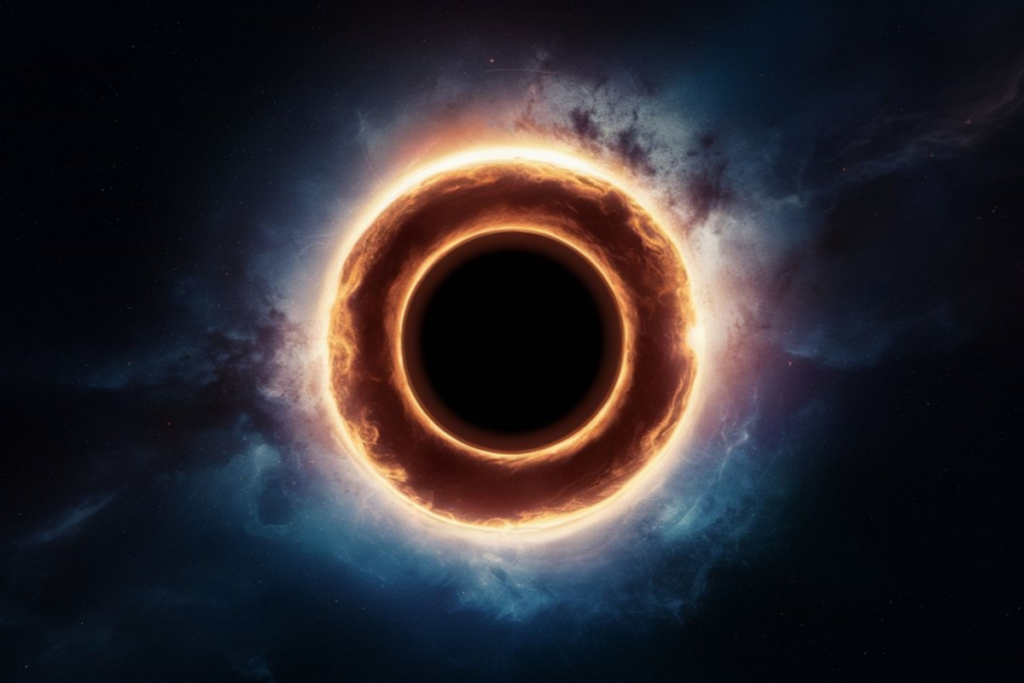
That level of similarity is striking. It suggests that current observations may not be sufficient to clearly distinguish between a supermassive black hole and a dense dark matter core. Even images that appear to show a black hole shadow could, in theory, be reproduced by the gravitational lensing caused by an extremely compact dark matter concentration.
Matching Observations Beyond the Galaxy’s Core
One of the most intriguing aspects of the study is that the dark matter model does not only apply to the inner regions of the Milky Way. The researchers found that it also aligns well with observations of the galaxy’s outer halo, where stars and gas orbit at great distances from the center. Measurements of the Milky Way’s rotation show a subtle slowdown at large radii, a feature that standard models sometimes struggle to explain.
According to the researchers, a fermionic dark matter core naturally supports this behavior. The same physics that governs the dense core near the center also influences how mass is distributed across the galaxy as a whole. This creates a unified picture in which dark matter shapes both the inner and outer dynamics of the Milky Way more consistently than previously thought.
This broader agreement with observational data is one reason the study has attracted attention. It suggests that dark matter may not simply be a background component of galaxies, but an active architect of their internal structure.
Big Questions Still Remain
Despite its promise, the dark matter core model is far from proven. The researchers themselves acknowledge that it does not yet outperform the black hole model in a decisive way. Both explanations remain statistically viable based on current data. There is also the fundamental problem that dark matter has not been directly detected, and it is unclear whether it behaves in the specific way assumed by the model.
Future observations will be crucial. Next generation telescopes and instruments are expected to deliver far more precise measurements of stellar orbits and gravitational effects near the Galactic Center. These data could reveal subtle differences between a black hole dominated system and one influenced by a dense dark matter core.
If those differences are found, they could reshape our understanding of how galaxies work and what truly governs their hearts. At the very least, the study highlights how much remains unknown about the Milky Way’s core and reminds us that even long accepted cosmic assumptions are still open to challenge.
