


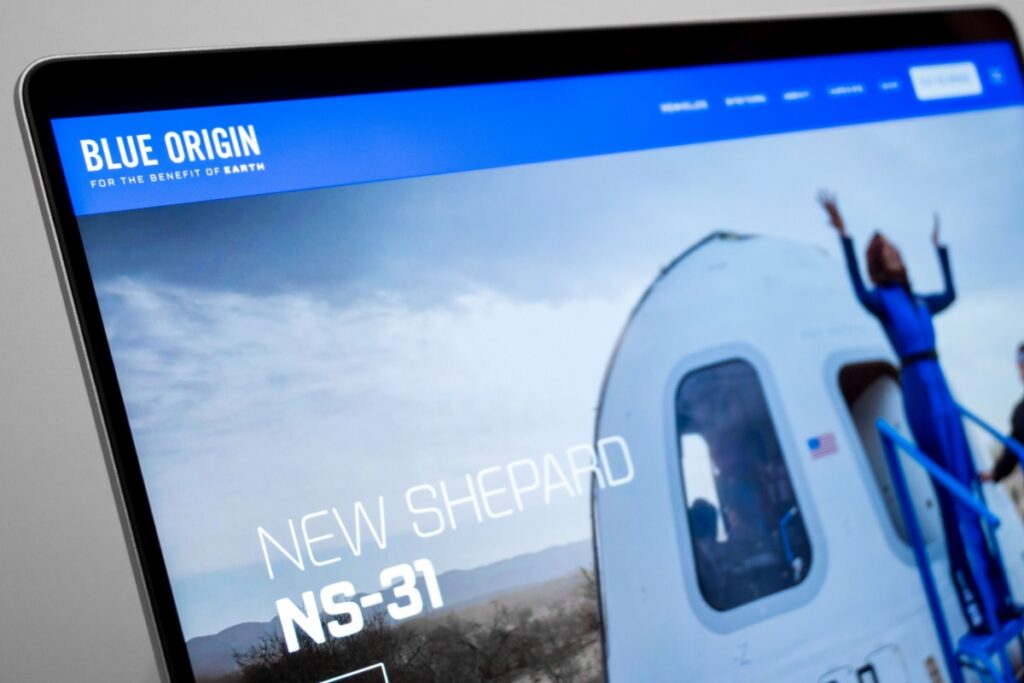
Blue Origin’s heavy-lift New Glenn rocket has been grounded following a recent launch failure that prevented a satellite from reaching its intended orbit. The mission lifted off from Cape Canaveral Space Force Station in Florida, marking the rocket’s third flight since its debut.
During the launch, the rocket’s reusable first-stage booster performed as expected and successfully landed on an ocean-based recovery platform. However, a malfunction occurred later in the flight when the upper stage failed to generate enough thrust. According to company officials, this shortfall prevented the spacecraft from reaching the required altitude and trajectory.
The payload, a communications satellite built for AST SpaceMobile, was intended to become part of a network providing direct satellite connectivity to smartphones. Because the rocket did not deliver the satellite into the correct orbit, both the upper stage and the satellite eventually reentered Earth’s atmosphere the following day.
Blue Origin chief executive Dave Limp indicated that preliminary data pointed to insufficient engine performance in the upper stage as the primary cause of the problem. Investigators are reviewing telemetry data to confirm the exact source of the malfunction.
Investigation Halts Future Flights
Following the unsuccessful mission, Blue Origin announced that all New Glenn launches would be suspended until a full investigation is completed. The Federal Aviation Administration is also participating in the review process, as is standard procedure for launch incidents involving commercial rockets operating from U.S. facilities.
Engineers will analyze both flight data and hardware performance to determine the corrective measures needed before operations can resume. Such investigations typically involve evaluating propulsion systems, structural integrity, and flight control software to identify contributing factors.
The grounding represents a significant pause for a rocket that has been positioned as a major competitor in the rapidly expanding commercial space industry. New Glenn is designed as a reusable launch vehicle capable of delivering large payloads into orbit, making reliability critical for maintaining customer confidence.
Although the launch failure resulted in the loss of the satellite mission, officials reported no injuries or safety risks to the public. Recovery of the first-stage booster was considered a technical success, reinforcing the viability of the reusable booster concept that aims to reduce launch costs over time.
Role in NASA’s Lunar Plans
The New Glenn rocket is expected to play a key role in upcoming space missions, including those linked to NASA’s Artemis program, which aims to return astronauts to the Moon later in the decade. NASA has selected New Glenn as a launch vehicle for components of its Blue Origin lunar lander system.
The rocket itself stands more than 320 feet tall and is named after John Glenn, the first American to orbit Earth in 1962. Its large payload capacity is intended to support missions involving satellites, space exploration equipment, and potentially human spaceflight systems.
Previous milestones have demonstrated the rocket’s capabilities. In earlier missions, New Glenn successfully carried NASA spacecraft intended for Mars exploration and achieved booster recovery at sea, marking an important step toward reusable launch technology.
Reusable rocket systems have become central to modern spaceflight strategy. By recovering and refurbishing major components, companies seek to reduce mission costs and increase launch frequency. Blue Origin’s design approach mirrors similar efforts across the industry, reflecting the broader trend toward sustainability and efficiency in orbital launches.
Commercial Space Competition Intensifies
The temporary grounding of New Glenn highlights the competitive environment shaping today’s commercial space sector. Companies developing heavy-lift launch systems face increasing pressure to demonstrate both reliability and cost efficiency as demand for satellite deployment grows worldwide.
New Glenn entered service after years of development and testing. Its first orbital test flight successfully reached space with a prototype satellite, marking an early milestone in Blue Origin’s broader strategy to expand into large-scale launch services.
Competition in the heavy-launch category has intensified in recent years, particularly as private companies collaborate with government agencies on deep-space missions. Reliable launch vehicles are essential for supporting planetary exploration, communications networks, and future human missions beyond low Earth orbit.
As investigators continue examining the cause of the recent malfunction, the outcome is expected to influence the timeline of future launches. The results may also shape the operational readiness of vehicles planned for upcoming missions linked to lunar exploration and advanced satellite deployment initiatives.
