


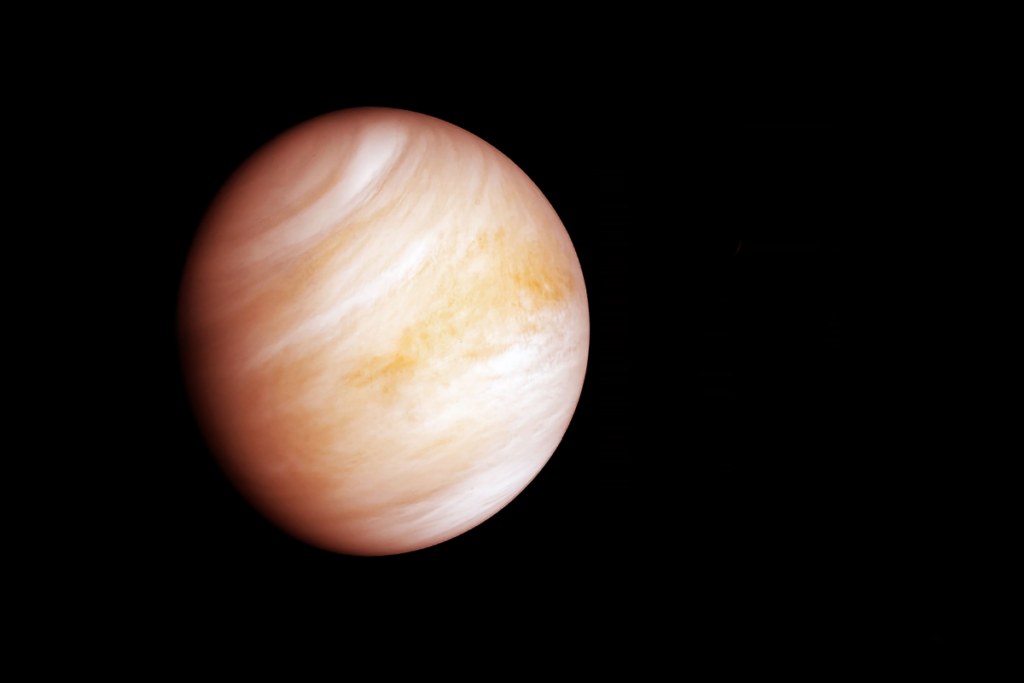
A Rare Glimpse Beneath Venus’ Hidden Surface
Scientists studying archival radar data from NASA’s Magellan mission have identified what appears to be a massive underground tunnel beneath the surface of Venus. The structure is believed to have been carved by volcanic activity, forming a lava tube that runs beneath the planet’s harsh and cloud-covered landscape. If confirmed, it would represent only the second known lava tube ever detected on Venus, placing it alongside similar structures previously identified on the Moon and Mars.
This finding adds to a growing body of evidence suggesting that Venus may be more geologically complex and dynamic than long assumed. For decades, the planet was widely considered inactive beneath its surface. The identification of an underground volcanic cavity challenges that idea and points toward a more active geological past, and possibly present, than scientists once believed.
Because Venus is permanently obscured by thick clouds, researchers cannot directly observe surface or subsurface processes. Instead, they rely heavily on radar imaging, making discoveries like this one dependent on careful analysis of subtle signals hidden in decades-old data.
How Magellan’s Radar Revealed Hidden Clues
The discovery is rooted in radar images collected by the Magellan spacecraft, which orbited Venus and mapped much of its surface using specialized radar technology. The spacecraft sent radio waves toward the planet and measured their return signals, allowing scientists to create detailed maps of surface features despite the opaque atmosphere.
These radar maps revealed long chains of pits and collapsed areas across Venus’ surface. Some of these features extend for vast distances, suggesting that they may have formed when underground lava channels collapsed, leaving surface depressions behind. Such pit chains have long hinted at the presence of extensive lava tubes beneath the Venusian crust.
In the latest analysis, researchers focused on specific localized collapses, similar to skylights, where sections of rock appear to have fallen inward. These features can expose voids below the surface and provide strong indicators of subterranean conduits. One standout formation showed a radar signature that closely matches patterns associated with collapsed lava tube roofs on other planetary bodies.
Nyx Mons and the Scale of Volcanic Activity
The most compelling candidate structure lies on the western flank of Nyx Mons, one of the planet’s major volcanoes. Venus is dominated by volcanic features, with more than a thousand large volcanoes and nearly a million smaller ones covering its surface. This context makes volcanic tunnels a plausible outcome of the planet’s geological history.
Analysis of the surrounding terrain suggests that the newly identified conduit could stretch for several dozen kilometers underground, though only part of it can currently be confirmed using existing data. The size and continuity of the structure remain uncertain, as radar limitations prevent scientists from seeing its full extent or assessing its stability.
Even so, the discovery is considered significant. Underground volcanic cavities can preserve information about a planet’s interior and thermal history, offering clues about how heat has moved through the crust over time. On Venus, such features could help scientists better understand whether the planet still experiences internal geological activity.
Future Missions May Confirm the Discovery
Confirming the structure’s full shape and scale will require new observations. Upcoming missions to Venus are expected to carry advanced radar instruments capable of capturing higher-resolution images and probing beneath the surface more deeply than Magellan ever could.
One such mission includes a subsurface radar instrument designed to penetrate hundreds of meters below the surface, even in areas without visible openings. This technology could potentially detect underground conduits directly and determine whether lava tubes on Venus are isolated features or part of a widespread network.
Researchers emphasize that this potential lava tube represents only the beginning of a broader investigation into Venus’ subsurface. As new missions revisit the planet with modern tools, scientists expect to uncover more evidence that Venus is not a dormant world frozen in time, but a planet with a far richer geological story still waiting to be told.
