


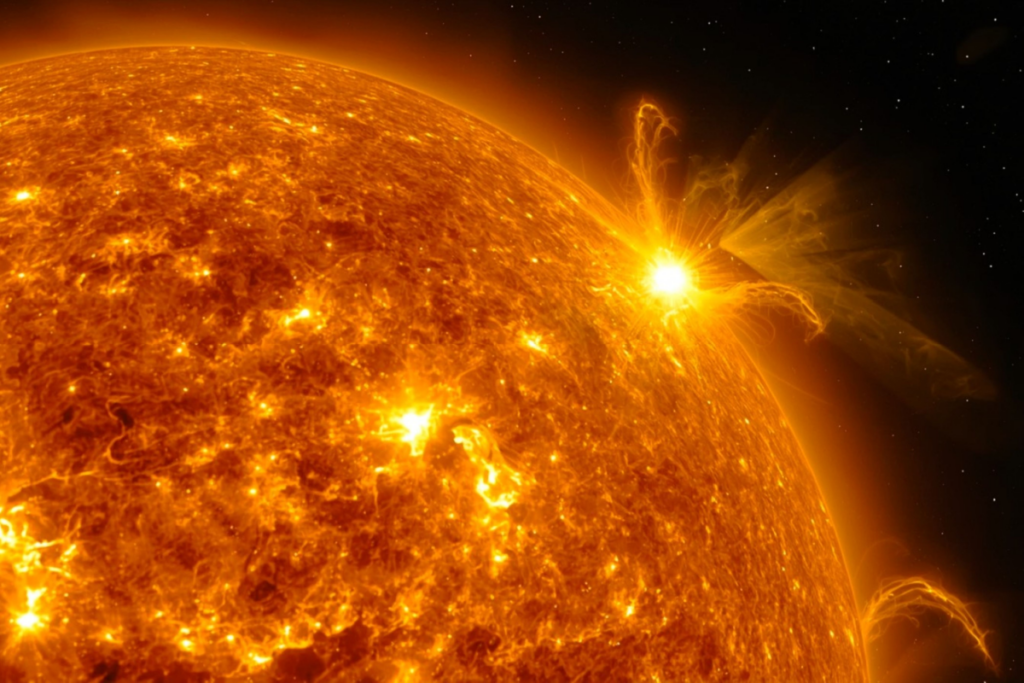
A New Look Inside a Solar Explosion
A major breakthrough in solar science has emerged from detailed observations made by the European Space Agency–led Solar Orbiter mission. Scientists have uncovered how a solar flare begins not as a single explosive event, but as a chain reaction driven by small, initially weak magnetic disturbances that rapidly intensify. This process resembles an avalanche, where a minor shift triggers a cascading release of energy that grows in scale and power.
Solar flares are among the most violent phenomena in the solar system. They occur when energy stored in twisted magnetic fields is suddenly released, heating plasma to millions of degrees and accelerating particles to extreme speeds. These events can have far-reaching consequences, including geomagnetic storms that interfere with satellites, navigation systems, radio communications, and power infrastructure on Earth. Until now, the precise mechanism that allows so much energy to be released so quickly had remained unclear.
Using one of its most detailed views of a large flare, Solar Orbiter captured the build-up, eruption, and aftermath of the event in unprecedented detail. The data reveal that a solar flare is not a single moment of release, but the result of a rapidly evolving sequence of magnetic reconnection events that interact and amplify one another.
The Magnetic Avalanche Process
At the heart of the discovery is a phenomenon scientists now describe as a magnetic avalanche. High-resolution imagery of the Sun’s outer atmosphere showed a structure of twisted magnetic strands forming an arch-like filament. These strands appeared and evolved on timescales of seconds, becoming increasingly tangled and unstable.
As instability grew, individual magnetic strands began to break and reconnect. Each reconnection released a small amount of energy, but together they triggered further reconnections nearby. This chain reaction spread quickly across the region, producing stronger and stronger bursts of energy. The process escalated until it culminated in a powerful solar flare.
During the eruption, the filament partially detached and unrolled violently, ejecting material into space. At the same time, bright flashes marked intense reconnection events occurring along its length. The observations confirm that large solar flares can emerge from the rapid interaction of many smaller magnetic events rather than a single, coherent explosion.
This finding provides the first direct evidence that the avalanche model, previously used to explain flare statistics across the Sun, also applies to individual large flares. It fundamentally reshapes how scientists understand the dynamics of solar eruptions.
Raining Plasma and Extreme Particle Energy
Another striking feature revealed by Solar Orbiter is what scientists describe as raining plasma blobs. As energy was released during the cascade of reconnections, heated plasma flowed rapidly downward through the Sun’s atmosphere in ribbon-like streams. These flows continued even after the main flare had subsided, indicating prolonged energy deposition.
Simultaneous ultraviolet and X-ray measurements showed where accelerated particles deposited their energy. The observations revealed that particles reached extraordinary velocities, approaching half the speed of light. This level of acceleration was not previously expected from an avalanche-type process and suggests that cascading reconnection events can be far more efficient at energizing particles than assumed.
Understanding where and how these particles gain energy is critical. High-energy particles can escape the Sun and pose radiation risks to spacecraft, astronauts, and technological systems. The new findings offer valuable insight into the origins of these hazards and provide a clearer physical basis for improving space weather prediction.
Implications for Forecasting and Future Missions
The ability to track a solar flare from its earliest magnetic disturbances through to its peak and decay marks a major step forward for solar physics. By combining data from multiple instruments, Solar Orbiter created a three-dimensional picture of how energy moves from magnetic fields into plasma across different layers of the Sun.
The results suggest that monitoring subtle magnetic changes before a flare erupts could be key to earlier warnings of space weather events. However, scientists also note that even higher-resolution observations, particularly in X-rays, will be needed to fully disentangle the smallest reconnection events driving the avalanche.
Beyond the Sun, the discovery raises broader questions about whether similar processes occur on other stars that produce flares far more powerful than those observed in our solar system. If magnetic avalanches are universal, they could explain stellar activity across the galaxy.
For now, Solar Orbiter has delivered one of its most significant insights yet, revealing the hidden engine of solar flares and transforming our understanding of how the Sun unleashes its explosive power.
