


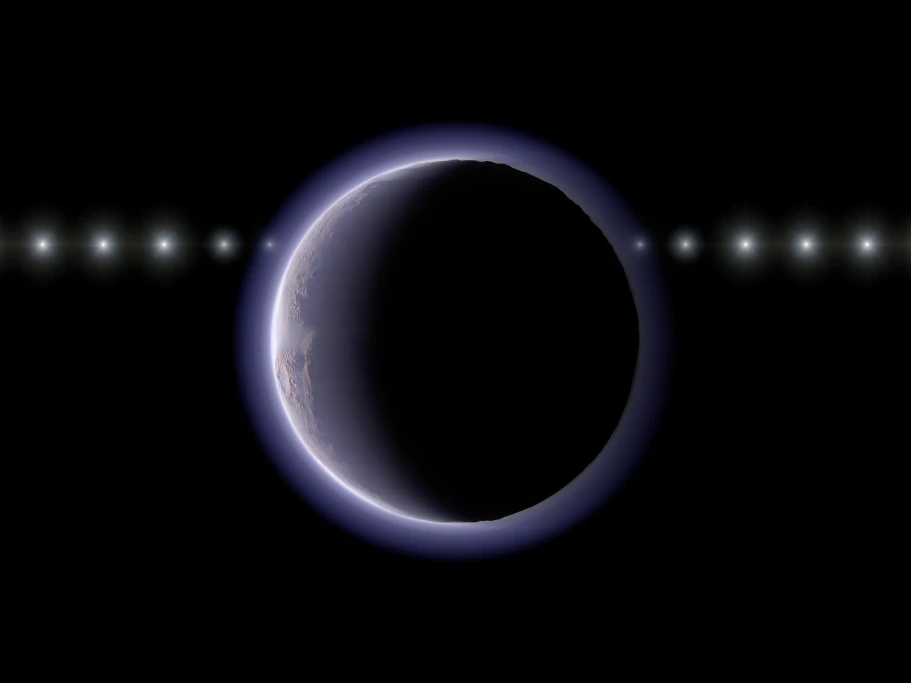
Astronomers have uncovered a surprising discovery at the edge of our solar system: a tiny, icy object far beyond Pluto may possess a delicate atmosphere. This finding challenges long-standing assumptions about which celestial bodies can sustain atmospheric layers and opens new doors to understanding the distant Kuiper Belt.
A Breakthrough in Deep Space Observation
Using advanced telescopes in Japan, researchers observed a distant object known as (612533) 2002 XV93 as it passed in front of a background star. This event, called an occultation, caused a subtle dimming of starlight—an effect that hinted at the presence of an atmosphere.
The discovery was led by Ko Arimatsu of the National Astronomical Observatory of Japan, who described the observation as both surprising and significant.
A Mini Pluto With Big Implications
Despite measuring only about 300 miles (500 kilometers) across, this distant body may be the smallest known object with a detectable atmosphere held by gravity. It resides in the Kuiper Belt, a vast area filled with icy remnants from the solar system’s formation.
“It changes our view of small worlds in the solar system, not only beyond Neptune,” Arimatsu said in an email. He added that finding such an atmosphere was “genuinely surprising,” challenging “the conventional view that atmospheres are limited to large planets, dwarf planets and some large moons.”
Scientific Skepticism and Excitement
Not all scientists are ready to accept the findings without further evidence. Alan Stern of the Southwest Research Institute, who led New Horizons, emphasized caution.
“This is an amazing development, but it sorely needs independent verification. The implications are profound if verified,” Stern said.
What Makes This Atmosphere Unique
The atmosphere surrounding this icy body is incredibly thin—estimated to be 5 million to 10 million times less dense than Earth’s atmosphere and even 50 to 100 times thinner than Pluto’s.
Scientists believe it may consist of gases like methane, nitrogen, or carbon monoxide. These elements could explain the way light dimmed during the observation.
How Did This Atmosphere Form?
Researchers propose two main theories:
- Impact Origin: A comet or collision may have released gases into space.
- Cryovolcanism: Ice volcanoes could be slowly releasing gases from beneath the surface.
Arimatsu explained the importance of continued observation:
“That is why future monitoring is so important. If the atmosphere fades over the next several years, that would support an impact origin. If it persists, or varies seasonally, that would point more toward ongoing internal gas supply.”
Looking Ahead: Confirming the Discovery
Future observations, potentially using the powerful James Webb Space Telescope, could confirm the composition and behavior of this faint atmosphere. These studies may redefine how scientists understand atmospheric formation on small celestial bodies.
This discovery marks a turning point in planetary science, suggesting that even the smallest worlds in the outer solar system may hold complex and dynamic environments. While further verification is needed, the possibility of an atmosphere on such a tiny object expands our understanding of where atmospheres can exist—and how they form in the coldest reaches of space.
