


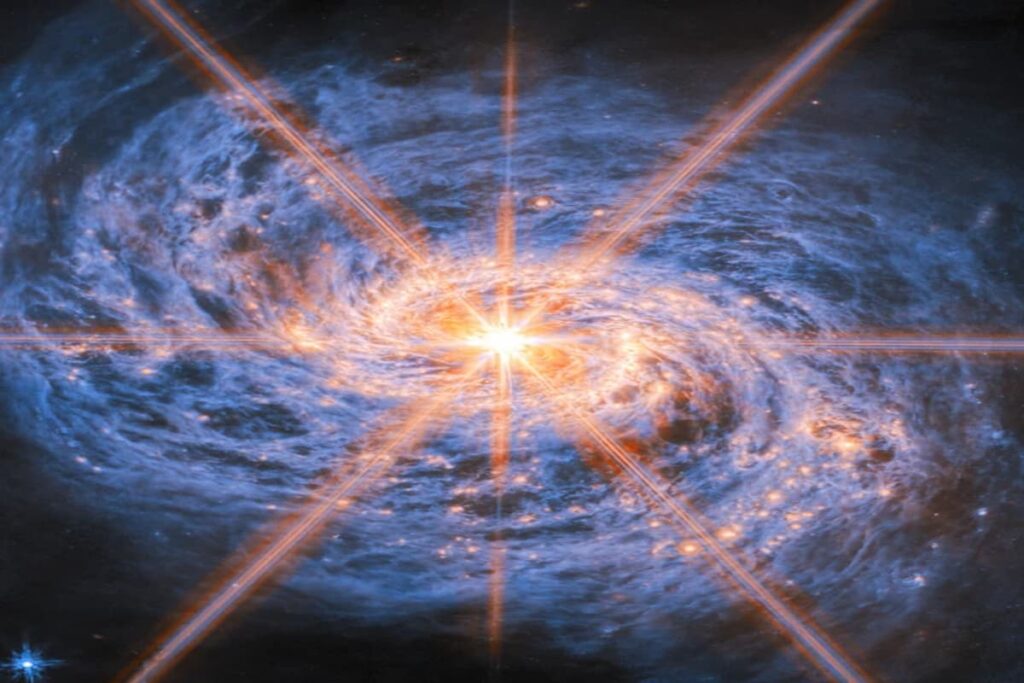
NASA’s James Webb Space Telescope has revealed a breathtaking new image of the spiral galaxy Messier 77, showcasing a brilliant galactic core powered by a supermassive black hole. Located roughly 45 million light-years from Earth in the constellation Cetus, also known as the Whale, the galaxy’s glowing center dominates the scene in one of the latest deep-space observations captured by Webb’s advanced instruments.
A Brilliant Spiral Galaxy Comes Into Focus
The newly released image highlights the luminous heart of Messier 77, a well-known spiral galaxy that has fascinated astronomers for decades. Positioned 45 million light-years away, the galaxy appears calm from a distance, yet its center hides one of the universe’s most energetic phenomena.
At the core of the galaxy lies an active galactic nucleus, a region so bright that it outshines nearly everything surrounding it. The dazzling glow comes from matter spiraling rapidly into a massive black hole.
NASA explained that the galaxy’s nucleus is powered by “a supermassive black hole that’s 8 million times more massive than the sun.” As surrounding gas and dust are pulled inward, they heat up to extreme temperatures and release intense radiation across space.
Webb’s Infrared Vision Reveals Hidden Structures
The stunning details visible in the image were captured using Webb’s mid-infrared instrument, which allows scientists to peer through thick clouds of cosmic dust that traditional telescopes often cannot penetrate.
Unlike visible-light telescopes, Webb can observe heat signatures and hidden galactic structures in remarkable clarity. This technology gives astronomers a closer look at how black holes interact with their environments and how galaxies evolve over time.
The vibrant image of Messier 77 reveals swirling dust lanes, glowing gas clouds, and the energetic region surrounding the black hole with unprecedented precision.
The Monster Black Hole at the Galaxy’s Center
At the center of Messier 77 sits a supermassive black hole estimated to be 8 million times heavier than the Sun. Although black holes themselves emit no light, the material orbiting around them becomes incredibly hot as it accelerates inward.
This process creates enormous amounts of energy, turning the galaxy’s core into what scientists call an “active nucleus.” These regions are among the brightest objects in the cosmos and help researchers better understand extreme gravity and the behavior of matter near black holes.
The new Webb observations may also help scientists study how galaxies and black holes grow together over billions of years.
Webb Continues Expanding Humanity’s Cosmic View
Since launching in 2021, the NASA and its international partners have used the James Webb Space Telescope to capture some of the most detailed images of the universe ever seen.
Often described as the world’s most powerful space telescope, Webb continues to provide scientists and the public with extraordinary views of distant galaxies, star-forming regions, and cosmic phenomena that were previously hidden from view.
The latest image of Messier 77 is another reminder of how modern astronomy is transforming humanity’s understanding of the universe and the mysterious forces shaping it.
Closing Paragraph
The dazzling new portrait of Messier 77 offers a remarkable glimpse into the violent and energetic heart of a distant galaxy. By using advanced infrared technology, NASA’s Webb Space Telescope continues uncovering details of the universe that were once impossible to observe. As scientists study these extraordinary images, each new discovery brings humanity one step closer to understanding the hidden mechanics of space, black holes, and the evolution of galaxies across the cosmos.
