


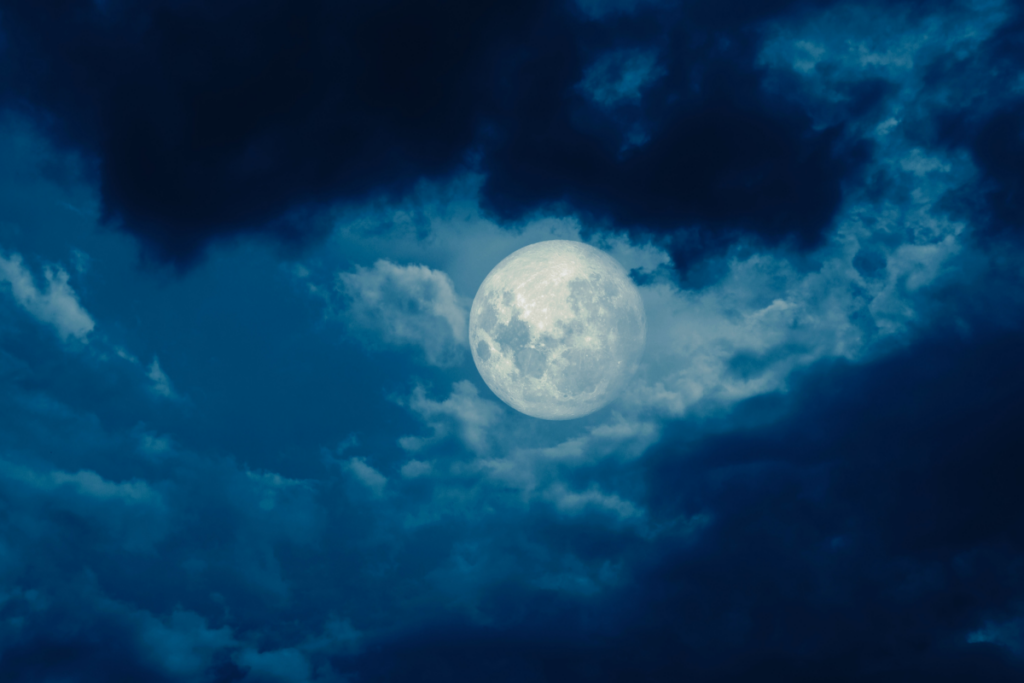
A Full Moon That Stands Out
The first full moon of the year arrives with unusual intensity as the wolf supermoon, a lunar event tied to mid winter traditions and named for the historic association with howling wolves across North America. This full moon is also a supermoon, meaning it appears slightly larger and brighter than an average full moon because it occurs near the closest point of the moon’s orbit to Earth. It marks the final supermoon in a recent sequence, giving it added visual impact and symbolic weight as a natural milestone in the night sky.
Beyond its size and brightness, the wolf supermoon signals the beginning of a year that will feature an uncommon number of full moons. With more lunar cycles than a typical calendar year, skywatchers can expect repeated opportunities for dramatic moonrises, rare alignments, and notable contrasts between moonlight and seasonal skies. The wolf supermoon sets the tone by combining visual beauty with astronomical significance.
While the precise moment the moon reaches full illumination is of interest to astronomers, most observers experience the event when the moon rises above the eastern horizon. At that time, the contrast between the glowing lunar surface and the fading light of dusk creates the most striking and memorable view.
Why This Supermoon Looks Bigger and Brighter
A supermoon occurs when the full moon aligns closely with perigee, the point where the moon’s orbit brings it nearest to Earth. Because the moon’s path around the planet is slightly elliptical, its distance varies throughout each cycle. When fullness and proximity coincide, the result is a moon that appears subtly larger and more luminous to the naked eye.
This wolf supermoon is the last in a run that included other seasonally named full moons, making it the closing chapter of a visually rich lunar period. Though the difference in size may seem modest, the enhanced brightness becomes more noticeable when the moon is low on the horizon, where atmospheric effects amplify its presence.
Another factor that adds to this moon’s impact is its position in the sky. In the Northern Hemisphere, the full moon that occurs closest to the deepest part of winter follows a higher arc across the sky. As the sun traces its lowest path during this season, the full moon mirrors that trajectory in reverse, climbing higher and remaining visible for longer stretches of the night. This extended visibility offers observers more time to appreciate its glow.
The Importance of Moonrise and Viewing Conditions
Moonrise plays a central role in how dramatic a full moon appears. The most compelling views occur when the moon rises shortly after sunset, during the period known as the blue hour. At this time, the sky retains a soft gradient of color rather than complete darkness, allowing the moon’s brightness to stand out without washing out detail.
When a full moon rises too early, the remaining daylight can dull its appearance. When it rises too late, the dark sky removes the visual contrast that makes moonrise so striking. The wolf supermoon benefits from rising during this ideal window, creating conditions that are especially appealing for photography and casual observation alike.
To make the most of the event, observers are encouraged to seek out open landscapes with a clear eastern horizon. Elevated viewpoints, coastlines, and wide open fields provide unobstructed views. While the moon is easily enjoyed with the naked eye, binoculars can enhance surface detail and add depth to the experience without requiring advanced equipment.
A Year Rich in Lunar Events
The wolf supermoon is only the opening act in a year filled with notable lunar activity. With an extra full moon compared to most years, the lunar calendar will include a blue moon, additional supermoons, and multiple eclipses. Among these events is a total lunar eclipse often referred to as a blood moon, which will be the last of its kind for several years. Another eclipse later in the year will offer a deep partial view, adding further variety to the night sky.
This abundance of lunar events is the result of the difference between the length of a solar year and a lunar year. Because lunar cycles are shorter, they gradually shift within the calendar, occasionally producing years with thirteen full moons instead of twelve. For observers, this creates a rare concentration of opportunities to engage with the changing rhythms of the sky.
As the first full moon of the year, the wolf supermoon carries both visual and symbolic significance. It serves as a reminder of the enduring connection between seasonal cycles, cultural traditions, and the predictable yet ever changing motion of the moon above.
