


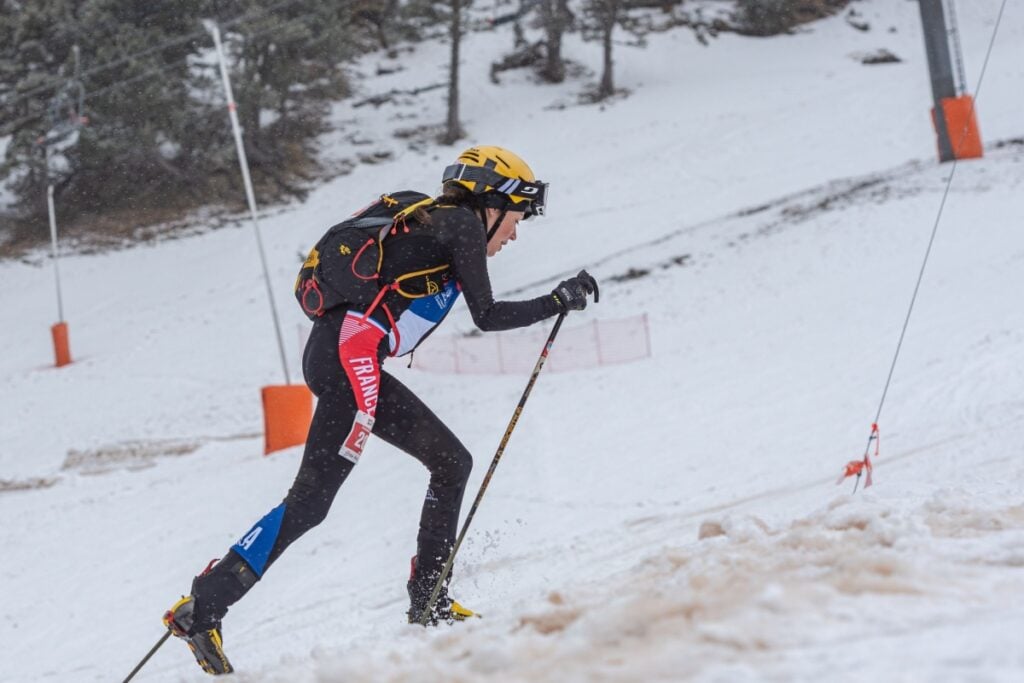
Ski mountaineering, often shortened to SkiMo, was added to the Olympic program at the Milano Cortina 2026 Winter Games as the only new sport for this edition of the Olympics. The discipline has long been practiced in alpine regions as a test of uphill endurance and downhill control, but the Olympic version packages that backcountry DNA into tightly managed races on a closed course, with strict equipment rules and closely monitored transition zones.
The Olympic venue has been the Stelvio Ski Centre in Bormio, Italy, which also hosts men’s alpine events at these Games. Even before medal races began, organizers and athletes framed the Olympic debut as a visibility breakthrough for a sport that has traditionally lived outside the mainstream, despite an established international circuit and a growing audience beyond Europe.
How Sprint And Relay Races Work
Olympic SkiMo is built around speed, precision, and rapid changes in technique. In the sprint, athletes tackle a short course that typically includes an uphill section on skis with climbing skins, a steep segment on foot with skis carried, and a final descent through gates, all compressed into an effort lasting only a few minutes for elite racers. The elevation change for the Olympic sprint is capped at around 70 meters, keeping the race explosive and forcing mistakes to become decisive.
The format mirrors other head-to-head Olympic events: heats, then semifinals, then a final, with transitions judged as tightly as the skiing itself. In Reuters’ on-site description of the Olympic debut, the sprint includes uphill “skinning,” a stair-running segment with skis on the athlete’s back, and a slalom-style finish where fatigue can quickly turn into technical errors.
The mixed relay adds tactics and teamwork. Teams consist of one woman and one man, and each athlete completes two loops, tagging their partner between laps; the woman starts, and the man finishes. In the Olympic framing cited by the NCAA, the relay course is built around a larger cumulative climb, about 140 meters, to extend the physical load while still demanding clean transitions.
Anna Gibson’s Rapid Route To The Olympic Start
One of the most closely watched U.S. stories has been Anna Gibson, a former University of Washington track athlete from Jackson, Wyoming, who moved from elite endurance running into SkiMo at remarkable speed.NCAA reported that Gibson reached the Olympics after racing only sparingly in ski mountaineering, following her and Cam Smith’s win in a mixed relay event on the International Ski Mountaineering Federation (ISMF) World Cup circuit in Utah, securing U.S. qualification for Italy.
NBC Olympics’ preview of the sport describes the U.S. pathway as unusually narrow: Team USA did not qualify for the sprint but did earn a place in the mixed relay through the Smith-Gibson pairing, which is highlighted as a historic American breakthrough on the World Cup calendar. Gibson’s background in alpine and Nordic skiing, alongside high-level running, has been presented as an advantage in a discipline where the endurance engine of an endurance athlete must coexist with quick mechanical skills at transitions.
In the NCAA’s account, Gibson emphasized that skiing was her first sport and that she later competed at an elite level in cross-country and track before returning to a form of racing that blends climbing efficiency with downhill control. The result is a profile that fits SkiMo’s Olympic pitch: athletes who can sustain near-maximal effort uphill, then switch instantly into a technical descent while managing equipment under pressure.
Debut Races Underlined How Small Errors Decide Medals
The first Olympic SkiMo races also delivered a clear message about the margins in this format: transitions and execution can outweigh pure fitness. Reuters’ reporting from Bormio described a debut held in heavy snow, with sprint heats lasting roughly three minutes and featuring penalties for procedural errors, turning transitions into a core competitive skill rather than a formality.
By the time medals were decided, that theme had become tangible. Reuters reported that Oriol Cardona Coll won the inaugural men’s sprint gold, while Switzerland’s Marianne Fatton captured the first Olympic title in the women’s sprint, with the women’s race shaped by a costly transition moment for favorite Emily Harrop. For SkiMo, the Olympic spotlight has arrived with its own defining storyline: speed matters, but the ability to execute transitions flawlessly when oxygen is scarce and legs are flooded can be the difference between winning and watching the podium from a step away.
