


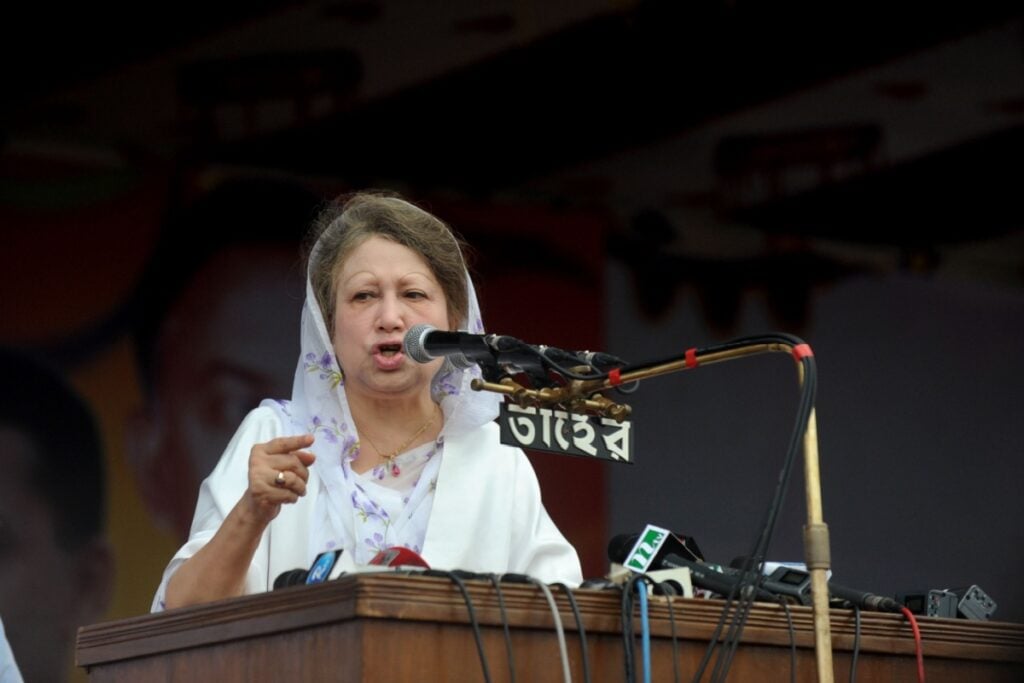
Former Bangladeshi prime minister Khaleda Zia has died at the age of 80, her party, the Bangladesh Nationalist Party (BNP), said in a statement issued Tuesday. Zia, the first woman elected to lead Bangladesh as prime minister, spent decades at the center of national politics in a rivalry with Sheikh Hasina that dominated elections, street protests and governance for a generation.
The BNP said Zia’s health had been fragile for years. She was freed from prison on medical grounds in 2020, but her family said the Hasina administration rejected at least 18 requests for her to seek treatment abroad. After Hasina was forced from office in August 2024, an interim administration led by Nobel Peace Prize laureate Muhammad Yunus approved overseas travel for Zia. She went to London in January 2025 and returned to Bangladesh in May, according to the party.
From Military Era To Elected Power
Zia’s political ascent followed the death of her husband, President Ziaur Rahman, who seized power as a military chief in 1977 and founded the BNP a year later. Rahman was killed in a coup attempt in 1981, and Zia became a leading opposition figure during a period marked by assassinations, coups and repeated interventions by the armed forces.
Her uncompromising stance against military rule helped build momentum for the movement that ended the presidency of former army chief H.M. Ershad in 1990. The BNP returned to office after the 1991 election, elevating Zia to the premiership at the start of Bangladesh’s renewed parliamentary era. She later won power again in 2001, heading a coalition that included the country’s main Islamist party, Jamaat-e-Islami, and pursuing pro-investment policies that reassured parts of the business community, according to accounts of her tenure.
Her second stint in office also drew scrutiny over allegations that her elder son, Tarique Rahman, exercised outsized influence and ran a “parallel” power center—claims long disputed by her supporters.
A Rivalry That Shaped Bangladesh
For decades, Bangladesh’s political story was framed by the competition between Zia and Hasina, the daughter of independence leader Sheikh Mujibur Rahman, who was assassinated in a 1975 coup. The two leaders alternated in power, led opposing parties and often escalated disputes beyond parliament and into the streets.
Zia’s time in office was repeatedly contested. She faced criticism over an early 1996 election in which the BNP won 278 of 300 parliamentary seats amid a boycott by major opponents who demanded a neutral caretaker government to oversee voting. The government lasted 12 days before a nonpartisan caretaker authority took over and new elections were held later that year.
Political violence also shadowed the period. In 2004, Hasina blamed the BNP government and Tarique Rahman for grenade attacks in Dhaka that killed 24 members of Hasina’s Awami League and wounded hundreds. Hasina narrowly escaped and later won the 2008 election, beginning a long stretch in power that critics described as increasingly authoritarian.
Legal Battles And Final Years
Zia’s later career was shaped by legal cases and illness. She said corruption prosecutions were politically driven, while the Hasina government maintained that courts acted independently. Zia was sentenced to 17 years in prison in two corruption cases linked to the alleged embezzlement of funds meant for a charity named after her late husband.
In January 2025, Bangladesh’s Supreme Court acquitted Zia in the last remaining corruption case against her—an outcome that, her supporters said, would have allowed her to contest the next national vote. Election officials have scheduled Bangladesh’s next parliamentary election for February 12, 2026, the first since Hasina’s removal from office.
In recent years Zia largely avoided rallies, but she remained BNP chairperson until her death, with Tarique Rahman serving as acting party leader since 2018. She was last widely seen at an annual Bangladesh military function in Dhaka Cantonment on Nov. 21, where Yunus and other political figures met her; she appeared frail and used a wheelchair.
Zia is survived by Tarique Rahman. Her younger son, Arafat Rahman, died in 2015.
