


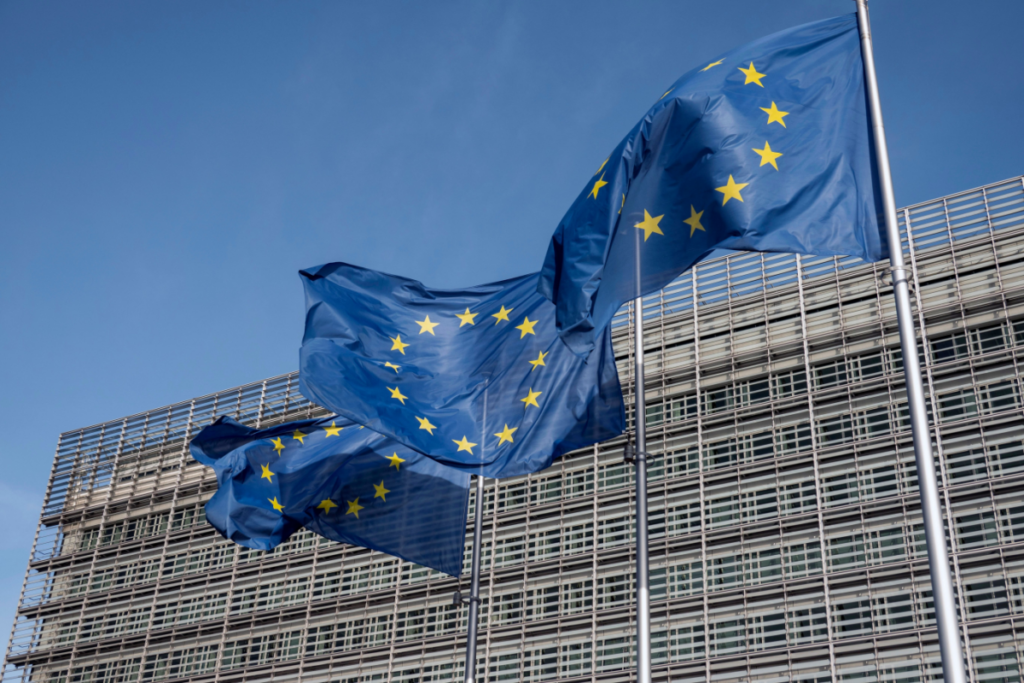
Brussels Seeks a Simpler, Stronger Union
The European Union is facing mounting pressure to overhaul its regulatory framework as leaders grapple with how to restore the bloc’s competitiveness against the United States and China. European Commission President Ursula von der Leyen has made clear that simplifying rules and reducing fragmentation must become central priorities as political and business leaders gather for high-level discussions.
Over the past two decades, EU growth has consistently lagged behind that of the United States. Productivity gains have been weaker, and innovation, especially in emerging sectors like artificial intelligence, has not kept pace. The concern in Brussels is not merely cyclical slowdown but structural underperformance.
Von der Leyen highlighted the contrast between the U.S., which operates with a unified financial system and a single dominant financial center, and Europe’s fragmented landscape. Across the EU, 27 national financial systems coexist alongside hundreds of trading venues. This patchwork structure, she argued, limits capital mobility and reduces the bloc’s ability to scale companies rapidly. The push for a deeper and more integrated capital market is now central to the competitiveness agenda.
Industry Demands Action on Energy and Bureaucracy
As EU leaders prepare to outline strategic responses, they are also listening closely to corporate executives. Major firms, including ArcelorMittal, Heidelberg Materials and Solvay, are pressing for urgent measures to halt industrial decline.
European businesses point to persistently high energy costs as a core disadvantage compared with competitors in the U.S. and China. They also cite the burden of regulatory complexity and administrative overhead as barriers to expansion and innovation. Calls for greater flexibility in labor regulations and a reduction in bureaucratic hurdles have grown louder in recent months.
Industry-backed research adds weight to these concerns. A recent study by Deloitte found that the EU outperformed global rivals on only a handful of competitiveness metrics out of more than twenty assessed. While Europe maintains strengths in areas such as the use of recycled materials, it falls behind significantly in energy pricing and the cost of doing business.
The message from business leaders is consistent: Europe has the tools to fix many of its weaknesses internally if it is willing to act decisively.
Climate Policy, Trade Pressures and Strategic Autonomy
At the same time, the EU is navigating geopolitical and economic turbulence. Trade tensions linked to Donald Trump have added uncertainty to transatlantic commerce. Meanwhile, Chinese restrictions on exports of critical minerals have highlighted Europe’s reliance on external suppliers for key technologies.
Brussels is drafting legislation that would introduce “Made in Europe” requirements for public procurement contracts, aiming to reduce dependence on China in strategic sectors. The bloc is also preparing revisions to its carbon market policy, an essential tool in its climate strategy but one that has become politically sensitive as industries contend with high energy prices and global competition.
Balancing decarbonization, digital transformation and defense spending requires significant financial resources. Leaders acknowledge that achieving strategic autonomy will demand both structural reforms and sustained investment.
Divisions Over the Path Forward
Despite broad agreement that Europe must become more competitive, member states remain divided on how to achieve this. Emmanuel Macron has advocated for expanded joint borrowing at the EU level to fund large-scale investments and strengthen Europe’s position against the dominance of the dollar. His vision includes deeper financial integration and stronger industrial policy.
Germany, for its part, emphasizes productivity improvements and trade agreements rather than expanding collective debt. The debate reflects differing economic philosophies within the bloc and underscores the complexity of forging consensus among 27 nations.
Former Italian prime ministers Mario Draghi and Enrico Letta, both authors of influential reports on competitiveness and the single market, are adding intellectual weight to the discussion. Letta has called for completing the EU single market within a fixed timeframe, arguing that deeper integration is the only viable response to external pressure from the U.S., China and Russia.
As summits unfold, the EU’s economic trajectory hangs in the balance. The challenge is not simply to catch up, but to redefine Europe’s role in an increasingly fragmented global economy. Whether through regulatory simplification, capital market integration, industrial support or fiscal coordination, leaders face a decisive moment in determining how Europe competes in the years ahead.
