


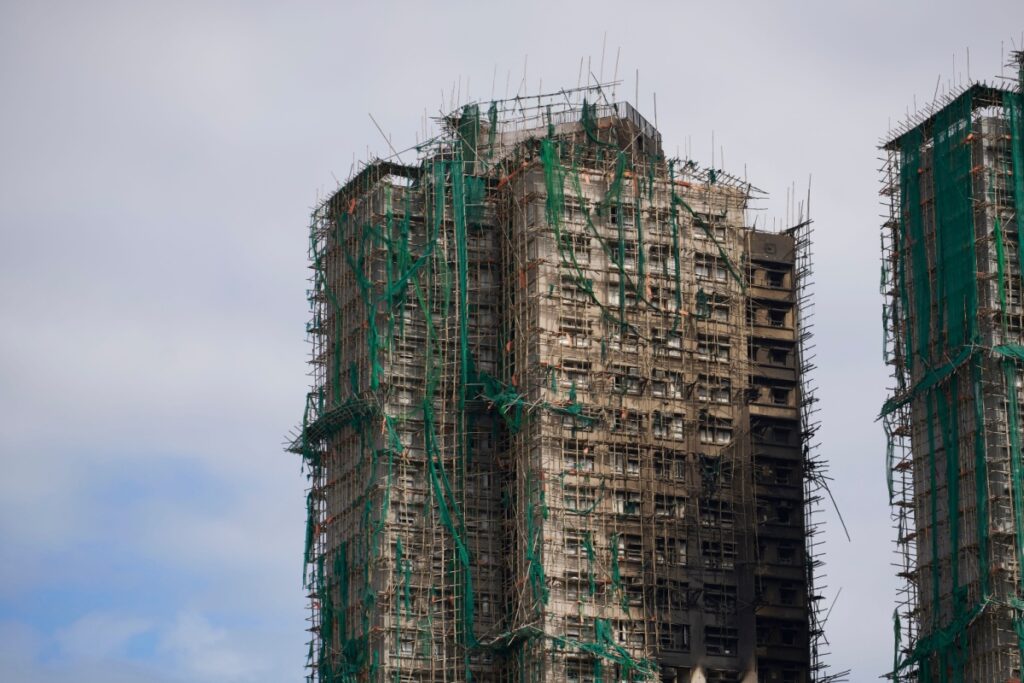
Hong Kong is facing difficult questions after a high-rise apartment fire killed at least 156 people at the Wang Fuk Court public housing complex in the Tai Po district. The late-November inferno, the city’s deadliest residential blaze in decades, has triggered anger over suspected construction corruption, weak enforcement of safety rules and failures in government oversight.
As residents leave flowers and paper cranes near the blackened towers, frustration has mounted over reports that renovation works relied on hazardous materials and opaque contracting. Police and Hong Kong’s Independent Commission Against Corruption (ICAC) have together arrested more than 20 people, including scaffolding subcontractors and company directors, on allegations ranging from manslaughter to corruption, as investigators examine a multi-million-US-Dollar renovation scheme for possible bid-rigging and cost-cutting.
Flammable Materials And Safety Lapses
Officials initially said the green netting draped over bamboo scaffolding at Wang Fuk Court complied with fire regulations. Later testing, however, found that 7 of 20 additional samples did not meet safety standards, suggesting that cheaper, substandard netting had been mixed with approved products.
Investigators say the fire spread rapidly after igniting plastic mesh and foam insulation boards used to seal windows during renovation, with strong winds pushing flames and smoke up the facades of 7 of the estate’s 8 towers, home to more than 4,000 residents. Some internal fire alarms reportedly did not sound, delaying evacuation and firefighting efforts.
The Labor Department says it reviewed product certificates for the netting and carried out 16 inspections at the estate since last year, most recently about a week before the blaze. Officials say they repeatedly warned contractors to comply with fire safety rules, but critics argue those visits failed to identify fundamental hazards.
Beyond Wang Fuk Court, authorities have suspended a series of construction and repair projects linked to the main contractor as a precaution, while residents in other housing estates report worries about flammable materials and complicated subcontracting chains that obscure responsibility.
Accountability And Political Fallout
The tragedy has unfolded against the backdrop of an increasingly restrictive political climate. Since the sweeping national security law came into force in 2020, public dissent in Hong Kong has largely been suppressed, and criticism of the government is often portrayed by officials as a security threat.
That tension surfaced quickly after the fire. A local activist who helped launch a petition demanding that senior officials accept responsibility was arrested by national security police, according to local media reports. The Office for Safeguarding National Security warned that “anti-China” forces would be punished if they used the blaze to incite hatred against the authorities.
At the same time, the disaster has become a test for Chief Executive John Lee, who has pledged a full investigation while urging residents not to politicize the tragedy. Lee has ordered a judge-led independent committee to examine why the fire spread so quickly, whether safety rules were enforced and how oversight of renovation projects can be strengthened. The inquiry will run alongside criminal and corruption probes and is expected to review how housing authorities chose and supervised contractors.
The blaze has also cast a shadow over the December 7 election for Hong Kong’s Legislative Council, the first since electoral rules were revamped to ensure that only “patriots” can stand for office. Analysts say turnout will be closely watched in Beijing as a sign of public satisfaction with the territory’s governance.
A City Confronts Its Towers
For many Hong Kong residents, the Wang Fuk Court disaster has revived memories of past catastrophes in a city where land is scarce and most people live in high-rise estates. Historic infernos such as the Happy Valley Racecourse fire in 1918 and the Wing On warehouse fire in 1948 helped shape modern building rules that were meant to prevent large-scale loss of life.
Despite those safeguards, the 2025 blaze has exposed how aging housing stock, layers of subcontracting and aggressive cost-cutting can undermine regulations on paper. Contractors’ alleged use of combustible materials, combined with uneven enforcement and limited transparency in renovation tenders, has fuelled fears that other estates could harbour similar risks.
With millions of people living in public or subsidized housing across Hong Kong, residents and specialists say the lessons drawn from Wang Fuk Court will be crucial for future safety and for public trust in the city’s institutions.
