


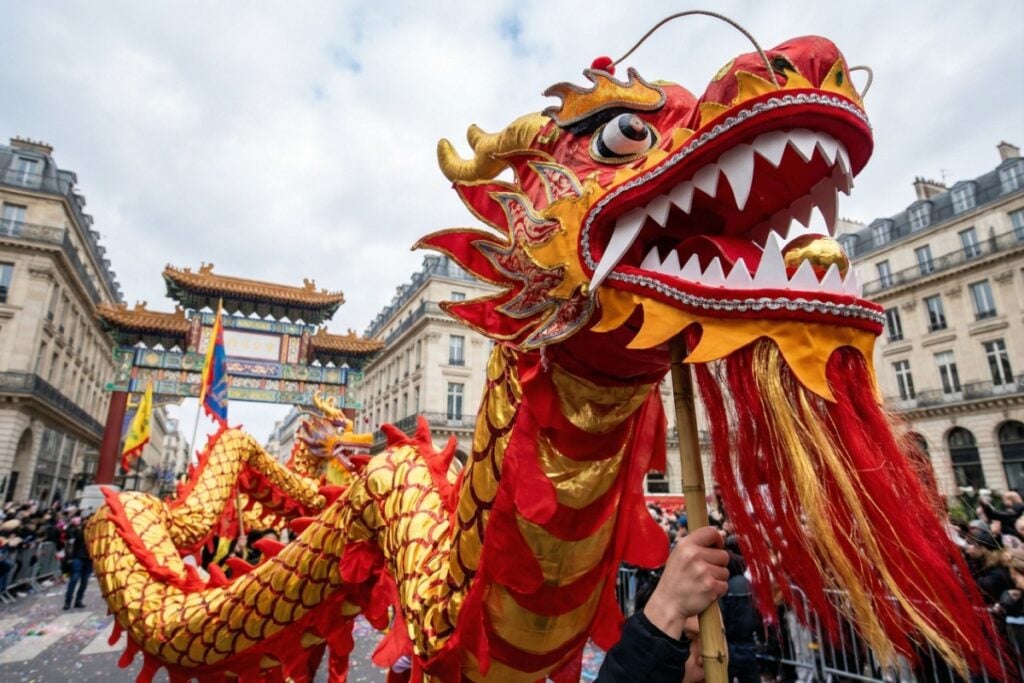
Lunar New Year celebrations began Tuesday with dense crowds, incense smoke, and the steady commerce of holiday markets, as communities across Asia and far beyond welcomed the Year of the Horse in the 12-animal Chinese zodiac cycle. The new year follows the Year of the Snake, and the holiday remains the most important annual observance in China and several neighboring societies, while also drawing large public gatherings in overseas communities.
In Beijing, thousands streamed into the former Temple of Earth area for seasonal fairs, browsing stalls selling snacks, toys, and small gifts. The scene blended the familiar, families moving slowly between vendors and performances, with a renewed sense of scale after years in which some people said the holiday felt quieter. Sun Jing, who traveled with her parents to the capital for the break, described the mood as a return to childhood memories: “I haven’t felt such a strong sense of Lunar New Year festivity in a very, very long time,” she said.
Across the city, crowds also converged on well-known temples to burn incense and offer prayers for good fortune, health, and success in the year ahead—an annual rhythm that remains central to the holiday’s first hours.
Humanoid Robots Share The Spotlight On National TV
Alongside traditional rites, China’s holiday broadcast underscored a more modern theme: technology as a national showcase. The annual CCTV Spring Festival Gala, aired Monday night ahead of the new year, again featured humanoid robots as a headline act. One segment paired children with machines in a martial-arts performance, with humanoids from Unitree Robotics running through synchronized sequences on stage and, at points, handling prop weapons as part of the choreography.
The appearance fits a broader push in China to present advances in robotics and artificial intelligence as both industrial momentum and cultural spectacle. Audience reactions, however, were mixed. Some viewers praised the performance as inspiring, while others said the emphasis on machines changed the tone of a program often associated with nostalgia and family ritual. Li Bo summed up that sentiment: “It lacks a bit of the New Year atmosphere,” he said. “It’s not as enjoyable as when I was little, watching the gala.”
Midnight Incense In Hong Kong And Bells In Taipei
Elsewhere, the holiday’s opening moments were marked by long-standing spiritual customs. In Hong Kong, worshippers lined up at temples around midnight, lifting bundled incense sticks, bowing repeatedly, and placing the burning offerings in large containers before the temple halls, an annual practice tied to hopes for luck and stability.
In Taipei, crowds gathered at the historic Baoan Temple, where a bell sounded 108 times, an auspicious number in local tradition, while visitors lit incense, bowed, and set offerings such as flower bouquets on tables in the temple grounds.
In Vietnam, where the festival is known as Tet, the countdown to the new year moved quickly into public celebration: outdoor concerts, fireworks across multiple cities, and light displays on major bridges and buildings drew crowds who clapped along to pop performances as the sky filled with bursts of color.
Moscow Festivals And Buenos Aires Chinatown Crowds
Lunar New Year’s reach was also visible well outside Asia. In Moscow, a two-week program of events opened Monday across multiple venues, with snowy streets decorated in red lanterns and dragon imagery and food stalls offering Chinese dishes. Organizers framed the festivities in part as a cultural symbol of closer China–Russia ties, which have drawn scrutiny in parts of Europe amid the ongoing war in Ukraine.
In Buenos Aires, thousands gathered in the capital’s Chinatown district for dragon and lion dances and martial-arts demonstrations on a main stage, reflecting the visibility of the Chinese community in Argentina. The report cited the Chinese immigrant community as numbering more than 180,000 people in the country.
Across these celebrations, temple courtyards, city streets, and televised stages, the first day of the lunar year showed how the holiday continues to travel and adapt, combining prayer, performance, and public festivity in settings shaped by local culture and, increasingly, by new technology.
