


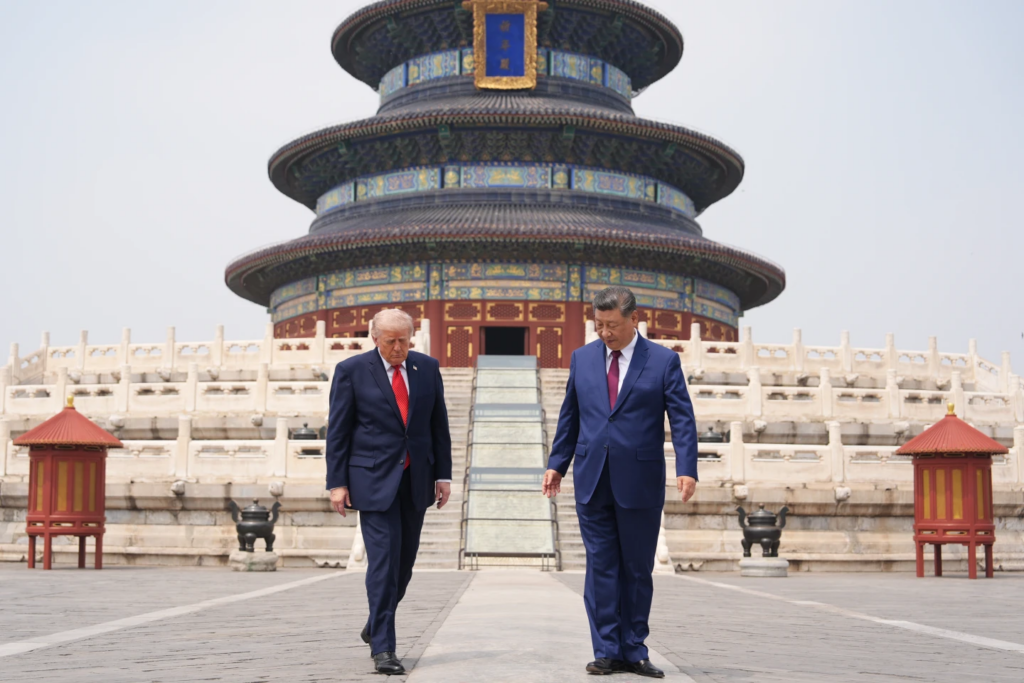
U.S. President Donald Trump returned to Washington after a high-stakes summit with Chinese President Xi Jinping, leaving one of the most sensitive geopolitical questions unresolved: whether the United States will move forward with a massive new arms package for Taiwan.
While both leaders described the summit as productive and important for stabilizing relations between the world’s two largest economies, deep disagreements over Taiwan, Iran, military strategy, and nuclear weapons continue to define the fragile relationship between Washington and Beijing.
A Delicate Decision on Taiwan Arms Sales
Trump acknowledged that he has not yet decided whether to approve the proposed arms package for Taiwan after hearing direct objections from Xi during their talks.
“I will make a determination,” Trump said. He added: “I’ll be making decisions. But, you know, I think the last thing we need right now is a war that’s 9,500 miles away.”
The Republican administration previously authorized an $11 billion weapons package for Taipei in December, while lawmakers approved an additional $14 billion arms sale in January. However, the latter cannot proceed until Trump formally submits it to Congress.
China has consistently opposed U.S. weapons sales to Taiwan, which Beijing considers part of its territory despite the island operating as a self-ruled democracy. Chinese officials have repeatedly warned that Washington’s relationship with Taiwan remains the most sensitive issue in U.S.-China relations.
Trump also confirmed that Xi reiterated Beijing’s strong opposition to Taiwanese independence during the summit.
“I heard him out,” Trump said. “I didn’t make a comment.”
Six Assurances Debate Resurfaces
Trump’s willingness to discuss Taiwan arms sales directly with Xi has sparked concern among foreign policy analysts, who argue the conversations may conflict with the “Six Assurances” established under former President Ronald Reagan in 1982.
One of those assurances states that the United States “did not agree to consult with the People’s Republic of China on arms sales to Taiwan.”
Trump acknowledged the issue surfaced during the summit discussions, potentially reigniting debate in Washington over how closely the administration should coordinate Taiwan policy with Beijing.
Nuclear Arms Talks Gain Momentum
Another major topic during the summit involved the future of nuclear arms control. Trump said he discussed a potential three-way agreement involving the United States, China, and Russia that would cap nuclear arsenals.
According to Trump, Xi appeared open to further discussions despite China historically resisting such arrangements.
“I got a very a positive response,” Trump said. “This is the beginning.”
The proposal comes after the expiration of the New START treaty between the United States and Russia earlier this year. The treaty had limited the world’s two largest nuclear arsenals for more than five decades.
China’s nuclear stockpile remains significantly smaller than those of Washington and Moscow. Pentagon estimates place China’s arsenal at more than 600 warheads today, though projections suggest Beijing could surpass 1,000 warheads by 2030. The U.S. and Russia each possess more than 5,000 warheads.
Trump has argued that any future arms control framework should include China rather than remain limited to Washington and Moscow.
Xi Uses Personal Diplomacy at Zhongnanhai
Xi appeared to make a calculated effort to strengthen personal ties with Trump by inviting him to Zhongnanhai, the Chinese leadership compound that serves as the official residence of China’s top leaders.
The two leaders walked through gardens filled with ancient trees and Chinese roses before holding nearly three hours of talks over tea and lunch.
Trump appeared especially impressed by the surroundings, calling the roses “the most beautiful” he had ever seen. Xi reportedly promised to send him rose seeds.
The compound, built around artificial lakes once used by Chinese emperors, is rarely used for foreign diplomatic visits. Analysts viewed the invitation as an attempt by Xi to offer a more personal and symbolic gesture to Trump.
“It’s been really a great couple of days,” Trump told reporters.
Xi described the summit as a “milestone” visit.
“We have established a new bilateral relationship, or rather a constructive, strategic, stable relationship,” Xi said.
Iran Conflict Adds Pressure to US-China Relations
Despite the positive tone surrounding the summit, tensions remain over the ongoing Iran conflict and its global economic consequences.
The leaders discussed reopening the Strait of Hormuz, a critical shipping route that carried roughly 20% of the world’s oil supply before the war began on Feb. 28.
“We feel very similar about (how) we want it to end,” Trump said while standing beside Xi. “We don’t want them to have a nuclear weapon.”
According to White House officials, Xi opposed proposals involving tolls on vessels crossing the strait and expressed interest in potentially increasing Chinese purchases of U.S. oil to reduce dependence on Gulf energy supplies.
At the same time, friction remains over China’s relationship with Iran. The U.S. State Department recently accused Chinese firms of providing satellite imagery to Tehran, while the Treasury Department targeted Chinese refineries accused of purchasing Iranian oil.
Although Trump claimed Xi offered to help address the Iran conflict, Beijing has shown little public interest in taking a larger diplomatic role.
Taiwan Continues to Loom Over the Relationship
Taiwan ultimately overshadowed nearly every major discussion during the summit.
Chinese officials amplified Xi’s warning that mishandling the Taiwan issue could push the two nations toward “clashes and even conflicts.”
Still, U.S. Secretary of State Marco Rubio insisted that American policy toward Taiwan has not changed.
“They always raise it on their side. We always make clear our position, and we move on to the other topics,” Rubio said. He also warned that it would be “a terrible mistake” for China to attempt taking Taiwan by force.
Trump, however, has occasionally sent mixed signals on Taiwan, fueling speculation that he could be more flexible in negotiations with Beijing than previous administrations.
A Fragile Stability Between Rival Superpowers
The summit between Trump and Xi showcased both the possibilities and limitations of modern U.S.-China diplomacy. While both leaders emphasized stability, cooperation, and constructive dialogue, the core disagreements between the two powers remain unresolved.
Taiwan continues to sit at the center of strategic tensions, while conflicts involving Iran, energy security, and nuclear expansion add new layers of uncertainty to the relationship.
For now, Trump appears determined to keep diplomatic channels open with Beijing while delaying a final decision on Taiwan arms sales. Whether that balancing act can hold amid growing global instability may define the next phase of U.S.-China relations.
