


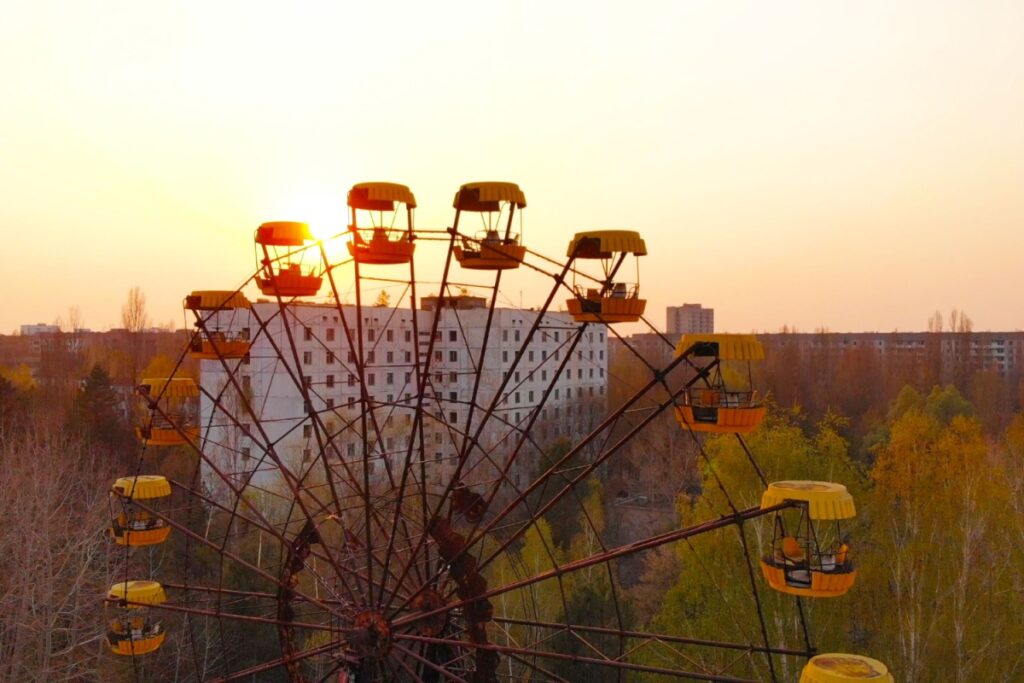
Nearly four decades after the nuclear accident that devastated the Chernobyl region, the surrounding landscape remains one of the most recognizable symbols of industrial disaster. The explosion at Reactor No. 4 on April 26, 1986, released radioactive material across large parts of Europe, forcing tens of thousands of residents to abandon their homes and creating a vast restricted area around the plant.
Today, large portions of that territory remain unsafe for permanent human habitation. The exclusion zone, spanning parts of northern Ukraine and neighboring Belarus, still contains elevated levels of radiation in soil and vegetation. Despite these hazards, scientists and conservation officials monitoring the region say the absence of human activity has allowed ecosystems to recover in unexpected ways.
Entire towns once evacuated during the crisis have been overtaken by vegetation. Buildings that once housed workers and families now sit partially hidden beneath dense forests, while roadways have gradually disappeared beneath expanding plant life. This transformation has led some researchers to describe parts of the area as resembling landscapes from centuries past, before industrial development altered the region.
Wildlife Populations Expand in Human-Free Zone
One of the most visible signs of ecological recovery has been the return of large animal populations. Wolves, lynx, moose, red deer, and brown bears now roam freely across territories where human presence was once constant. Some of these species had vanished from the region decades before the nuclear accident, making their reappearance particularly notable to scientists.
Among the most striking examples of wildlife recovery is the growth of Przewalski’s horses, a rare species once declared extinct in the wild. Introduced to the exclusion zone in the late 1990s, these horses have formed stable populations and adapted to local conditions, demonstrating how species raised in captivity can reestablish natural behaviors when placed in suitable habitats.
Researchers working in the region rely heavily on remote monitoring methods, including motion-activated cameras attached to trees. These tools allow scientists to track animal movements without exposing themselves to unnecessary radiation risks. Field observations have shown that animals often use abandoned structures as shelter, taking advantage of the unusual environment created by the disaster.
Experts attribute much of the wildlife recovery to the absence of agriculture, industry, and urban development. Without regular human interference, habitats have remained largely undisturbed, enabling animals to expand their territories and reproduce at sustainable rates.
Radiation Effects and Ongoing Scientific Study
Although wildlife populations appear stable, researchers continue to study how radiation affects long-term biological health. Some subtle changes have been documented in certain species. For example, scientists have observed darker skin pigmentation in frogs living in highly contaminated areas, while birds exposed to elevated radiation have shown increased rates of eye conditions such as cataracts.
Despite these observations, scientists report that widespread population declines linked directly to radiation have not been documented across the region. Many species appear to tolerate environmental exposure better than initially expected, though researchers caution that the long-term consequences remain uncertain.
The zone has become a unique outdoor laboratory where scientists examine ecological adaptation under extreme conditions. By comparing animals living in contaminated areas with those in nearby regions, researchers hope to better understand how ecosystems respond to environmental stress and recover over time.
War-Related Risks Add New Challenges
While nature has reclaimed large parts of the exclusion zone, new threats have emerged in recent years. Military activity during Russia’s invasion of Ukraine introduced additional environmental concerns. Troops moving through the area disturbed contaminated soil while constructing defensive positions, increasing the risk of spreading radioactive particles.
Forest fires have also become a growing concern. Blazes linked to both natural causes and wartime activity have swept through contaminated forests, raising fears that radioactive material trapped in vegetation could be released into the atmosphere. Such events highlight the fragile balance between ecological recovery and lingering hazards associated with the disaster.
Despite these risks, conservation specialists say the region remains a powerful example of environmental resilience. The continued presence of large mammals and diverse species illustrates how ecosystems can rebound when human pressure is removed, even under conditions that would normally be considered highly unfavorable. Scientists monitoring the area continue to study how this recovery evolves as environmental and geopolitical conditions change.
